
Know your honey · 8 min read
Lahaul Honey: A Guide to Himalayan Cold-Desert Honey
Beyond Rohtang Pass lies Lahaul, a high cold desert with one short summer. This guide gathers everything we've written about the valley, its flowers and the bees that work there.
By Akhil Verma, Co-founder, Not Your Beesness · · Updated
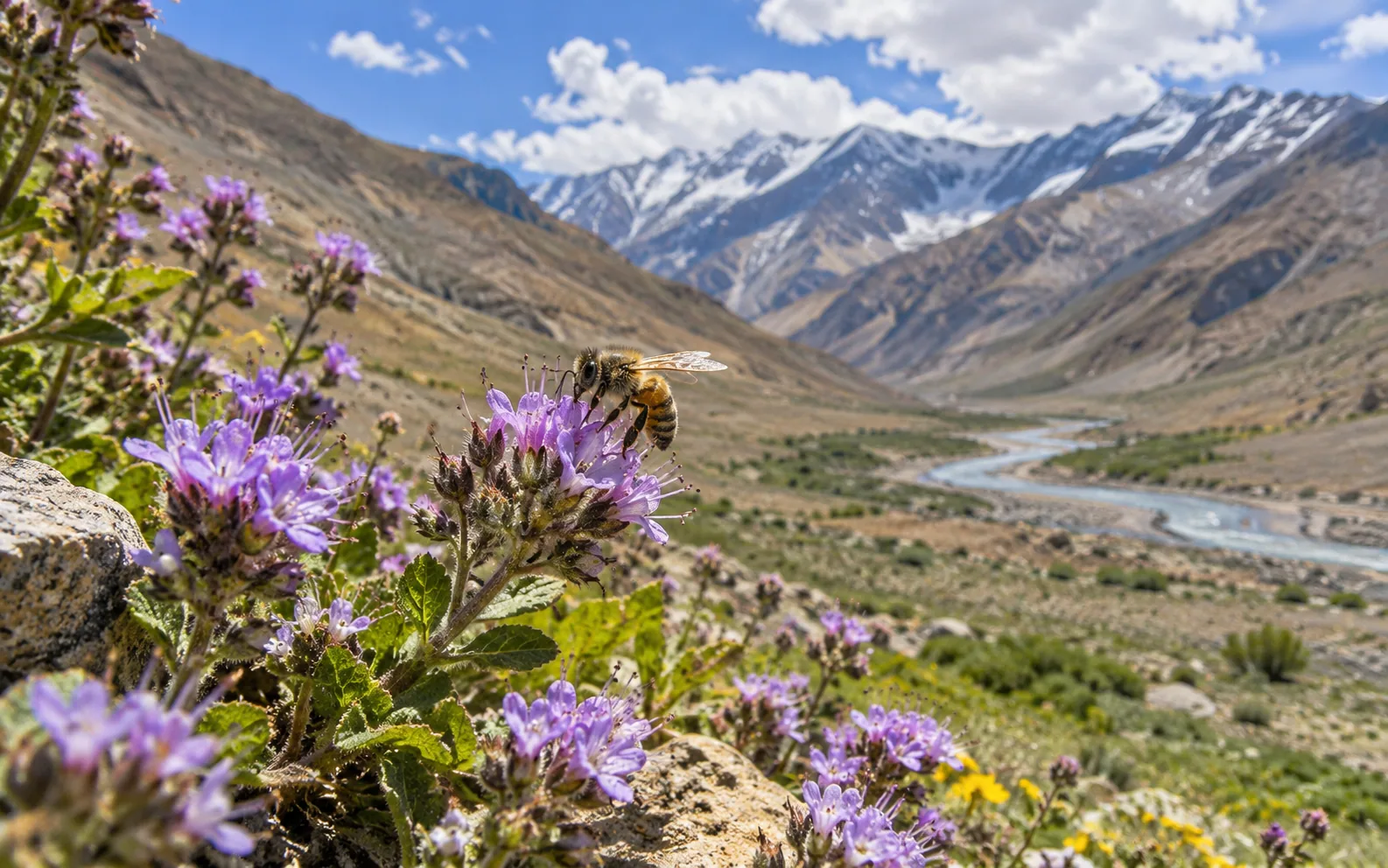
Lahaul honey is made in one of the hardest places bees are kept in India.
Quick answer: Lahaul honey comes from a high cold desert beyond Rohtang Pass, where valley floors sit around 10,000 ft and bees get one short summer. Its flowers grow where glacier water reaches, and the honey is seasonal and limited.
Begin with the valley itself, then the bees, then the plants. Where the evidence runs out, each post says so.
The valley
- Beyond the Rohtang Pass: entering Lahaul, the high cold desert
Cross Rohtang Pass and the monsoon stays behind. Lahaul is a cold desert in the Himalayan rain shadow, with valley floors around 10,000 feet. - The glacial stream nectar: how snow and ice water Lahaul's flowers
Lahaul gets almost no monsoon rain. Snow and glacier melt, led by hand along kuhls, waters its fields and flowers, and that's where the bees work. - The Lahaul summer rush: a short season between long winters
Lahaul's year is mostly winter, and alpine flowering peaks in July and August. Why there's no measured '4-week window', and what shapes the season. - The Sissu waterfall corridor: how water draws a green line down a dry mountain
Above Sissu, a waterfall turns a strip of dry Lahaul mountainside green. Why water decides where flowers and bees thrive, and what we can't claim. - The high-altitude sun: does strong mountain UV change nectar?
UV rises about 10% per 1,000 m, so Keylong gets roughly 31% more than sea level. Studies find UV-B barely changes nectar's sugar strength. - The Chenab river origins: where Lahaul's two glacier rivers meet
The Chenab begins in Lahaul as two glacier rivers, the Chandra and Bhaga, rising near Baralacha La and meeting at Tandi near Keylong. - The Miyar valley excursion: Lahaul's remote western side valley
Miyar is a remote side valley of Lahaul: twelve farming villages at 9,300–11,500 ft, summer meadows above, and a long glacier up to Kang La. - The Pangi border margins: where the Chenab leaves Lahaul for the forests of Chamba
Pangi, in Chamba just west of Lahaul, is lower and forested: deodar, blue pine, fir and birch climbing to alpine meadows along the Chenab. - The Gondhla castle corridor: the seven-storey tower of the Chandra valley
Gondhla's seven-storey tower fort, built of stone and timber in kath-kuni style, has watched over Lahaul's Chandra valley for centuries. - The monastic gardens: the old Buddhist monasteries of Lahaul
Four of Lahaul's best-known Buddhist monasteries, from 8th-century Guru Ghantal to Kardang, the largest, and an honest note on their 'gardens'. - The Keylong valley agriculture: how Lahaul's farming shapes its summer
Lahaul farms one irrigated season a year: seed potatoes, peas, vegetables, kuth and heeng. Why the crops matter less to bees than the water. - The glacial transition: how Lahaul's changing snow could shift its spring
The snowline over Lahaul's glaciers rose about 1,300 ft from 1980 to 2007, and snow cover is shrinking. What that could mean for the valley's spring.
Bees at altitude
- The 11,000-foot challenge: what it takes for honeybees to live this high
How high can honeybees live? In Himachal, the native hive bee is kept up to about 11,150 ft. What Lahaul's cold, short summers mean for bees. - The trans-Himalayan terroir: does cold desert air make honey thicker?
Thickness depends on water and temperature. In one Himachal study, Lahaul honey held 16.5% water: below the middle, but not the driest district. - The glacial silt factor: do mountain minerals end up in your honey?
No study links glacier silt to honey. Minerals follow the flowers first, and darker honey holds more. Lahaul's was darkest of eight districts. - The sub-zero survival strategy: how honeybees get through a Himalayan winter
Keylong has recorded -30°C. Bees survive by clustering, shivering to keep the core warm, and burning stored honey. How the winter cluster works. - The early freeze alert: what unseasonal snow means for bees in the hills
Lahaul's September 2018 snow, the April 2023 cold that killed rented bees, and Keylong's earliest snow in 17 years: why early cold hurts colonies.
Plants of Lahaul
- The wild buckwheat fields: the dark, malty honey crop of the cold Himalaya
Buckwheat (kuttu) suits the cold, dry Himalaya and is a strong nectar crop. Abroad its honey is dark and malty. What we can and can't claim. - The alpine meadow magic: the short, colourful window when high meadows bloom
High meadows bloom in a rush after snowmelt: early primulas and gentians, a July–August peak, a few late bloomers, and a short window. - The blue pine margins: Lahaul's few trees, and the honeydew question
Blue pine is one of the few trees of Lahaul's cold desert, but honeydew from it there is unrecorded. Willows, poplars, junipers, birch and pine. - The wild caraway bloom: the mountain spice that grows wild in Lahaul
Wild caraway (kala zeera, shingujira) grows at 10,500–14,100 ft in Lahaul and draws many insects. Why its spice, in the seed, isn't in honey. - The high-pass flora: the hardy wildflowers of Lahaul's rocky heights
Botanists record 985 plant taxa across Lahaul-Spiti and 188 species around Chandra Tal and Suraj Tal. Why little high-pass flora reaches honey. - The sea buckthorn shift: Lahaul's famous berry bush, and what it gives bees
Sea buckthorn has separate male and female bushes and is wind-pollinated, its pollen drifting about 50 ft. Its value is the berry, not nectar. - The alpine chicory bloom: the sky-blue flower that opens at dawn and closes by noon
Chicory's blue flowers open about 5:30–7:30 am, close by noon and bloom for 75–102 days. A real bee plant; its role in Lahaul honey is unrecorded. - The wild thyme patches: Himalayan thyme on Lahaul's rocky slopes
Himalayan thyme (jangli ajwain) grows on Lahaul's rocky slopes at 4,900–14,100 ft and bees love thyme. Why we can't claim a thyme note in our jar. - The wild angelica mystery: the rare Himalayan herb that needs protecting
Himalayan angelica (Angelica glauca) is endangered, its wild numbers down about 70% in ten years. Why it's a plant to protect, not a honey source. - The alpine clover cycle: how mountain clovers differ from the plains
Lahaul's meadows and Kalka's fields grow different clovers. Which ones honeybees prefer, how they differ, and why nobody has tested the taste. - The wild sage clumps: meet Artemisia, the silvery shrub of Lahaul's slopes
The silvery 'wild sage' on Lahaul's dry slopes is usually Artemisia, a wind-pollinated daisy-family shrub. Why it gives bees little nectar. - The mountain lavender variant: why there's no wild lavender in Lahaul
True lavender grows wild from the Mediterranean to south India, not in Lahaul. The purple spikes on Himalayan slopes are other mints, like catmint. - The wild forget-me-not bloom: the little blue flower with a signal for insects
Forget-me-nots guide insects with a yellow ring that fades once a flower is done. High in the Himalaya, their visitors are often flies, not bees. - The alpine dandelion rush: why bees love the humble dandelion, up to a point
Dandelions are one of the first spring foods for bees, with plenty of nectar. But their pollen is short on some nutrients. The honest picture. - The wild rhubarb margin: Himalayan rhubarb and how it's pollinated
Himalayan rhubarb is a vulnerable medicinal herb of the north-western Himalaya, pollinated by both wind and insects. What it does and doesn't add to honey. - The high pass willow margins: Lahaul's first green, and the bees' first food
Willows flower on bare twigs before their leaves, making them one of spring's first bee foods. Why Lahaul's willows, along fields and kuhls, matter. - The Lahaul herb directory: a visual guide to the cold desert's plants
Fifteen plants of Lahaul's cold desert, from willow and wild thyme to edelweiss and sea buckthorn, sorted by what each gives bees. - The glacier-fed potentilla: the bright yellow cinquefoils of the high meadows
Potentillas are open, five-petalled flowers that peak in Himalayan meadows in July and August. Easy for bees to reach, and what we can't claim. - The alpine edelweiss myth: the Himalayan edelweiss of Lahaul
Edelweiss isn't only Alpine: a Himalayan edelweiss grows from Kashmir to Bhutan, including Lahaul. Its white 'petals' are woolly leaves, not flowers.
Common questions about Lahaul honey
Where is Lahaul? In Himachal Pradesh, north of Manali, beyond Rohtang Pass and the Atal Tunnel. Keylong, its main town, sits at about 10,100 ft.
Why is Lahaul honey limited? The bees get only a few summer months between long winters, so each year's batch is small.
How is Lahaul honey different from Kalka honey? Different place, flowers and season. Two places, two jars.
More guides
Raw, unfiltered honey, bottled as it is.
Meet the Lahaul jar, from ₹799 for ½ kg · or see what is coming next.
Not Your Beesness, sold on āsthālaya. Delivered across India.


