
Know your honey · 3 min read
The high-pass flora: the hardy wildflowers of Lahaul's rocky heights
Up near Lahaul's high lakes and passes, the ground looks like bare stone. Botanists who have searched it carefully found nearly two hundred kinds of plant. Here is what they found, and why most of it is beyond the reach of hive bees.
By Akhil Verma, Co-founder, Not Your Beesness ·
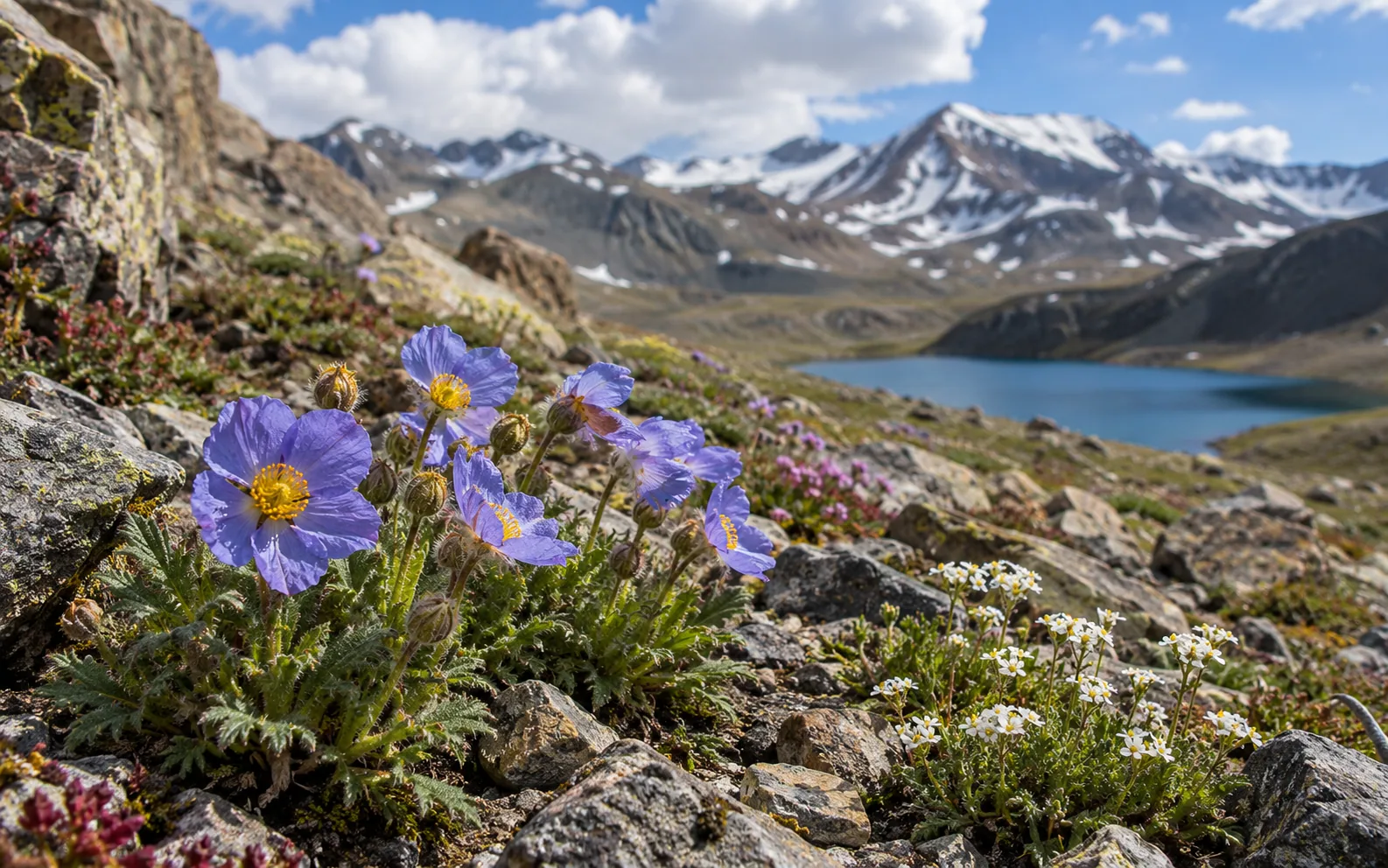
From the road over a high pass, the slopes look empty: scree, boulders and wind. Kneel down and look closer, and they are not empty at all.
Quick answer: Lahaul wildflowers are surprisingly varied: 985 plant taxa across Lahaul-Spiti and 188 species around Chandra Tal and Suraj Tal. But most high-pass flora grows far above where hive bees are kept.
Lahaul's high country is one of the harshest places plants can grow: cold, dry, windy, with a summer of only a few weeks. Yet botanists keep finding more there.
 Stony ground, surprising variety.
What has been counted
- Across Lahaul and Spiti, a major flora of the district records 985 kinds of flowering plant and conifer, based on more than ten years of fieldwork.
- Around Chandra Tal and Suraj Tal, two high-altitude lakes, a 2021 survey recorded 188 species.
- Of those, 2 are found only in the Himalaya, and 6 are classed as threatened.
Chandra Tal, the "moon lake", sits at about 14,100 feet. Its meadows bloom with wildflowers in the brief summer.
How plants survive up here
High-mountain plants share a few tricks:
- Staying low. Cushions and rosettes hug the ground, out of the worst of the wind.
- Flowering fast. With a short summer, they bloom quickly once the snow goes. The alpine meadow magic.
- Finding shelter. They gather in damp hollows, between rocks and along lake edges, wherever water and warmth collect.
What it means for honey
Here we have to be honest. Most of this high flora grows far above where hive bees are kept. In Himachal, the native hive bee is kept up to about 11,150 feet. The 11,000-foot challenge.
So the rare flowers of the high passes are unlikely to be a real part of any jar of Lahaul honey. The bees work the valley's lower slopes, fields and water-fed meadows. The high-pass flora belongs to bumblebees, flies and butterflies, and to the botanists.
A myth worth clearing up
"Rare high-altitude flowers make rare honey." Not usually. For a flower to shape a honey, bees have to visit it in large numbers. Rare plants, by definition, can't supply much nectar.
A trekker's ritual
If you visit Chandra Tal, stay on the paths. The meadows around the lake have been damaged by overgrazing, and every footstep on a cushion plant matters. Take photos, not flowers.
Common questions about Lahaul wildflowers
Are there bees at Chandra Tal? Wild bumblebees and other insects, yes. Hive honeybees are rarely kept that high.
What does "endemic" mean? That a species grows naturally in one region and nowhere else.
Keep reading
Part of our Lahaul honey guide.
Where this comes from
- 985 taxa in the flora of Lahaul-Spiti, from more than ten years of field surveys: Aswal & Mehrotra, Flora of Lahaul-Spiti (Bagchee)
- 188 species around Chandra Tal and Suraj Tal, 2 Himalayan endemics, 6 threatened: Dey et al., 2021, Check List 17(6)
- Chandra Tal at about 4,300 m (14,100 ft); wildflowers in summer; overgrazing: Wikipedia, Chandra Taal
- Apis cerana kept up to about 3,400 m: Parihar et al., 2020
Raw, unfiltered honey, bottled as it is. From the valley floors below the passes.
Meet the Lahaul jar, from ₹799 for ½ kg · or see what is coming next.
Not Your Beesness, sold on āsthālaya. Delivered across India.


