
Know your honey · 4 min read
The wild caraway bloom: the mountain spice that grows wild in Lahaul
Wild caraway, the kala zeera of mountain kitchens, grows in Lahaul's high meadows, and its flowers draw a crowd of insects. But a caraway aroma in honey is a claim no one can back up. Its spice lives in the seed.
By Akhil Verma, Co-founder, Not Your Beesness · · Updated
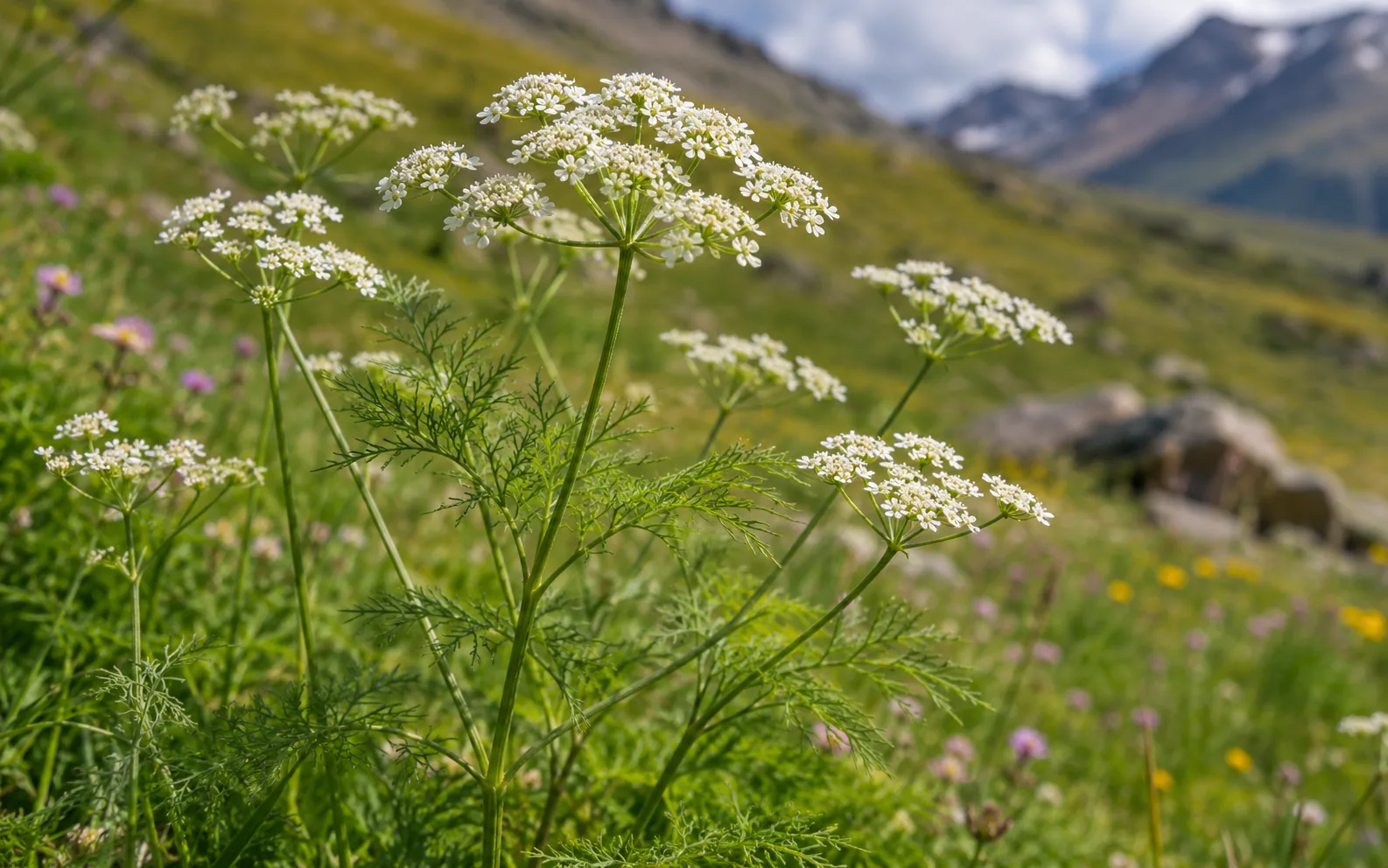
Crush a caraway seed between your fingers and the smell is unmistakable: warm, sharp, a little like aniseed. In Lahaul, that plant grows wild.
Caraway, Carum carvi, is the kala zeera sold in mountain markets. In Lahaul, it is called shingujira. It grows in high meadows and on damp, shaded slopes, and families have long gathered its seeds for the kitchen and for home remedies.
 A real mountain spice. Its aroma is in the seed, not the nectar.
Where it grows
In India, wild caraway grows in the high-altitude regions of Ladakh, Lahaul and Spiti, Kinnaur, Pangi and parts of Uttarakhand. It is common in meadows and moist places at about 10,500 to 14,100 feet, and flowers from about June to August.
Its flowers come in umbrella-shaped clusters of tiny white blooms, like its cousins coriander and fennel.
Who visits the flowers
Caraway flowers are popular with insects. A study of caraway fields in central Europe found 121 species of bees, wasps and flies carrying its pollen. Honeybees were among them, alongside many wild bees and hoverflies. The researchers suggested caraway can be an important late-summer food for insects.
So in Lahaul's short summer, wild caraway is very likely part of the menu for whatever bees are working nearby.
What we can't claim
The topic we were given asks how mountain spices "subtly influence" Lahaul honey's aroma. We'd love to tell you that. We can't:
- The spice is in the seed. Caraway's famous aroma comes from oil in the seed, which ripens after flowering. Bees visit the flowers, not the seeds.
- No study links it to honey. We found no research on caraway's effect on the taste of honey.
- We don't know how much is in our jar. Only pollen analysis could show that. How pollen analysis works.
What we can say: our Lahaul jar is described as deeper, amber and aromatic, from a mix of mountain flowers. Caraway may be one small voice in that mix.
A myth worth clearing up
"Honey tastes of the plant's spice or fruit." Rarely in a simple way. Nectar is mostly sugar and water, with small traces of aroma. A spice plant's flavour usually lives in its seeds, bark or leaves, not its nectar.
A kitchen ritual
Make a simple mountain-style chai: crush a pinch of kala zeera with ginger, brew, let it cool a little, then stir in honey. You get the spice from the seed and the sweetness from the bees: the honest way to enjoy both. Why not in boiling chai?
Common questions
Is kala zeera the same as black cumin? The name is used loosely. In the hills, it often means caraway. Elsewhere, it may mean Bunium persicum or even nigella. Check the seeds.
Is wild caraway protected? It is gathered heavily in some areas. Buy from sellers who harvest sustainably.
Keep reading
Part of our Lahaul honey guide.
Where this comes from
- Local name shingujira in Lahaul; wild in Ladakh, Lahaul and Spiti, Kinnaur, Pangi and Uttarakhand; meadows at 3,200–4,300 m; flowering June to August or September: Himalayan Voices, Carum carvi
- 121 species of Hymenoptera and Brachycera carrying caraway pollen; caraway as late-summer food: Kilian et al., 2023, Molecular Ecology (Western Sydney University)
- Caraway's aroma from the seed's essential oil: Wikipedia, Caraway
- No source links caraway to the taste of honey. That gap is why the post makes no such claim. Heights converted from metres and rounded.
Raw, unfiltered honey, bottled as it is. From a valley where spices grow wild.
Meet the Lahaul jar, from ₹799 for ½ kg · or see what is coming next.
Not Your Beesness, sold on āsthālaya. Delivered across India.


