
Know your honey · 4 min read
The blue pine margins: Lahaul's few trees, and the honeydew question
Blue pine is one of the few trees of Lahaul's cold desert. Elsewhere, bees make honeydew honey from pine trees. In Lahaul, nobody has recorded it. Here is what grows in the valley, and what each tree offers bees.
By Akhil Verma, Co-founder, Not Your Beesness · · Updated
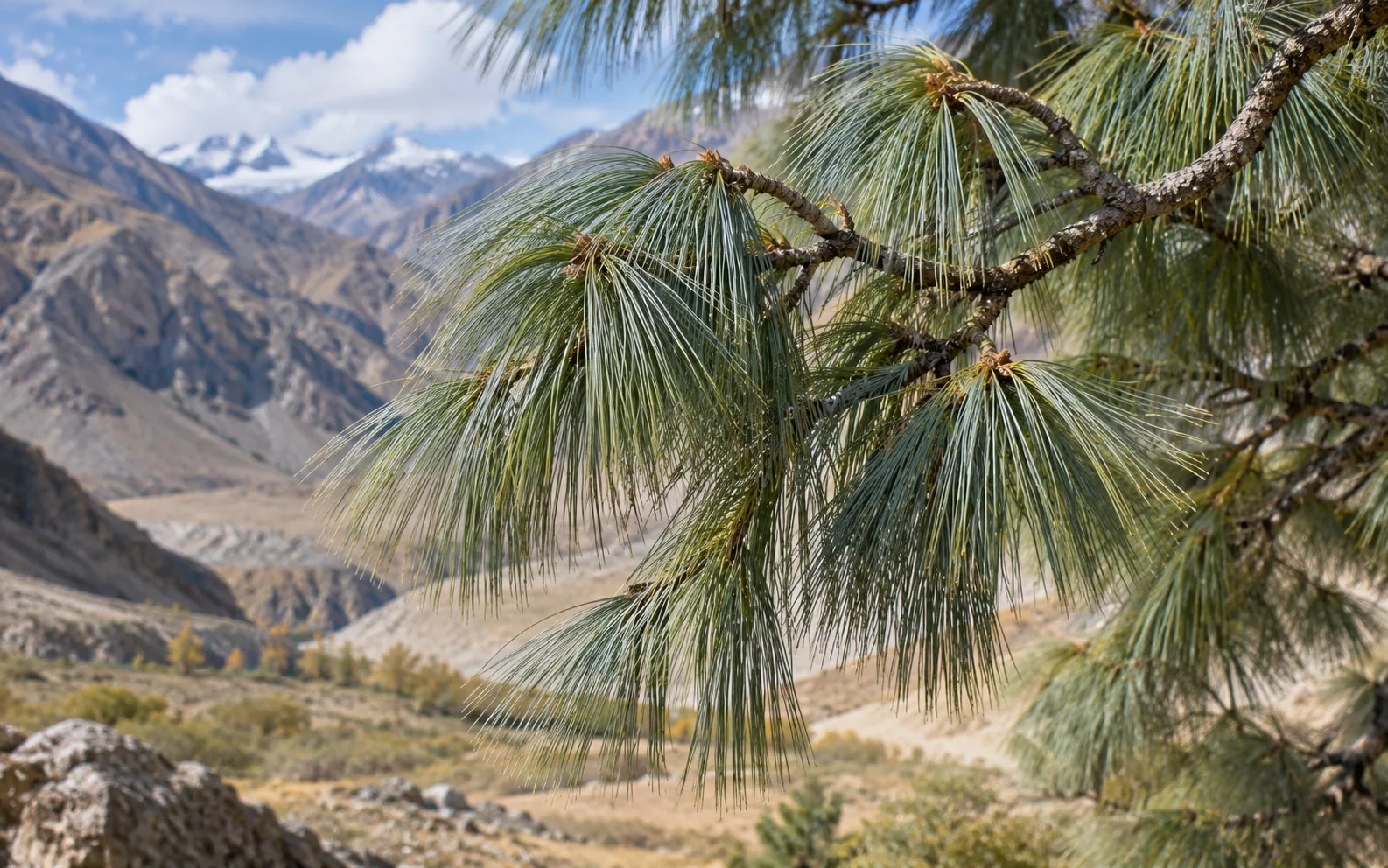
In the cold desert, every tree tells you where the water is.
Lahaul is mostly treeless. The trees it does have grow where streams and kuhls reach, or on the cooler, damper slopes. Blue pine is one of them, but it is not common. And the idea of blue pine "honeydew" in Lahaul honey runs ahead of the evidence.
 Willows feed the bees. Blue pine's role is unrecorded.
Lahaul's few trees
Researchers describe the Indian cold deserts as mostly treeless, with only a few tree species, including blue pine (Pinus wallichiana), Himalayan birch and juniper.
- Willows are the valley's working trees. Farmers plant them along fields and kuhls for fuel, fodder and timber. Shrubby willows also grow wild up to about 12,600 feet.
- Poplars have been planted with willows for wood since at least the mid-twentieth century.
- Junipers survive in old, scattered stands, from about 8,900 feet up, under pressure from grazing and wood-cutting.
- Himalayan birch is the highest-growing tree, doing best above about 11,500 feet.
- Blue pine appears among the cold desert's few trees, but it is not a common sight in the valley.
What each tree offers bees
- Willows are among the best early flowers for bees anywhere, giving pollen and nectar in spring.
- Poplar, juniper, birch and pine are wind-pollinated. Their flowers offer little or no nectar.
The honeydew question
Pines can give honey another way. Sap-sucking insects such as aphids feed on the tree and give off a sugary liquid called honeydew. Bees can collect it and make honeydew honey: darker, less sweet and more mineral than flower honey.
That happens with pines in other countries. In the Kalka foothills, it is a known possibility with chir pine. The pine foothill margin.
But in Lahaul, we found no record of blue pine honeydew being collected by bees, or of it showing up in honey. With so few pines, it may not matter much. We won't claim it.
A myth worth clearing up
"Pine honey comes from pine flowers." No. Pine flowers make pollen for the wind and no nectar. Pine honey, where it exists, is honeydew honey, made from the insects' sugary liquid.
A tree-spotting ritual
On a drive through Lahaul, notice how the green clusters around the villages: willows and poplars lining the fields and channels. That green belt is where most of the valley's bee life is.
Common questions
Is honeydew honey bad? No. It is prized in many countries for its deep, less-sweet taste. It just isn't flower honey.
Does your Lahaul honey contain honeydew? We don't know, and we don't claim it. A lab test could tell.
Keep reading
- The wild caraway bloom
- The alpine meadow magic
- The pine foothill margin
- The high pass willow margins
- The high-pass flora
Part of our Lahaul honey guide.
Where this comes from
- Indian cold deserts mostly treeless, with few trees including Pinus wallichiana, Betula utilis and Juniperus polycarpos; birch most adaptable above 3,500 m: Sustainability, 2023 (MDPI)
- Willows planted along fields and kuhls; wild up to 3,850 m: Rawat & Everson, 2013, Journal of Mountain Science
- Juniper stands in Lahaul, from about 2,700 m, under grazing pressure: Rawat & Everson, 2012, Journal of Mountain Science
- Willow and poplar plantations in Lahaul: Cultivation of Willows and Poplars in Lahaul, Indian Forester
- Honeydew sources, including pines: Wikipedia, List of honeydew sources
- No source records blue pine honeydew in Lahaul honey. Heights converted from metres and rounded.
Raw, unfiltered honey, bottled as it is. From the green belts of a cold desert.
Meet the Lahaul jar, from ₹799 for ½ kg · or see what is coming next.
Not Your Beesness, sold on āsthālaya. Delivered across India.


