
Know your honey · 5 min read
The pine foothill margin: what honeydew means in the hills around Kalka
Climb a little above Kalka and the first chir pines appear. Pine forests are famous for a dark, woody honey that has nothing to do with flowers. Here is what that honey is, how it is made, and how you would ever know if it was in your jar.
By Akhil Verma, Co-founder, Not Your Beesness · · Updated
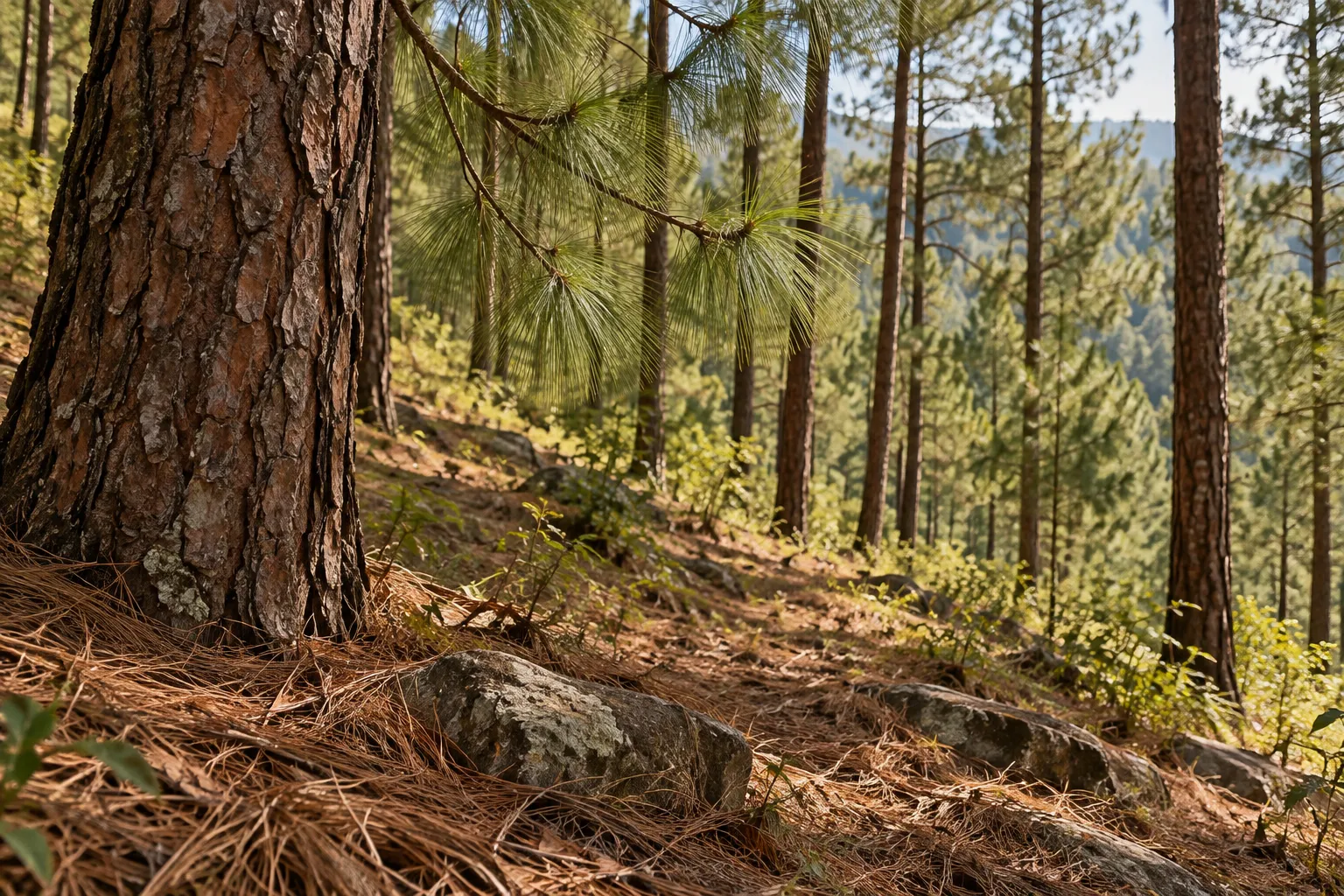
Somewhere on the road out of Kalka, the scrub thins and the first tall chir pines appear. From there, the pine forest climbs with you almost all the way to Shimla.
Chir pine grows in the outer Himalaya from about 1,650 feet up to around 7,200 feet, often in pure stands that carpet whole hillsides with needles. At about 2,150 feet, Kalka sits right at the lower edge of that belt, where the warm foothill scrub meets the pines.
That edge matters for honey. Pine forests in other parts of the world are famous for a dark, woody honey that has nothing to do with flowers at all.
 Kalka sits at the lower edge of the pine belt. Honeydew comes from trees and tiny insects, not flowers.
First, pine gives bees no nectar
Pine trees do not have flowers that make nectar. They spread their pollen on the wind. So a pine forest on its own offers bees nothing to make honey from.
Pine honey happens only when someone else does the work first.
How honeydew happens
- A tree. Pine, oak, fir and some other trees.
- A tiny insect. Small sap-sucking insects feed on the tree's sap. They take what they need and leave the extra behind as sweet, sticky drops on the needles and leaves.
- A bee. Honeybees find those drops and collect them, just as they would collect nectar.
- Honeydew honey. Back in the hive, the bees turn it into honey. It is dark, woody, less sweet and slow to set, and it is often what people mean when they say "forest honey".
The world's best-known pine honey comes from Turkey and Greece, where one particular scale insect lives on Turkish pine. Turkey alone makes thousands of tonnes of it a year.
And around Kalka?
Here is the honest answer: we have not found any record of chir-pine honeydew honey being made in this part of India. The scale insect behind Turkish pine honey is a Mediterranean species, and we found no sign of a chir-pine equivalent here.
India does have documented honeydew sources. The best known is the lac insect, the same insect that gives us lac and shellac. It is farmed on trees like ber, palash and kusum, and studies have recorded bees collecting its honeydew.
So in the hills around Kalka, honeydew is possible, but it is not something we can assume. Our Kalka jar is sold as what it is: raw multiflora honey from the foothill scrub and orchards.
How you would ever know
Not by taste or colour alone. A dark, bold flower honey like jamun can taste "foresty" too. More on dark honey.
Two things tell you for sure:
- A lab test. Honeydew honey carries more minerals, and a simple test of how well the honey conducts electricity separates it from flower honey. It is one of the standard checks food labs use.
- The label. Under FSSAI rules, honey made from honeydew must be named "Honeydew Honey", and a mix must say "Blend of Honeydew Honey and Blossom Honey".
If a jar promises "pine" or "forest" honey but its label does not say what it actually is, that is worth a question.
Two pine myths
"Pine honey tastes of pine resin from the tree." Not quite. The woody, resin-like taste comes from the insects' honeydew and how the bees process it. Bees do not collect resin for honey. (They do gather tree resin, but to seal and protect the hive, not to eat.)
"Honey from a pine area is pine honey." Not necessarily. Bees in a pine area still go to whatever flowers are in bloom. A jar is only honeydew honey if the bees really worked honeydew, and the test and label say so.
A pine-margin winter ritual
When the cold settles over the hills:
- Adrak aur shahad for a scratchy throat: a little fresh ginger juice with a spoon of honey. Tradition, not medicine.
- A spoon of honey in warm haldi doodh, stirred in once it has cooled from scalding. Never into the boiling pan. (Here is why.)
And honey is not for babies under one.
Common questions
Is there honeydew in your Kalka honey? Our Kalka jar is sold as multiflora blossom honey. If a batch were ever mostly honeydew, the rules would require us to say so on the label, and we would.
Will you sell pine or forest honey? Our wild forest honey is on our list. When it arrives, the label will tell you exactly what it is.
Where can I see the pine belt? On the road or the toy train from Kalka to Shimla. Watch the slopes change from scrub to pine as you climb.
Keep reading
Part of our Kalka honey guide.
Where this comes from
- Chir pine from about 500 to 2,200 m, in Shivalik and lower Himalayan forests: Indian Forester; WWF, Himalayan subtropical pine forests
- Turkish pine honey and its scale insect: Honey Traveler, pine honeydew; Siberian Journal of Forest Science
- The lac insect as a honeydew source: Sharma et al., Bee World, 1999, via ScaleNet
- Electrical conductivity separates honeydew from blossom honey: TU Dresden; Springer, 2024
- FSSAI naming rules for honeydew honey: Food Safety and Standards (Food Products Standards and Food Additives) Regulations, Reg 2.8.3
Raw, unfiltered honey, bottled as it is. Named for its place, and labelled for what it is.
Find your Kalka jar, from ₹499 for ½ kg · or see what is coming next.
Not Your Beesness, sold on āsthālaya. Delivered across India.


