
Know your honey · 3 min read
The Shivalik oak margins: where 'oak honey' really comes from
Ban oak forests crown the hills above Kalka, and 'oak honey' is prized in Europe for its dark, complex taste. But oaks give bees no nectar. Here is how oak honey really happens, and why there is none in a foothill jar.
By Akhil Verma, Co-founder, Not Your Beesness · · Updated
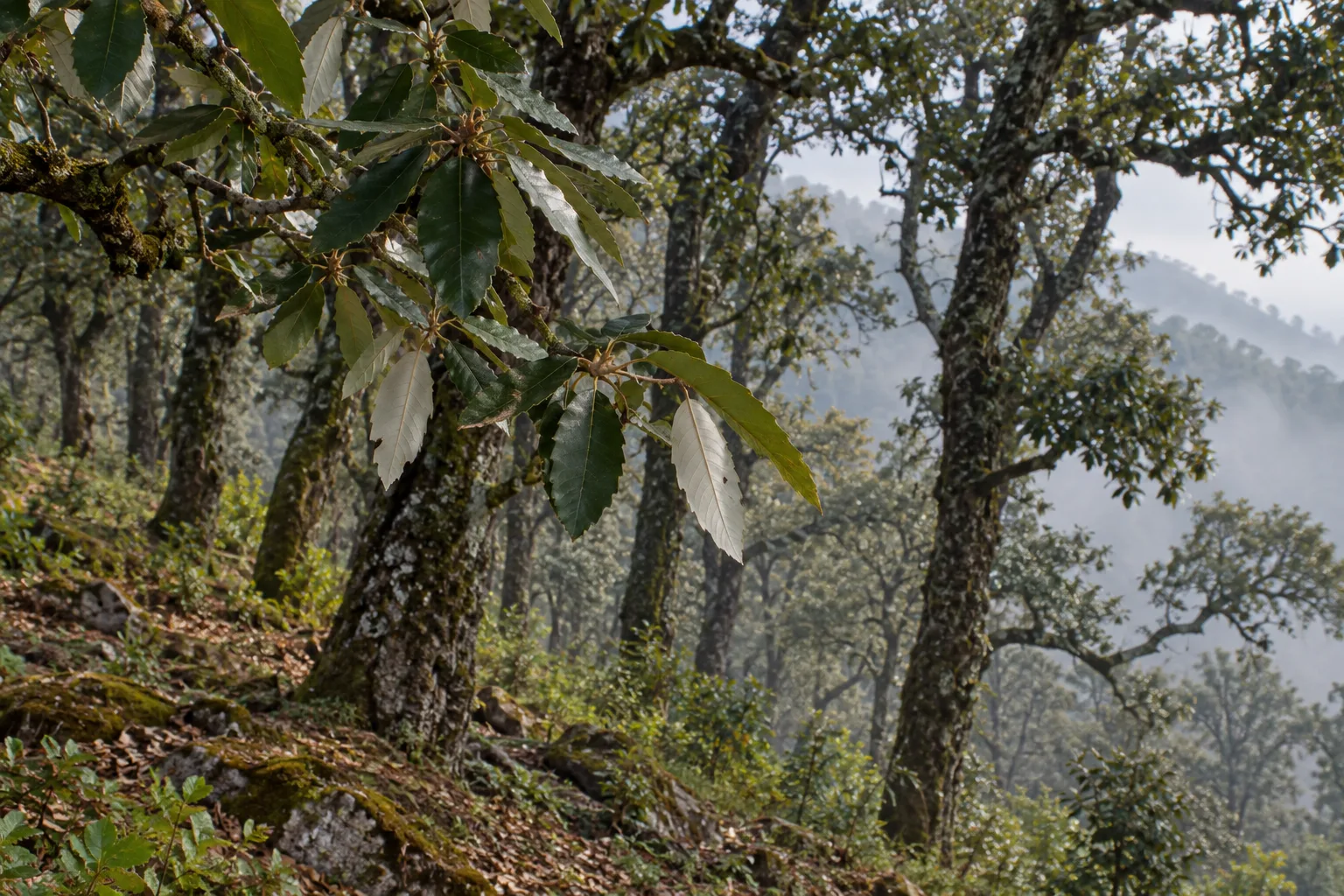
Drive up past Dharampur and the forest changes again: among the pines, broad-crowned oaks appear, their leaves silver underneath.
This is ban oak, a tree so valued in Himachal that it is protected from felling. Oak forests are also behind one of Europe's most prized honeys. So, does the foothill honey carry some of that oak character?
No, and the reason is a good story.
 Ban oak grows far above the foothills, and its "honey" comes from honeydew.
Oaks give bees no nectar
Oaks are wind-pollinated. Their dangling catkins shed pollen on the breeze. They have no showy petals and no nectar for bees.
So where does "oak honey" come from?
From honeydew. Tiny sap-sucking insects living on oak leaves leave behind sweet, sticky drops, and bees collect those drops and turn them into honey. More on honeydew.
Oak honeydew honey is made in Spain, Turkey and Portugal. Studies describe it as dark and rich in phenolic compounds, the plant substances that give tea and red wine some of their depth.
And the "tannins"? You'll sometimes see oak honey described as tannic. Oak wood and bark are famous for tannins, but studies of oak honeydew honey talk about a range of phenolic compounds, not tannins as such. It is the honeydew, not the tree's tannins, that gives the honey its character.
Ban oak lives far above Kalka
Ban oak grows at roughly 4,900 to 7,900 feet. Kalka sits at about 2,150 feet. So the oak belt starts around Dharampur and covers places like Kasauli, but it is nowhere near the foothill scrub our Kalka jar comes from. The ridge flora.
What the label must say
Under FSSAI rules, honey made from honeydew must be labelled "Honeydew Honey". So a genuine oak honey should say so.
A myth worth clearing up
"Dark, bitter-edged honey has oak tannins." Usually not. Darkness and depth come from the source, whether flowers like jamun or honeydew, and from age and heat. Where dark honey comes from.
An oak-forest ritual
On a winter trip to the hills, warm haldi doodh with a spoon of honey, stirred in once it has cooled from scalding. Tradition, not medicine. Honey is not for babies under one.
Common questions
Is there oak honey in India? We know of none sold as such in this region. If there were, it would be labelled honeydew honey.
Why is ban oak protected? Himachal brought it under rules that restrict felling, along with species like mango and toon.
Keep reading
Part of our Kalka honey guide.
Where this comes from
- Oak honeydew honeys, dark and phenolic-rich (Spain, Turkey, Portugal): Universidad de Sevilla; Kırklareli oak honey study; IPB Portugal
- Ban oak at about 1,500–2,400 m: Wikipedia, Quercus leucotrichophora
- Himachal felling restrictions on ban oak and five other species: The Tribune
- FSSAI naming rule for honeydew honey: Reg 2.8.3
Raw, unfiltered honey, bottled as it is. From the foothills, below the oaks.
Find your Kalka jar, from ₹499 for ½ kg · or see what is coming next.
Not Your Beesness, sold on āsthālaya. Delivered across India.


