
Know your honey · 3 min read
The orchard margins: who really visits the mango blossom around Kalka
Each spring, the mango orchards around Pinjore fill the evening air with the scent of baur. You might expect them to be humming with honeybees. The busiest visitors are often much smaller, and a surprise.
By Akhil Verma, Co-founder, Not Your Beesness · · Updated
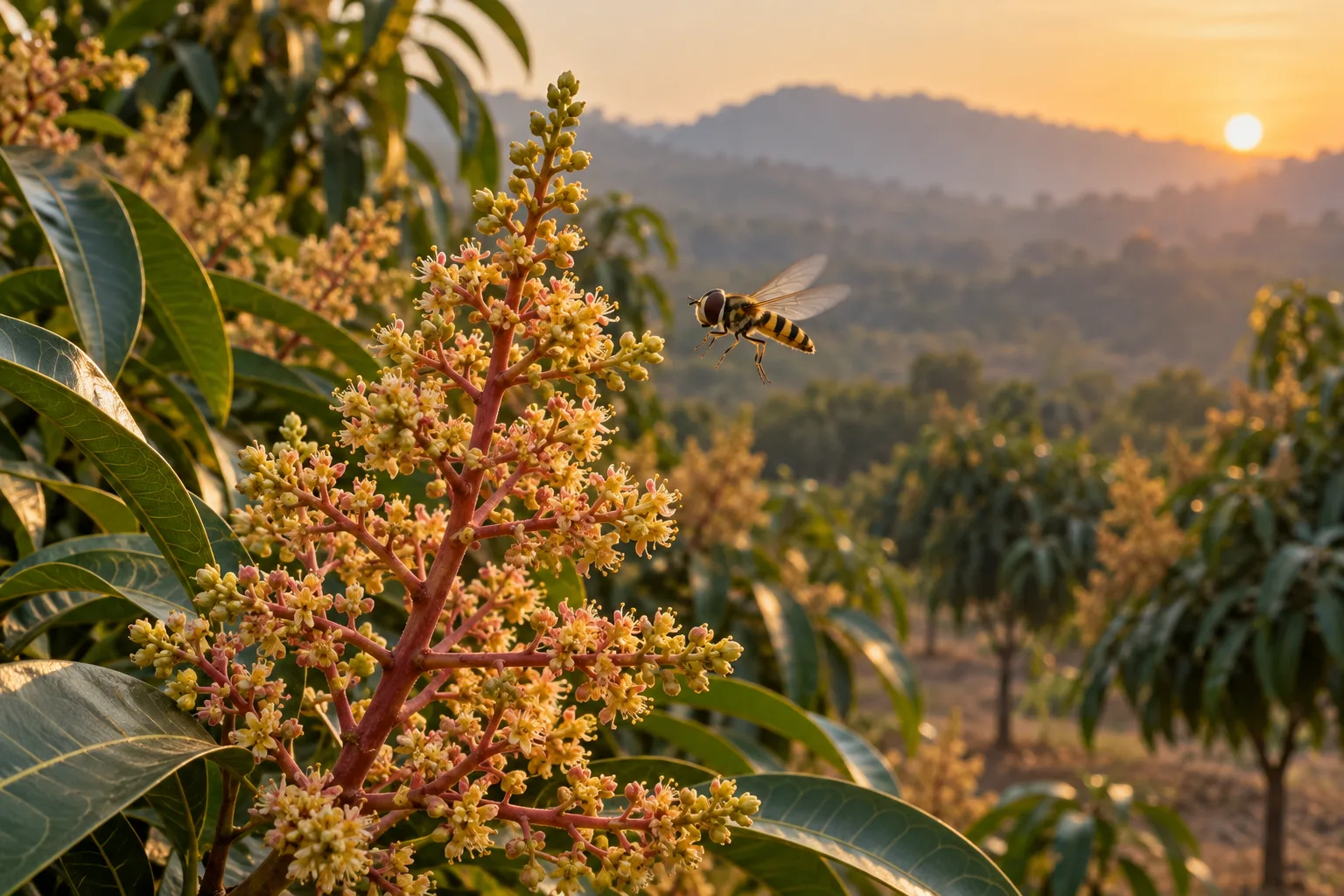
Drive past the orchards around Pinjore in late February and you will smell them before you see them: the sweet, slightly sharp scent of mango baur.
Each tree holds hundreds of cone-shaped clusters of tiny cream-yellow flowers. For a honey brand, the obvious question is: are the bees all over it? The answer is more interesting than yes.
 Mango's most frequent visitors are often small flies, not bees.
Mango's busiest visitors: flies
Mango flowers are tiny, open and short on nectar. They suit small flies very well.
A survey at Pantnagar in the Uttarakhand foothills found that hoverflies made up about 45% of all visitors to mango flowers. Older Indian work also named hoverflies, houseflies and stingless bees among mango's main pollinators.
And the honeybees?
Honeybees do visit mango blossom, sometimes in good numbers. But studies suggest they are less effective pollinators of mango than many native insects. For mango growers, the flies and wild bees often matter most.
When baur appears
Around Kalka and Pinjore, mango blossom comes in February and March, right in the middle of the foothills' main spring flow. See it on the bloom calendar.
Mango honey: does it exist?
Yes, in places with huge orchards. A study in Malda, West Bengal, analysed mango honeys from that orchard region. So bees can make honey mostly from mango where orchards are vast.
Around Kalka, orchards are one part of a mixed landscape. So we can't promise "mango notes" in our Kalka jar. As multiflora honey, a spring batch may include some mango nectar, alongside the scrub and other trees. The taste of any batch follows its weeks.
A myth worth clearing up
"If a flower smells sweet, bees must love it." Not always. Mango's scent draws many insects, and small flies are often the most frequent visitors.
Mango season in the kitchen
- Aam panna in summer: sweeten it with a spoon of honey instead of sugar, stirred into the cooled pulp.
- A drizzle of honey over cut mango and thick dahi in May.
Tradition, not medicine. Honey is not for babies under one.
Common questions
Do you sell mango honey? No. Our Kalka honey is multiflora.
Do bees help mango farmers? Yes, but many other insects help too. Healthy orchard edges with wild flowers support all of them.
Keep reading
- The eucalyptus winds
- The silk cotton bloom
- The flame of the forest
- The Shivalik oak margins
- The acacia influx
Part of our Kalka honey guide.
Where this comes from
- Hoverflies about 45% of mango flower visitors (Pantnagar): AgEcon Search
- Hoverflies on mango in Assam: Indian Journal of Entomology; Singh (1960) on flies and stingless bees, via Indian Journal of Horticulture
- Honeybees less effective mango pollinators than native insects (study summary, unverified original): SuperKalam
- Mango honeys from Malda: Asian Journal of Pharmaceutical and Clinical Research
Raw, unfiltered honey, bottled as it is. From the foothills, orchard margins and all.
Find your Kalka jar, from ₹499 for ½ kg · or see what is coming next.
Not Your Beesness, sold on āsthālaya. Delivered across India.


