
Know your honey · 6 min read
Springtime in Kalka: tracking the first wildflower blossoms of the year
Long before the calendar says spring, the Kalka foothills start to flower. Here is what blooms first, in what order, and what the bees make of it.
By Akhil Verma, Co-founder, Not Your Beesness · · Updated
In Kalka, spring starts in January, in a mustard field, while the rest of North India is still wrapped in shawls.
By the time the calendar admits it is spring, the foothills have been flowering for weeks. For the bees, this is the year's main event: the stretch from January to April when most of the honey is made.
This is a field guide to that season. What opens first, what follows, and how to spot each one on a drive up from Chandigarh.
 The first blossoms around Kalka, in the order they open. Every winter shifts the bars a little.
January: yellow fields and red trees
Sarson (mustard) comes first. The fields just below the hills turn yellow around Basant Panchami, which is why the festival is dressed in yellow. On a warm afternoon the bees are out among the flowers, even in January.
Semal (silk cotton) follows close behind. Look for tall, bare trees on the plains edge and along the roads, covered in big red flowers with not a single leaf. Birds, squirrels and bees all crowd in for the nectar. Later the pods split and release the soft white fluff that grandmothers once used to stuff pillows.
How to spot it: if a big tree is bare of leaves yet glowing red against the sky in February, it is almost certainly semal.
February: the scrub wakes up
Now the foothills themselves come alive.
- Basuti (adusa) flowers in the scrub on the slopes, with small white, lipped flowers. Many families know the plant from the winter cough kadha. Bees know it for its nectar.
- Safeda (eucalyptus) begins on the plantations below, with fluffy cream blossoms high up in the trees. Bees work them in huge numbers. (Our eucalyptus honey comes from this bloom.)
- Aam ka baur (mango blossom) fills the orchards around Pinjore. You smell it before you see it: a sweet, slightly sharp scent on the evening air.
March: the colourful month
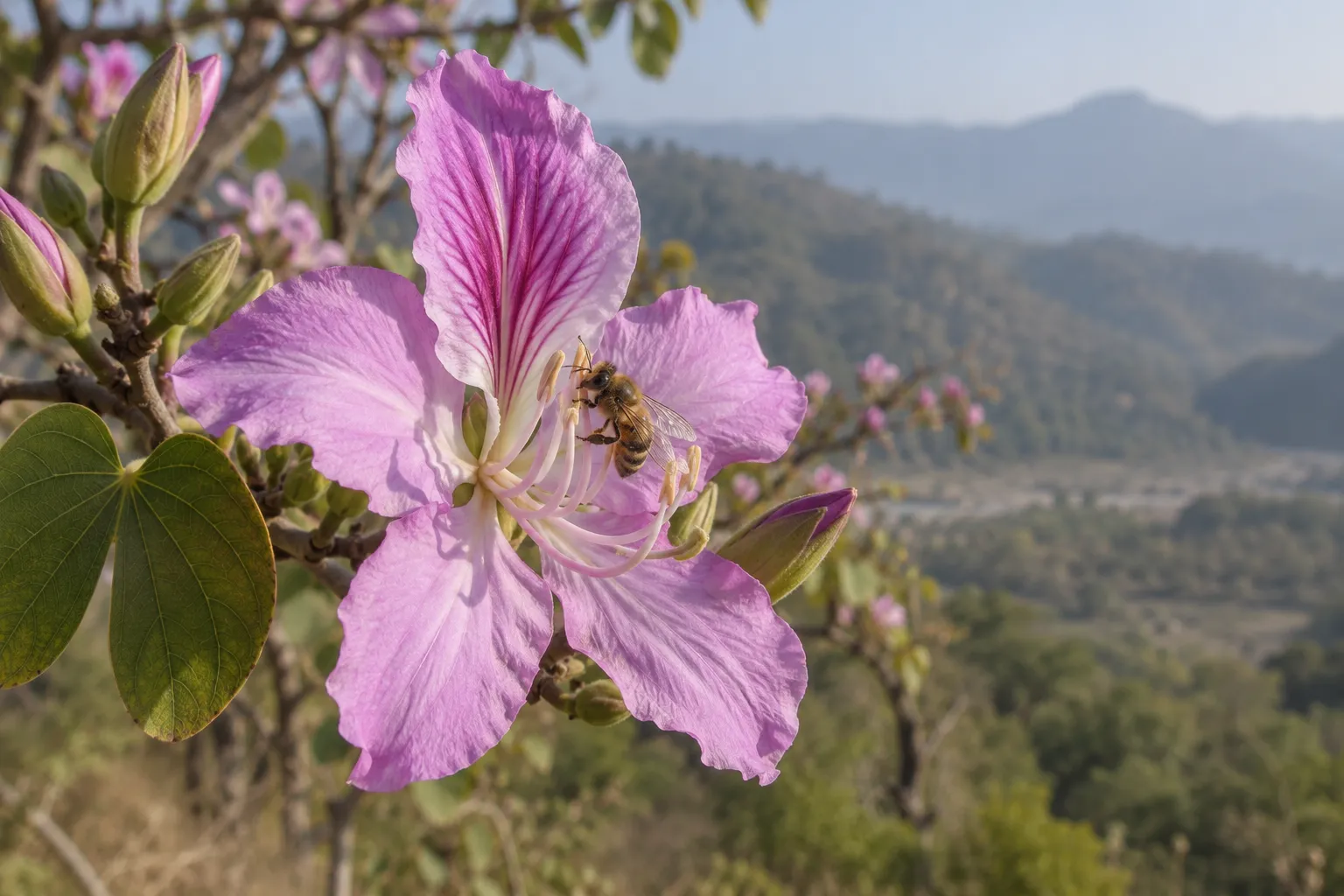
Kachnar covers the slopes in pink and purple, like an orchid that grew into a tree. In many North Indian kitchens, its buds go into kachnar ki sabzi, a dish that exists for just a few weeks a year.
Palash (tesu), the flame of the forest, lights up the dry scrub in orange. Its flowers are the traditional source of Holi colour, soaked overnight to make a soft saffron water. One thing to know if you go looking: palash does not flower every year on every tree. A winter that is too cold, too dry or too wet can skip a season.
Shisham starts along roads and field edges, with small pale flowers that are easy to miss but a favourite of bees.
April: the last of the spring flow
Jamun flowers in the orchards and along old avenues, small and pale, weeks before its purple fruit. Bees working it make one of the darkest honeys there is. (Our jamun honey is the next single-flower batch.)
By the end of April the hills have had their best months. Studies of hives in Haryana find colonies at their strongest in April, before the summer heat closes the season.
Spring climbs the hill
If you drive from Kalka (about 2,150 feet) up to Kasauli (about 6,300 feet) in March, you can watch the calendar run backwards. Flowers that are finishing in the foothills may only be opening on the ridges.
That rolling bloom is why the Kalka bees get a longer, warmer season than bees in the high valleys. Read the full story of the Shivalik corridor.
What spring means for your jar
Spring honey often sets fast. Mustard is one of the quickest-setting nectars there is. If a spring batch turns pale and firm like ghee in the cold, that is natural. Here is why, and how to make it runny again.
Every batch tastes of its weeks. A batch heavy with mustard and basuti will not match one full of orchard blossom and kachnar. That is what multiflora means, and it is why raw honey changes from batch to batch while factory honey never does.
Darker is not burnt. Jamun and some tree blossoms make naturally dark honey. Colour follows the flower, not the factory.
A spring myth, gently
"A spoon of local honey a day will cure spring allergies."
It is a lovely idea, and you will hear it everywhere. But the pollen that causes most spring sneezing comes from wind-blown grasses and trees, and very little of it ends up in honey. In the best-known trial, people with hay fever who ate local honey did no better than those given a syrup that only looked like honey. The evidence since then is mixed at best.
Enjoy your honey for what it is: a taste of the season. For allergies, see a doctor.
A daadi ka nuskha for changing weather
When the weather swings between cold mornings and warm afternoons, many homes reach for the same small ritual:
- Tulsi and honey. A few fresh tulsi leaves crushed into a spoon of honey, taken slowly.
- Adrak and honey. Fresh ginger juice with a spoon of honey for a scratchy throat.
These are tradition, not medicine. Both work best with honey stirred in warm, never boiling (here is why), and honey is not for babies under one.
Common questions
When is the best time to see Kalka in bloom? Late February to mid-March, when basuti, mango blossom, kachnar and the first palash overlap. Go on a sunny weekday morning, when the bees are busiest.
Does your Kalka honey come from these flowers? Our Kalka jar is raw multiflora from the foothills, so it carries whatever was in bloom when the bees made it. No two batches are quite alike. Meet the Kalka jar.
Why does Lahaul honey come later in the year? Lahaul sits above 10,000 feet and gets one short summer. Its bees work wild thyme, sea buckthorn and clover long after Kalka's spring is over. Two places, two jars.
Keep reading
Part of our Kalka honey guide.
Where this comes from
- Semal flowering, January to March in north India: SeasonWatch citizen-science data via RoundGlass Sustain; FAO EcoCrop
- Kachnar, flowering from February to April: Flowering trees of India (PDF)
- Palash, flowering February to April, and not flowering every year: Wikipedia, Butea monosperma
- Basuti, flowering February to April: KIRAN, Government of India
- Mustard, eucalyptus and shisham as bee plants in the region: Status and prospects of migratory beekeeping in Punjab
- Local honey and allergies: Rajan et al., Annals of Allergy, Asthma & Immunology, 2002, summarised by the American Bee Journal and AAFA
- Colonies strongest in April in Haryana: Munis Entomology & Zoology
- The bloom windows in the illustration are indicative. The bees and the weather decide the exact week.
Raw, unfiltered honey, bottled as it is. Kalka multiflora, from ₹499 for a ½ kg jar.
Find your Kalka jar · or see what is coming next, from eucalyptus to jamun.
Not Your Beesness, sold on āsthālaya. Delivered across India.


