
Know your honey · 6 min read
Two places, two jars: Himalayan honey from Lahaul and Kalka
One honey from a cold desert above 10,000 feet. One from the first hills of the Shivaliks. Both raw, both multiflora, and nothing alike. Here is why, and how to tell real honey from a well-dressed jar of syrup.
By Akhil Verma, Co-founder, Not Your Beesness · · Updated
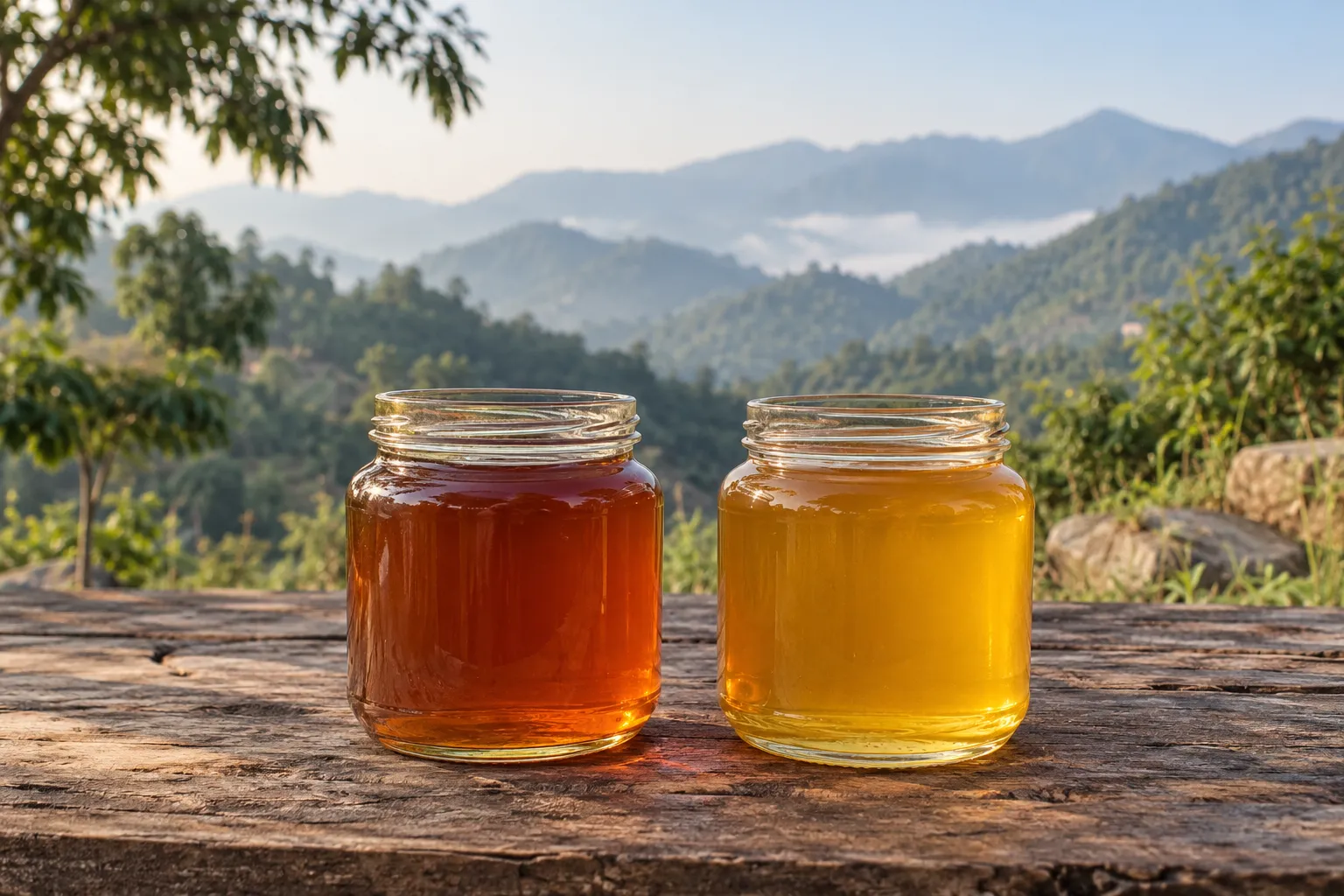
Most honey on a supermarket shelf will never set in winter, because it was heated and filtered until it stopped behaving like honey.
Real honey is different. It smells of the flowers it came from, it changes a little every season, and when the nights turn cold it thickens and sets, the way desi ghee does in a December kitchen.
We bottle it from two very different corners of the Himalaya and keep them apart, so each jar tastes of its own place.
 Same kind of honey. Different places, different flowers.
Jar 01: Lahaul, where every bloom counts
Go past Manali, through the Atal Tunnel, and you reach Lahaul: a high cold desert in the rain shadow of the Himalaya, with valley floors above 10,000 feet. Keylong, its main town, sits at about 10,100 feet.
For much of the year, Lahaul lies under snow. The bees get one short summer, when hardy alpine plants such as wild thyme, sea buckthorn and clover flower on the slopes.
- Deeper, amber and intensely aromatic. A honey with a lot to say.
- Small by nature. A short season means a small harvest.
- For slow moments: off the spoon, over curd, or as a gift for someone you think about.
Meet the Lahaul jar · from ₹799 for ½ kg
Jar 02: Kalka, where the Shivaliks begin
Now come back down to Kalka, where the plains meet the first hills of the Shivaliks and the old road to Shimla starts to climb.
The bees here work a longer, warmer season than in the high valleys. Spring walks slowly uphill, so the foothills bloom in waves: mustard on the plains, basuti on the slopes, then orchard blossom. (Read the full story of the Shivalik corridor.)
- Warm, rounded and golden. Easy to love, and the one children reach for.
- Made for every day: the morning glass of warm water, the roti drizzle, the spoon in your chai once it has cooled to sipping heat.
Meet the Kalka jar · from ₹499 for ½ kg
Why do two Himalayan honeys taste so different? Both are multiflora: the bees take whatever is in bloom. Different place, different flowers, different honey. Factory honey tastes the same every time because it is blended and processed to.
"My honey has set. Is it fake?"
No. Raw honey sets as it ages, especially in a cold North Indian kitchen, just as pure ghee goes grainy in winter. It has not spoiled and it has not been faked.
Stand the jar in warm, not boiling, water and it flows again. Never the microwave, never the stove.
One honest note: setting is not a purity test in either direction. Some genuine honeys stay runny for months. Here is the full answer on why honey sets.
The ant test, and other kitchen tests that do not work
Every Indian family has a trick for testing honey. We love them, but we would rather be honest with you.
- "Ants will not touch pure honey." Myth. Ants love real honey as much as sugar syrup. They are after sweetness.
- "Pure honey sinks in water without dissolving." Not reliable. Thick syrups sink too.
- "Real honey sits on your thumb without spreading." Not reliable. It depends on how thick the syrup is and how warm the room is.
- "Real honey burns when you light it." Not reliable, and please do not try it at home.
Here is why it matters. In 2020, India's Centre for Science and Environment tested 13 well-known honey brands, and 10 of them failed an advanced lab check for added sugar syrup. Those honeys had passed the usual tests. Modern adulteration is designed to fool a kitchen test.
What real honey looks like in your kitchen
No kitchen trick can prove purity, but you can still tell a living honey from a lifeless one. With raw, unfiltered honey you will notice:
- It smells of flowers, most strongly when you first open the jar.
- It is slightly cloudy, not glassy-clear.
- It may have a thin foam on top. That is just air bubbles, and it is safe to eat. (More on foam.)
- It sets in the cold and softens again in warmth.
- Every batch is a little different.
When a honey tastes exactly the same every time, that should make you curious, not reassured.
Daadi ke nuskhe for the season ahead
Long before wellness was a trend, Indian kitchens kept honey for daily care:
- The morning glass. A spoon of honey in lukewarm water, with a squeeze of nimbu if you like.
- Adrak aur shahad. Fresh ginger juice stirred into a spoon of honey, taken slowly for a scratchy winter throat. Some families add a few crushed tulsi leaves.
- Warm haldi doodh. Let the milk cool from scalding to warm, then stir in honey instead of sugar.
All three are tradition, not medicine. All three follow the same old rule: do not cook your honey. (Why not in boiling chai?)
For parents: honey is not for babies under one, not even a lick. If someone at home is managing blood sugar, ask their doctor how much honey suits them.
Why a jar of raw honey costs what it does
- From two named places, Lahaul and Kalka, kept apart, never blended.
- Seasonal and limited. When a Lahaul batch is gone, the next one waits for next summer.
- One coarse strain, bottled raw. The pollen and character stay in.
You are not paying for a picture of a mountain on the label. You are paying for honey that still behaves like honey.
Keep reading
Part of our real honey guide.
Where this comes from
- Lahaul elevation (Keylong, about 3,080 m) and alpine flora: Not Your Beesness, Our honeys
- CSE honey adulteration study, December 2020: Business Today
- Why honey sets: Honey notes, My honey has set. Is it spoiled?
Raw, unfiltered honey, bottled as it is. Lahaul for the moments that matter. Kalka for every morning.
Find your jar · or give both: the Diwali gift box (1 kg Lahaul + 1 kg Kalka, ₹2,299) or the Navratri & Dussehra box (½ kg + ½ kg, ₹1,199).
Not Your Beesness, sold on āsthālaya. Delivered across India.


