
Know your honey · 5 min read
Real Honey Guide: How to Tell Raw Honey From Syrup
Every family that buys honey worries about syrup. This guide gathers everything we've written on telling real honey apart: what works, what doesn't, and what a label must say.
By Akhil Verma, Co-founder, Not Your Beesness · · Updated
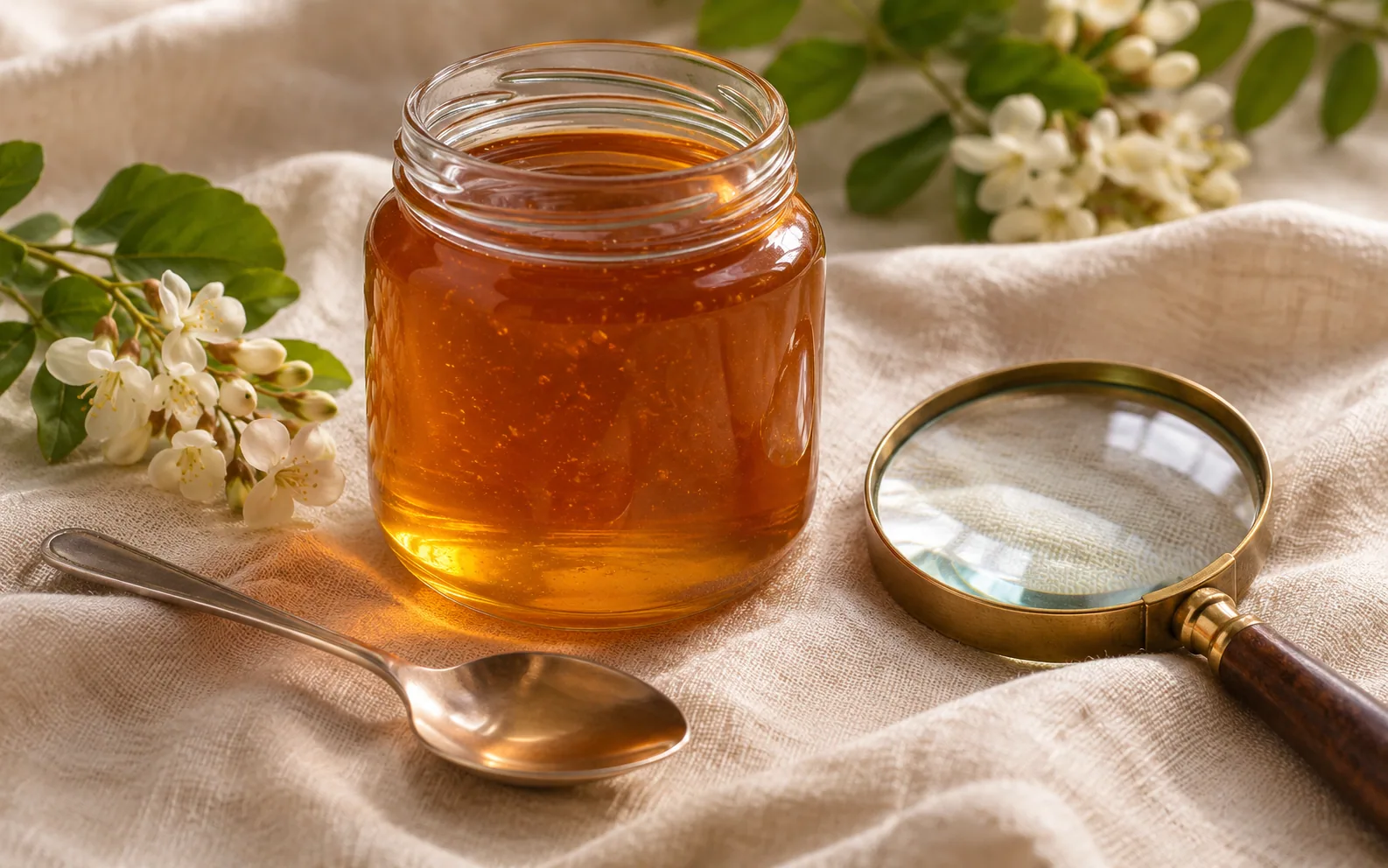
There is no reliable kitchen test for fake honey. There are, though, plenty of honest clues.
Quick answer: There's no reliable home test to check pure honey: kitchen tests like the ant test and the water test don't work. Real raw honey smells of its flowers, varies by batch and often sets in the cold; a lab test and an honest seller are the real proof.
Start with the first post below if you're new: it covers the myths most families grew up with. Then go by what you're curious about.
Spotting real honey
- Two places, two jars: Himalayan honey from Lahaul and Kalka
Raw Himalayan honey from Lahaul and Kalka: why the two taste different, why real honey sets in winter, and why the ant test fails. - Golden hour in the Shivaliks: reading the warm colours of foothill honey
Beekeepers grade honey in seven colours, from water white to dark amber. What colour says about flowers and season, and why it can't prove purity. - The wild mustard drift: when mustard really blooms, and how to tell it's in a honey
Mustard flowers in winter on the North Indian plains. Only pollen analysis shows how much is in a honey, and FSSAI's 45% rule decides the name. - The Jispa valley harvest: why two batches from one valley never taste the same
Why do two batches from one valley differ? Flowers, weather, foraging spots and ripeness all shift raw multiflora honey, and that's a good sign. - The isolated hive project: what Lahaul's remoteness can, and can't, do for honey
Lahaul's remoteness keeps bees far from factories and heavy traffic, but it can't stop syrup being added after harvest. What purity depends on. - The polyfloral balance: what multiflora honey really means
Multiflora honey comes from many flowers with none above 45% of the pollen. How it differs from single-flower honey, and why it varies. - The pollen count: what microscopes can and can't tell you about honey
Pollen analysis shows which flowers a honey came from, not whether syrup was added. Why India's 2020 honey tests needed NMR to catch adulteration. - The micro-batch system: what a batch number on a honey jar tells you
A batch number traces a honey jar to the lot it was packed from. What it means under India's labelling rules, what else to check, and what it can't prove.
The full index
- The master floral index: every plant we've written about, across both valleys
Every plant we've written about across the Kalka foothills and Lahaul, in one table: what grows where, what it gives bees, and what isn't there. - The master seasonal roadmap: a year in the life of your honey
Kalka flowers from January; Lahaul is under snow until spring. A month-by-month honey season calendar for both valleys, with links to each stage.
Texture, taste and storage
- Foot of the mountains: what really makes Kalka honey thick and smooth
Thick, slow-pouring honey isn't down to low hills. Water, warmth and flowers decide it, and you can check all three in your own kitchen. - The spring equinox harvest: why no honey has a flavour fixed by its date
No honey has a flavour fixed by its harvest date; harvest follows capped comb. How the UC Davis honey flavour wheel helps you name what you taste. - The foothill gravity pull: what really dries honey, and what gravity actually does
Honey takes up water from humid air and gives it up in dry air. Bees do the drying; gravity just lets air and wax rise in a settling tank.
What's in your honey
- The Shivalik soil factor: how much does soil really shape honey?
Does soil shape honey's taste the way it shapes wine? A little, but not the way labels suggest. How soil reaches honey, and how much it matters. - The Shivalik eco-buffer: why good honey keeps its distance from busy roads
Studies in Egypt, Turkey and Russia found more lead or cadmium in honey near busy roads. Why good apiaries keep their distance from traffic. - The tree line boundary: does high-altitude honey have more enzymes?
Honey's enzymes, diastase and invertase, come from bees and are damaged by heat. No study shows high-altitude honey has more. What protects them.
From hive to jar
- The final Kalka press: the life of a jar of raw honey, from flower to table
Bloom, forage, ripen and cap, harvest, extract, strain and settle, jar: the life of a raw honey jar, plus FSSAI's 'Pressed Honey' label rule. - The high-pass logistics: how heat, not cold, is the enemy of a honey jar
Cold doesn't hurt honey; months of heat slowly do. Storage studies show HMF rising at 35°C but not at 0–25°C. How to look after your jar. - The high altitude pressure: does thin mountain air change how honey is made?
Water boils at about 89°C in Keylong, but raw honey is spun, not boiled. Why altitude doesn't change honey extraction, and what dries honey instead. - The single-origin mandate: why we keep Lahaul and Kalka honey apart
What single-origin honey means, what it takes to keep two honeys apart from hive to jar, and why it matters for taste and honesty.
Common questions about how to check pure honey
Does honey that has set like ghee mean it's fake? No. Raw honey often crystallises in the cold. Here is why.
Is darker honey purer? No. Colour mostly shows which flowers the bees used. What honey colour tells you.
What should a honey label tell me? Under FSSAI rules, a single-flower name needs that plant to be at least 45% of the pollen, and honey pressed from the comb must say "Pressed Honey".
More guides
- Our Lahaul honey guide
- Our Kalka honey guide
- Our guide to how bees make honey
- Our Honey kitchen guide
Raw, unfiltered honey, bottled as it is.
Find your jar: Lahaul from ₹799 or Kalka from ₹499, for ½ kg · or see what is coming next.
Not Your Beesness, sold on āsthālaya. Delivered across India.


