
Know your honey · 3 min read
The Shivalik eco-buffer: why good honey keeps its distance from busy roads
Bees fly through whatever air surrounds their hive. Studies from several countries find that honey from beside busy roads carries more metal. That is why careful beekeepers set their boxes well back.
By Akhil Verma, Co-founder, Not Your Beesness · · Updated
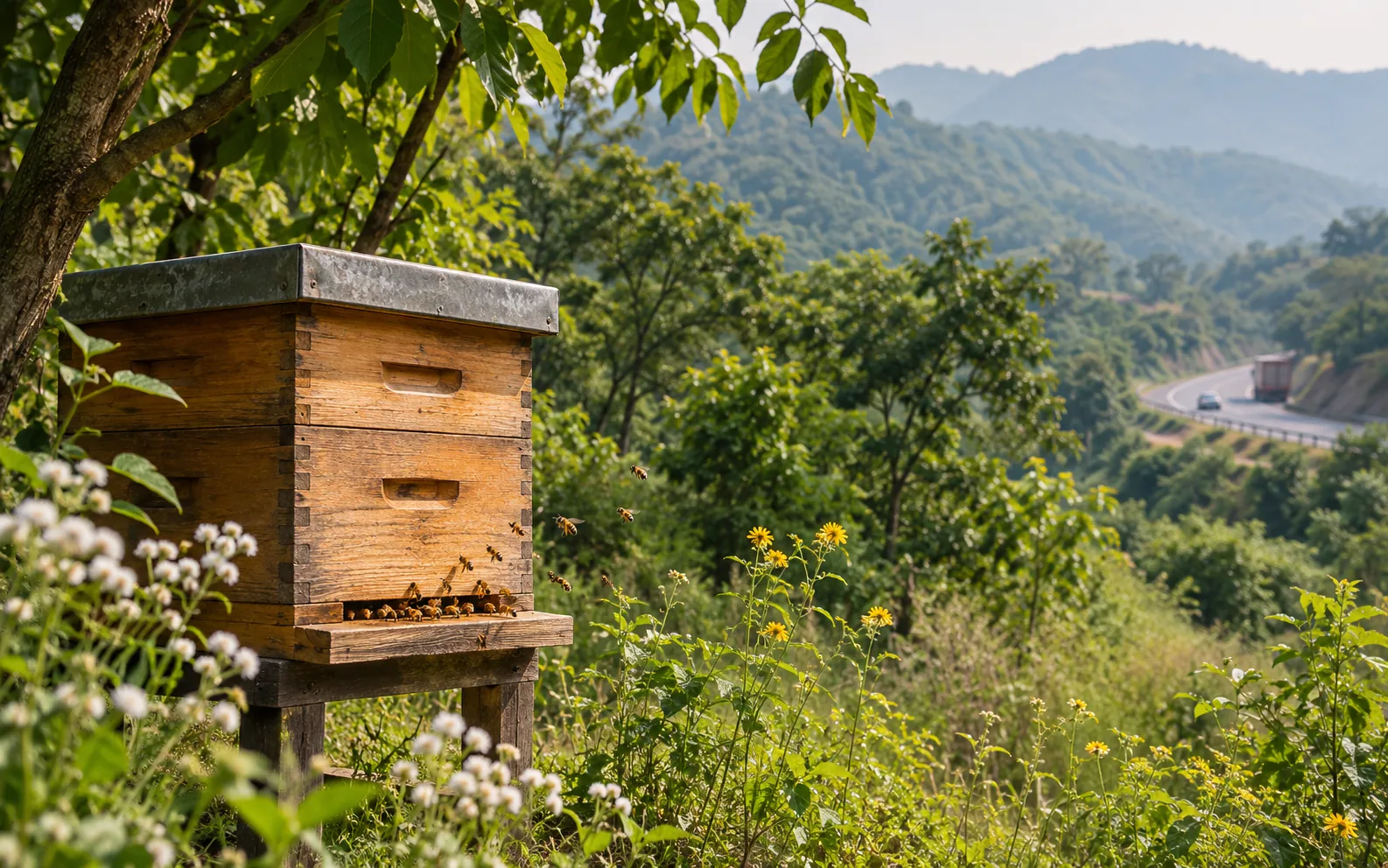
A bee doesn't choose its air. It flies through whatever surrounds its hive, and brings a little of it home.
That is the simple reason careful beekeepers keep their boxes away from heavy traffic. Exhaust, brake dust and tyre wear settle on flowers near busy roads, and some of it can end up in nectar, pollen and honey.
 Four times the lead nearest the road, in one study. Distance helps.
What the studies say
- Egypt. One study measured honey from apiaries at different distances from main roads. Honey nearest the road had 5.00 mg/kg of lead. Honey farthest away had 1.25 mg/kg: a quarter as much.
- Turkey. Researchers placed hives at intervals along a highway. Cadmium was the clearest sign of traffic pollution in bee products, and it was highest at the highway edge.
- Russia. Bee products from apiaries near a federal highway carried more lead, cadmium and other metals than samples from a forest area.
- Eastern Turkey. In 200 honey samples, metal levels were below EU limits. Even so, the authors advised siting apiaries far from roads and traffic.
These are small regional studies, and they don't all agree on every metal. But they point the same way: distance from heavy traffic is good practice.
Why distance helps, but isn't magic
Bees usually forage within about 3 km of the hive, sometimes farther. So moving hives back from a highway reduces exposure. It does not remove it. Good siting looks at the whole circle: roads, factories, sprayed fields, and clean water and forage.
In the Shivalik foothills, much of the land is a patchwork of scrub, forest edge, orchards and small fields. The Shivalik corridor describes that landscape. How a foothill apiary sits covers the rest of the siting checklist.
A myth worth clearing up
"Bees filter out pollution, so honey is always clean." Not entirely. Bees and their honey can pick up traces of what is in the air and on flowers. That is why scientists use bees to monitor pollution. Siting matters.
A daadi-style rule
Daadi wouldn't pick saag from beside the main road, and for the same reason, a careful beekeeper won't park boxes there. Buy honey from people who can tell you where their bees were.
Common questions
Is roadside honey dangerous? Many samples in these studies were within limits. The point is that farther is better, not that every roadside honey is unsafe.
Can I test my honey for metals at home? No. That needs a laboratory.
Keep reading
Part of our real honey guide.
Where this comes from
- Egypt, lead in honey by distance from main roads (5.00 vs 1.25 mg/kg): Journal of the Egyptian Environment
- Turkey, Tokat-Turhal highway, cadmium highest at the highway edge: Turkish Journal of Agriculture, Food Science and Technology
- Russia, Nizhny Novgorod, higher metals in bee products near a federal highway: DOAJ
- Eastern Turkey, 200 samples below EU limits, advice to site apiaries away from roads: Ankara University Faculty of Veterinary Medicine Journal
- The bar comparison in the illustration is from one study.
Raw, unfiltered honey, bottled as it is. From quiet foothill country.
Find your Kalka jar, from ₹499 for ½ kg · or see what is coming next.
Not Your Beesness, sold on āsthālaya. Delivered across India.


