
Know your honey · 3 min read
The foothill apiary: how beekeepers set up hives in the Shivalik woods
A good apiary looks simple: a few wooden boxes under a tree. But every choice, from the shade to the stand to which way the entrance faces, is there for a reason. Here is how beekeepers typically set up hives in the foothills.
By Akhil Verma, Co-founder, Not Your Beesness · · Updated
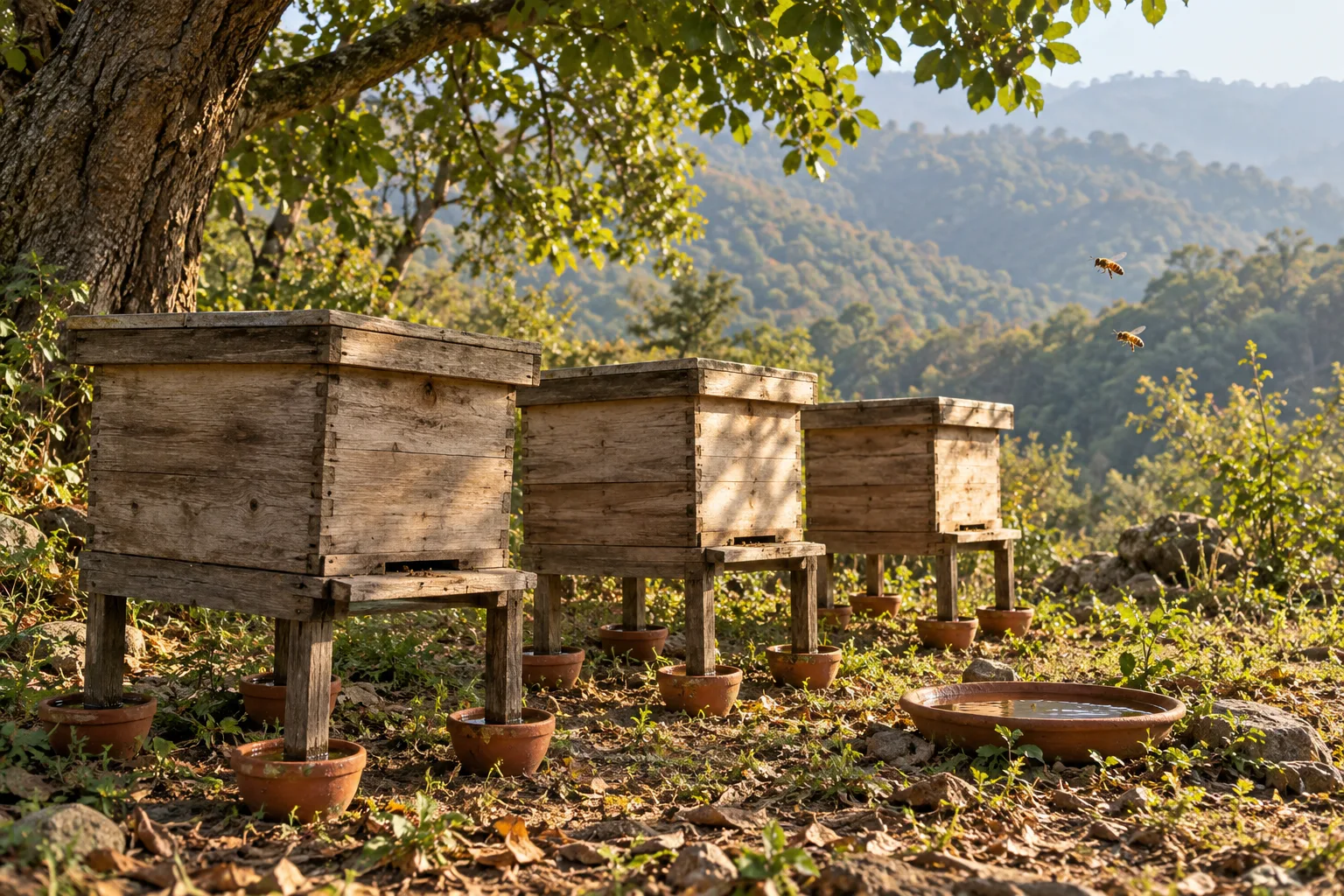
From the road, an apiary is just a row of wooden boxes at the edge of a field or under the trees. Up close, every detail has a job.
This post shows how beekeepers typically set up hives in the foothills. Every beekeeper adapts it to their own site, and this is not a picture of any one apiary.
 General good practice for a foothill apiary. Every beekeeper adapts it to the site.
Five things a good site needs
1. Flowers within reach. Bees usually forage within about 3 km. A good site has plenty in bloom close by: scrub, orchards, trees. What decides a bee's working day.
2. Shade from the harsh afternoon sun. In the foothill summer, a hive in full sun overheats. Light shade keeps the brood comfortable. The May heatwave.
3. Clean water nearby. Bees drink, and in the heat they carry water home to cool the hive.
4. A stand with ant guards. Hives sit on stands, with the legs in small cups of water so that ants can't climb up and raid the honey.
5. An entrance facing the morning sun. Many guides suggest facing the entrance east, so the bees warm up and start work early. The Shivalik sunrise.
And of course: a well-drained spot, away from pesticide spraying.
Two kinds of box
The Newton hive is a smaller box designed for the Indian honeybee (Apis cerana), whose colonies are smaller.
The Langstroth hive is the larger box used for the European honeybee (Apis mellifera). This bee was first successfully introduced in India in 1962, at Nagrota Bagwan in Himachal Pradesh, and is now the main bee of commercial beekeeping in the north.
What about our own apiaries?
Our Kalka jar comes from beekeepers in the Kalka foothills. We'd rather show you their real set-up than describe it from the outside, and we hope to share it in a future post.
A myth worth clearing up
"Bee boxes hurt the bees." No. A well-made box simply gives the colony a dry, safe home with frames the beekeeper can lift out and check, without destroying the comb.
Common questions
Can I keep bees at home? Many people do, with training. Start with a local beekeeping course and a mentor.
Which bee makes better honey? Both make real honey. The European honeybee usually stores more of it.
Keep reading
- The stone wall apiaries
- The great drying
- The local apiary journals
- The clean-up phase
- The night-blooming jasmine
Part of our guide to how bees make honey.
Where this comes from
- Newton hive for Apis cerana; Langstroth for European bees: TNAU Agritech; Wikipedia, Beekeeping in India
- Apis mellifera first introduced at Nagrota Bagwan in 1962: Beekeeping presentation, SlideShare
- Site selection (drainage, shade, ant moats, east-facing entrance, water, low pesticide): Agridots apiary management; Farmonaut
- The drawing is schematic and general.
Raw, unfiltered honey, bottled as it is. From the foothill hives.
Find your Kalka jar, from ₹499 for ½ kg · or see what is coming next.
Not Your Beesness, sold on āsthālaya. Delivered across India.


