
Know your honey · 3 min read
The clean-up phase: how beekeepers prepare hives for winter
A colony's winter is decided in autumn. Beekeepers check stores, join weak colonies to strong ones, shrink the entrance, and in Himachal's high hills, often load the hives and head for the plains.
By Akhil Verma, Co-founder, Not Your Beesness ·
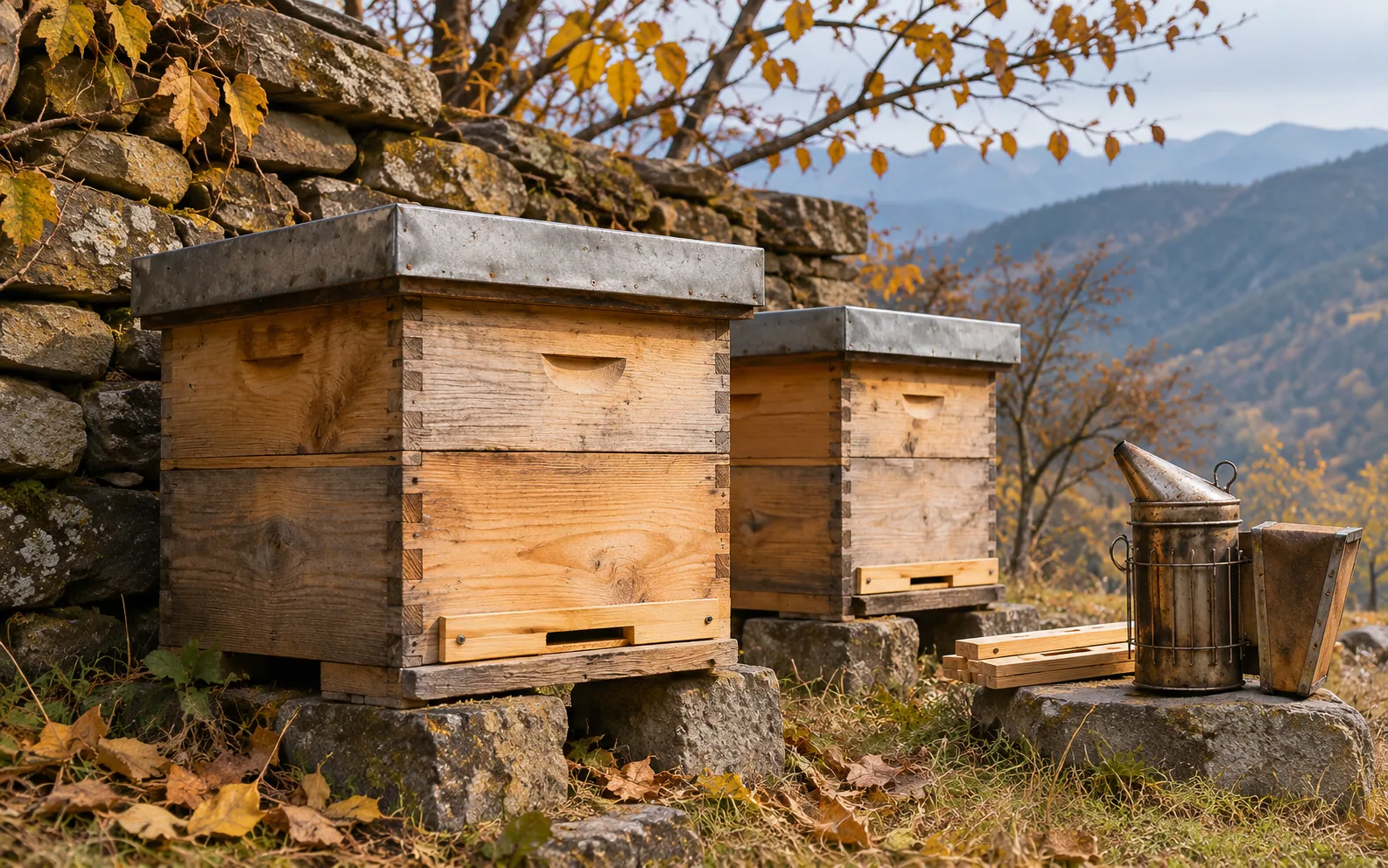
A beehive's winter is decided in autumn, weeks before the first cold night.
Quick answer: Preparing hives for winter means leaving enough honey (about 35–45 lb in cold climates), uniting weak but healthy colonies, and fitting an entrance reducer. In Himachal's high hills, many beekeepers move colonies to the plains instead.
When the last big bloom fades, a beekeeper's job changes: from making honey to making sure the colony survives until spring. Here's what that usually involves.
 Winter is won in autumn.
1. Leave the bees enough honey
The honey a colony eats in winter is the honey left in the hive. Guidance for cold climates suggests a colony needs roughly 16–20 kg (35–45 lb) of stores. In a mild winter, less. Where stores are short, beekeepers feed sugar syrup or fondant before the cold sets in. The winter slowdown.
2. Join the weak to the strong
A small colony struggles to keep its cluster warm. Beekeepers often unite a weak colony with a stronger one, but only if both are healthy, so disease isn't spread. Colonies also need plenty of young bees going into winter; old ones won't last until spring.
3. Shrink the door
An entrance reducer narrows the hive's opening. A smaller door keeps heat in, and is easier to defend against wasps and robber bees in autumn's lean weeks.
4. In the high hills: leave
In Himachal, many beekeepers with Italian bees don't winter in the hills at all. Surveys found colonies kept in the state from about April to October, then moved to the plains of Haryana, Punjab, Rajasthan and Uttar Pradesh. The nomadic keepers.
In the Kalka foothills, winters are mild enough that bees can often fly, and the work is lighter.
What we can't claim
The topic we were given asks how we prepare "the hives for their long winter rest". We haven't documented our partner beekeepers' autumn routine publicly, so this is the general practice, not ours.
A myth worth clearing up
"Taking all the honey is fine; bees make more." Not before winter. Honey left in the hive is the colony's food until spring.
An autumn ritual
When you open a new jar in October, remember the beekeeper's rule of thumb: the bees' share comes first.
Common questions about preparing hives for winter
Do bees need to be fed in winter? Only if their stores run short. Beekeepers prefer to leave enough honey.
Why do beekeepers wrap hives? In very cold places, some insulate hives to help the cluster hold its heat. It's less needed in mild climates.
Keep reading
Part of our guide to how bees make honey.
Where this comes from
- Roughly 16–20 kg of stores, young bees going into winter: University of Edinburgh, Bees ready for winter
- Uniting only healthy colonies, and other winter preparation: National Bee Unit, Fact Sheet 19; strengthening weak colonies by uniting in autumn: SGRRU, Seasonal management lecture
- Colonies kept in Himachal April–October, then moved to the plains: see sources in The nomadic keepers
- A general picture of practice, mostly from temperate climates.
Raw, unfiltered honey, bottled as it is. With the bees' share left behind.
Find your jar: Lahaul from ₹799 or Kalka from ₹499, for ½ kg · or see what is coming next.
Not Your Beesness, sold on āsthālaya. Delivered across India.


