
Know your honey · 4 min read
The sub-zero survival strategy: how honeybees get through a Himalayan winter
Keylong has recorded -30°C. Honeybees don't hibernate through cold like that. They pack into a living ball, shiver to make heat, and burn their stored honey to stay alive. Here is how the winter cluster works.
By Akhil Verma, Co-founder, Not Your Beesness ·
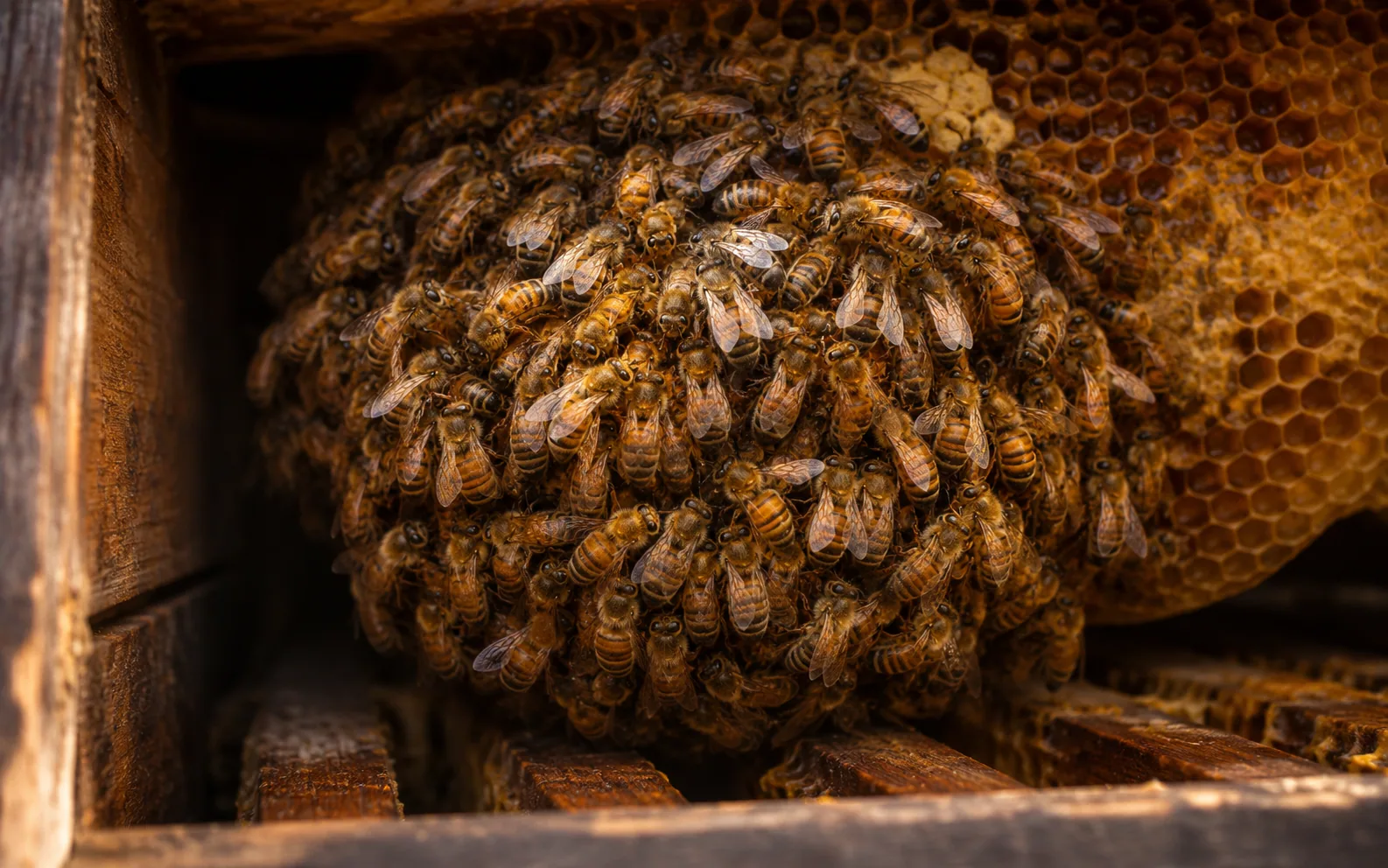
A Lahaul winter can drop to -30°C. A single honeybee would die in minutes. Thousands together can make it to spring.
Quick answer: Here's how bees survive cold: they pack into a winter cluster, shiver their flight muscles to keep the core warm, and burn stored honey as fuel. Keylong's record low is -30°C, a severe test.
Bees don't hibernate. Instead they do something remarkable: they huddle into a tight ball and make their own heat. And the fuel for that heat is the honey they made in summer.
 A ball of bees, warm at the heart, fuelled by honey.
The winter cluster
As the air cools to about 14°C, bees start to draw together. In real cold, they form a tight cluster on the comb:
- The core is warm. Bees there shiver their flight muscles without flying, which makes heat, much like we shiver.
- The outer shell is made of bees packed tightly together, acting as insulation.
- Bees take turns. Cold bees on the outside move in to warm up and feed; warm ones move out.
The cluster tightens when it gets colder and loosens when it warms. When there are young bees (brood) to raise, the centre is kept near 34°C. Without brood, it runs cooler.
Fuel is everything
All that shivering burns energy, and the energy comes from stored honey. A colony needs enough honey to last the winter, and it needs to be able to reach it. In a long cold snap, a cluster can starve even with honey just a few inches away, because it is too cold to move.
That is why beekeepers never take all the honey. The bees need their share to survive.
What about Lahaul?
Keylong has a recorded low of -30°C, and heavy winter snow. That is a severe test for any colony. Many Himachal beekeepers move their bees down to the plains for winter, where there are flowers and milder weather. The nomadic keepers explains how.
The native Indian hive bee copes well with cold and big swings in temperature, which is one reason it has long been kept in the Himalaya. The 11,000-foot challenge.
We don't claim how any particular Lahaul colony spends the winter. That varies by beekeeper.
A myth worth clearing up
"Bees sleep through winter." No. A winter cluster is busy all the time: shivering, shuffling, eating. It is closer to a long, slow night shift than a sleep.
A winter ritual
On the coldest morning of the year, warm a cup of milk, let it cool a little, and stir in a spoon of honey. You are using the same fuel the bees use to get through their winter. Why not in boiling chai?
Common questions about how bees survive cold
Do bees leave the hive in winter at all? On a warm, sunny winter day, some fly out briefly to relieve themselves. Then they go back to the cluster.
What happens to the queen? She stays in the warm centre of the cluster, surrounded by her workers.
Keep reading
Part of our Lahaul honey guide.
Where this comes from
- Clustering from about 14°C, shivering flight muscles, outer bees rotating inward, brood kept near 34°C, risk of starving near stores: Honey Bee Suite, temperature regulation in a winter cluster; The Bee Supply, temperature dynamics of the winter cluster
- Keylong record low of -30°C and heavy winter snow: Wikipedia, Kyelang
- Apis cerana coping with low winter temperatures and big swings: ICIMOD
- Temperatures in the illustration are approximate; sources differ slightly.
Raw, unfiltered honey, bottled as it is. Summer's work, made to last a winter.
Meet the Lahaul jar, from ₹799 for ½ kg · or see what is coming next.
Not Your Beesness, sold on āsthālaya. Delivered across India.


