
Know your honey · 3 min read
The 11,000-foot challenge: what it takes for honeybees to live this high
Lahaul's valley floors sit around 10,000 to 11,000 feet. That is close to the upper limit where hive bees are kept at all. Here is what life is like for bees at that height, and one popular idea about the tree line that doesn't hold up.
By Akhil Verma, Co-founder, Not Your Beesness · · Updated
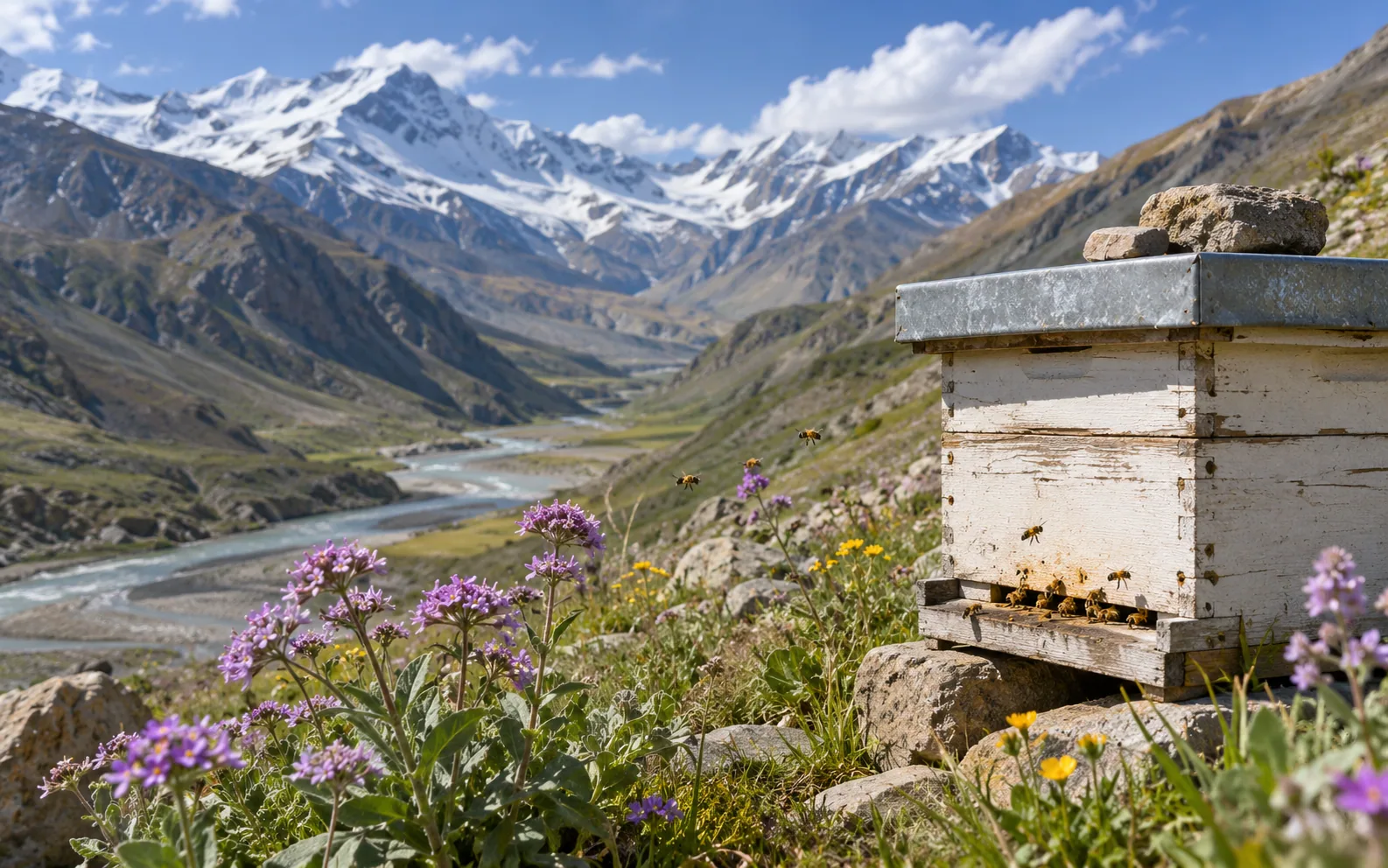
At 10,000 feet, a summer night can still drop close to freezing. For a honeybee, that changes everything.
Bees are small, cold-blooded insects that need warmth to fly. They work best in warm, still, sunny weather. Lahaul offers plenty of sun, but little else that is easy.
 Lahaul sits near the top of where hive bees are kept.
How high can hive bees go?
A study of honey across Himachal Pradesh describes the native Indian hive bee, Apis cerana, as kept by farmers across the Himalaya from about 1,000 to 11,150 feet (300 to 3,400 m). The same study included apiaries in Lahaul and Spiti.
So Lahaul's valleys, at around 10,000 to 11,000 feet, are close to the top of that range. Bees can live here, but only just.
What makes it hard
- Cold. Bees need their flight muscles warm before they can fly. Cold mornings start the day late, and chilly evenings end it early.
- A short season. Snow lingers into spring and comes back in autumn. Flowers, and bees, get a few busy summer months. The Lahaul summer rush.
- Long winters. Colonies have to survive months of cold on the stores they made in summer.
The native hive bee is known for coping with cold and big swings in temperature. That is one reason it has been kept in the Himalaya for generations.
Past the tree line? Not quite
It is tempting to picture Lahaul's bees working "past the tree line". But Lahaul's bare slopes are bare mostly because they are dry, not because they are too high for trees.
- Himalayan birch does best above about 11,500 feet in Lahaul.
- Wild willows grow up to about 12,600 feet.
Both grow higher than the valley floors. Where water reaches, trees grow. The glacial stream nectar explains how.
A myth worth clearing up
"The higher the honey, the better it must be." Not on its own. Height changes which plants grow and how long the season lasts. That gives a honey its character. It does not make it automatically "better". The tree line boundary looks at one such claim.
A slow-morning ritual
High-altitude bees wait for the sun before they start work. Do the same on a cold morning: let the sun come up, warm a cup of milk (not boiling), and stir in a spoon of honey once it has cooled a little. Why not in boiling chai?
Common questions
Are there wild honeybees that live even higher? The Himalayan cliff bee, Apis laboriosa, builds huge combs on high cliffs. It is not kept in hives.
Do Lahaul's bees stay there all winter? That depends on the beekeeper. Some colonies are wintered where they are; others may be moved. We don't make claims about any particular apiary's practice.
Keep reading
- The trans-Himalayan terroir
- The early freeze alert
- Foot of the mountains
- The sub-zero survival strategy
Part of our Lahaul honey guide.
Where this comes from
- Apis cerana managed in the Himalaya from about 300 to 3,400 m; study included Lahaul and Spiti apiaries: Parihar et al., 2020, Journal of Entomology and Zoology Studies
- Apis cerana coping with low winter temperatures and big swings: ICIMOD
- Birch most adaptable above 3,500 m in Lahaul: Sustainability, 2023 (MDPI)
- Willows natural in Lahaul up to 3,850 m: Rawat & Everson, 2013, Journal of Mountain Science
- Heights converted from metres and rounded.
Raw, unfiltered honey, bottled as it is. Made near the top of the bees' world.
Meet the Lahaul jar, from ₹799 for ½ kg · or see what is coming next.
Not Your Beesness, sold on āsthālaya. Delivered across India.


