
Know your honey · 3 min read
The trans-Himalayan terroir: does cold desert air make honey thicker?
Thick honey feels like proof of quality. Cold, dry mountain air does help bees make it. But in one study of Himachal honey, Lahaul's sample was on the drier side, not the driest. Here is what really decides how thick a honey is.
By Akhil Verma, Co-founder, Not Your Beesness · · Updated
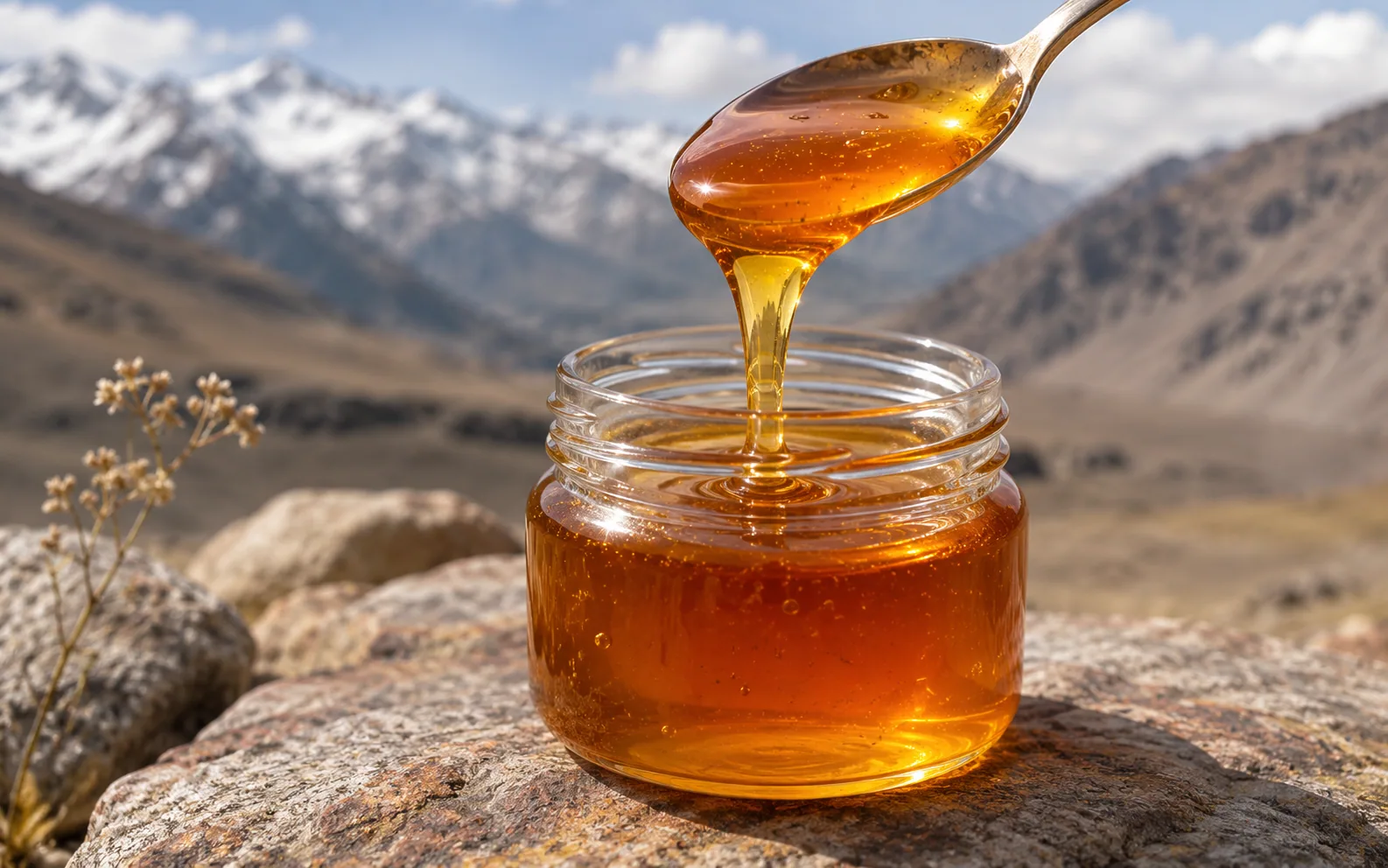
Tip a jar of honey and watch how slowly it moves. Most of what you are seeing is water, or rather, the lack of it.
Honey's thickness comes down to two things: how much water it holds and how warm it is. Less water and cooler honey means thicker honey. The mountains can help with the first. They don't guarantee it.
 Lahaul's honey sat on the drier side in one study. Not the driest.
What makes honey thick
Laboratory studies of honey from many countries agree:
- Water: the less water, the thicker the honey. A few percent makes a big difference.
- Temperature: cold honey is much thicker than warm honey. The same jar pours easily in May and barely moves in January.
So when you compare two honeys, compare them at the same temperature.
Where cold, dry air comes in
Bees make honey by drying nectar in the hive. Dry air helps them do it. How bees dry honey has the details. Lahaul's dry summers should, in principle, make that job easier.
What one study found
Researchers tested honey from eight districts of Himachal Pradesh, including Lahaul and Spiti. For the native hive bee, Apis cerana:
- Lahaul and Spiti: 16.5% water
- Driest sample: Hamirpur, 15.7%
- Wettest samples: Shimla and Mandi, 18.6%
Lahaul's honey from European honeybees in the same study held 16.0%. Every sample was under the 20% FSSAI limit.
So Lahaul's honey was below the middle, but not the driest. A low-lying district beat it. That tells us the mountains help, but so do the beekeeper's timing and the season.
How far to trust it: three apiaries per district, in one study. A pattern worth knowing, not a promise for any one jar.
A myth worth clearing up
"Thicker honey is always purer honey." Not necessarily. Thick honey is usually riper, which is good. But syrup can be thick too, and real honey thins when it's warm. Thickness is one clue, never the whole proof.
A tasting ritual
Take two honeys out of the cupboard on the same day, so they are at the same temperature. Tip each jar slowly and compare. Then taste. Thickness tells you about water. Taste tells you about flowers.
Common questions
Why does my Lahaul honey set solid in winter? Cold and the natural sugar balance make raw honey crystallise. It is normal. Why honey sets.
Should I warm thick honey to make it pour? Gently, if you must: stand the jar in warm (not hot) water. Never microwave it.
Keep reading
Part of our Lahaul honey guide.
Where this comes from
- Water content of Apis cerana and A. mellifera honey from eight Himachal districts, including Lahaul and Spiti: Parihar et al., 2020, Journal of Entomology and Zoology Studies, Table 1
- Viscosity falls with higher water content and temperature: Bakier, 2007, Polish Journal of Food and Nutrition Sciences; Yanniotis et al., 2006, AGRIS
- FSSAI moisture limit of 20%: Food Safety and Standards (Food Products Standards and Food Additives) Regulations, Reg 2.8.3
Raw, unfiltered honey, bottled as it is. Ripened in thin, dry mountain air.
Meet the Lahaul jar, from ₹799 for ½ kg · or see what is coming next.
Not Your Beesness, sold on āsthālaya. Delivered across India.


