
Know your honey · 3 min read
The high altitude pressure: does thin mountain air change how honey is made?
Up in Lahaul, water boils at about 89°C instead of 100°C. That changes how you cook dal. It doesn't change how raw honey is extracted, because honey is spun out of the comb, not boiled.
By Akhil Verma, Co-founder, Not Your Beesness ·
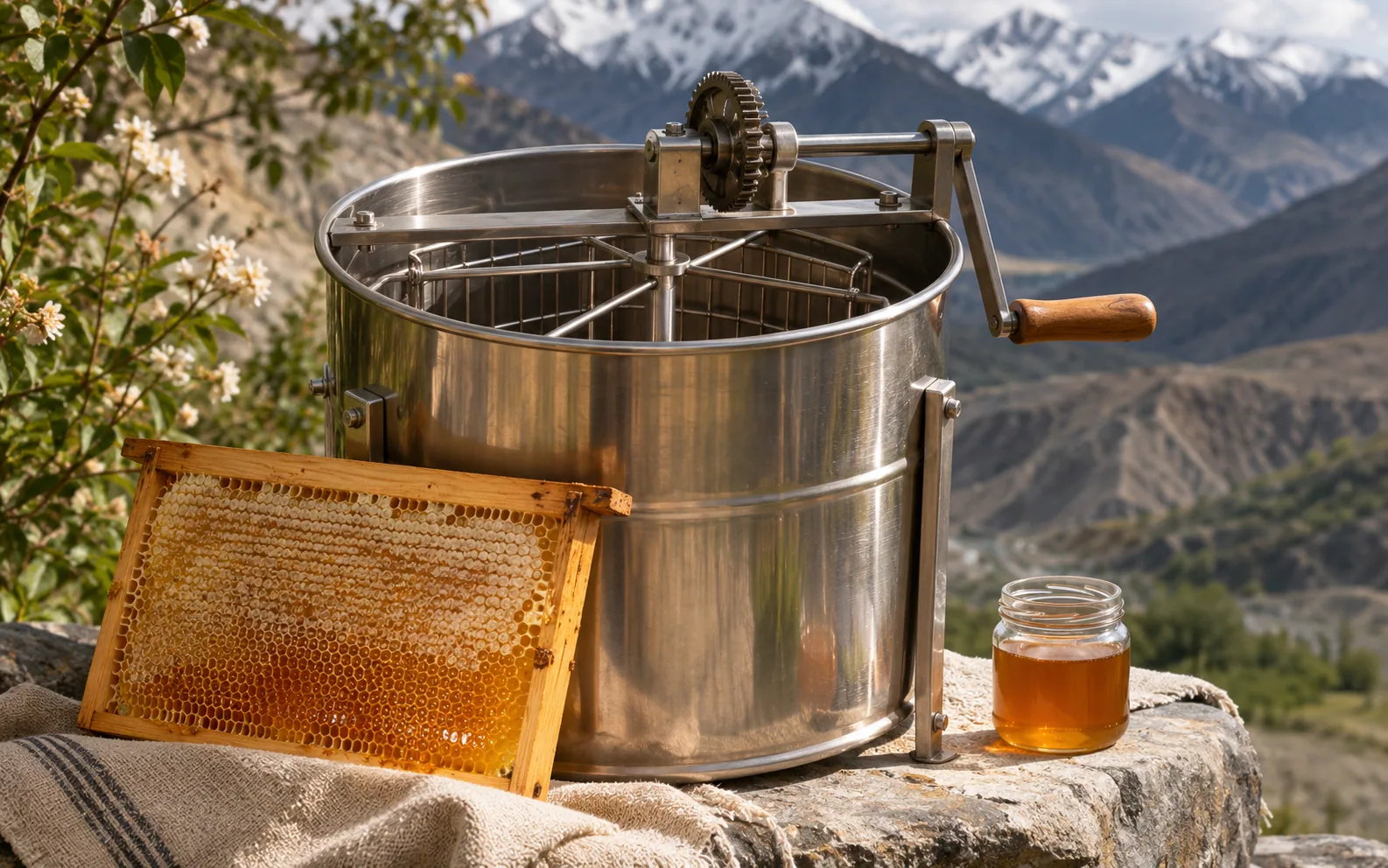
Cook rice in Keylong and it takes longer, because water boils at only about 89°C up there. So does the thin air change honey too?
Quick answer: Honey extraction is mechanical: capped frames are spun in an extractor, with no boiling or vacuum. Thin mountain air lowers water's boiling point to about 89.5°C at Keylong, but raw honey is never heated, so it doesn't matter.
The topic we were given asks about "the unique physics of honey extraction in the mountains". It's a fair question. The short answer is that the physics that matters at altitude, a lower boiling point, has nothing to do with raw honey, because raw honey isn't boiled.
 Thin air changes boiling, not spinning.
What thin air does
At height, there's less air pressing down, so water boils at a lower temperature:
- Sea level: 100°C
- Kalka, about 2,150 ft: about 97.7°C
- Manali, about 6,730 ft: about 93°C
- Keylong, about 10,100 ft: about 89.5°C
Roughly, every 1,000 feet of height lowers the boiling point by about 1°C.
How honey is actually extracted
Raw honey is spun, not cooked:
- Bees ripen honey and seal it with wax. How bees dry honey.
- Beekeepers slice off the wax caps.
- Frames go into an extractor, which spins them so the honey flies out.
- The honey is coarse-strained and left to settle. The final Kalka press.
It's purely mechanical: no boiling, no vacuum, no pressure step. Air pressure plays no meaningful part.
Where altitude could matter
Only if honey were heated. Heating honey, at any height, harms its enzymes and raises freshness markers like HMF. Does heat damage honey? Good raw honey isn't heated at all, so the lower boiling point never comes into it.
What does dry honey?
The bees do, by fanning nectar in the hive until it's ripe. After that, the humidity of the air matters more than its pressure: honey takes up water in damp air and gives it up in dry air. Does honey absorb water?
A myth worth clearing up
"Mountain honey is thicker because of the air pressure." No. Thickness depends on water content and temperature. Is high-altitude honey thicker?
A kitchen experiment
If you visit the hills, boil water and check it with a kitchen thermometer. You'll see the lower boiling point for yourself. Then remember: none of that heat ever touches a jar of raw honey.
Common questions about honey extraction at altitude
Does honey boil? Honey can be heated until it bubbles, but that damages it. Raw honey should never be boiled.
Should I warm set honey? Only gently, in warm (not hot) water. Why honey sets.
Keep reading
Part of our real honey guide.
Where this comes from
- Boiling point of water by altitude: Engineering ToolBox, boiling points of water at altitude
- Heights converted and rounded; boiling points interpolated from the table.
- Extraction steps: see sources in The final Kalka press.
Raw, unfiltered honey, bottled as it is. Spun, never boiled.
Find your jar: Lahaul from ₹799 or Kalka from ₹499, for ½ kg · or see what is coming next.
Not Your Beesness, sold on āsthālaya. Delivered across India.


