
Know your honey · 4 min read
The final Kalka press: the life of a jar of raw honey, from flower to table
Every jar of raw honey closes a loop that starts with a flower. Here is the whole cycle, step by step, and the one word on a label that tells you how the honey left the comb.
By Akhil Verma, Co-founder, Not Your Beesness · · Updated
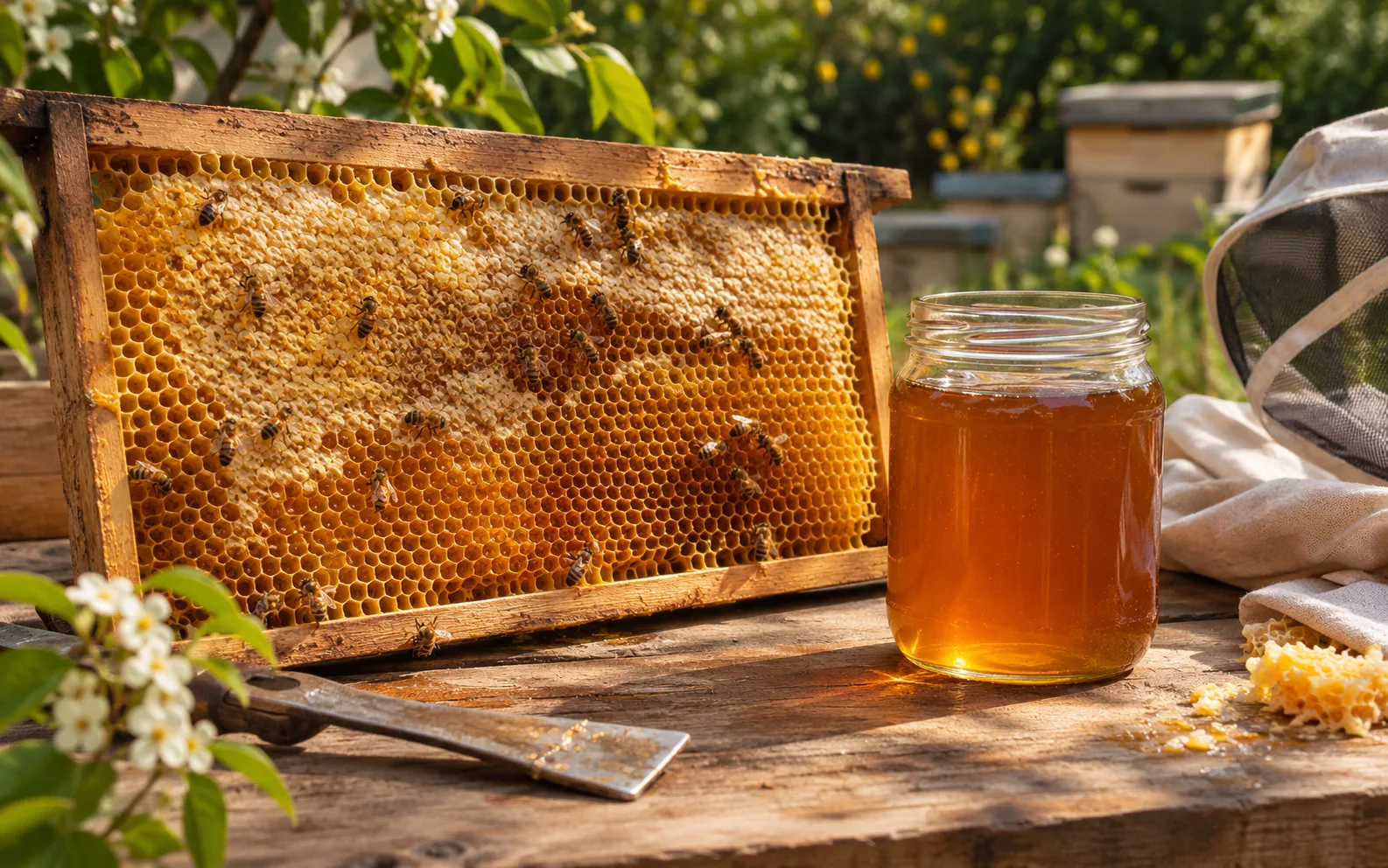
A jar of raw honey on your table is the last step of a loop that began with a flower, months before.
This is the closing post in our run on the foothills. We have walked through the flowers, the seasons, the weather and the bees. Here is how it all comes together in a jar, in seven plain steps. It is the general cycle, the way raw honey is made anywhere. Timings change every year.
 Seven steps, one loop. It starts again with the next bloom.
1. Bloom
It starts with flowers. In the foothills, the year runs from the first spring blossom through summer trees and monsoon greens to autumn scrub. Springtime in Kalka is a good place to start.
2. Forage
Bees carry nectar home in their honey stomach, usually from within a few kilometres of the hive. Calm, warm weather means more trips. Wind and rain mean fewer.
3. Ripen and cap
In the hive, bees dry the nectar by fanning their wings, until it thickens into honey. Then they seal each cell with wax. How bees dry honey.
4. Harvest
Beekeepers take frames that are mostly capped, which is the bees' own sign that the honey is ripe. Why no date can promise a flavour.
5. Extract
There are two main ways to get honey out of the comb:
- Spinning. The wax caps are sliced off and frames are spun in an extractor. The comb can go back to the bees.
- Pressing. The comb is crushed and the honey squeezed out. This is common with wild and traditional hives.
6. Strain and settle
Raw honey is coarse-strained to catch wax and bits of comb, then left to rest. Air bubbles and fine wax rise to the top and are skimmed off. What gravity really does.
7. Jar
Raw honey is bottled as it is: no heating to make it look clear, no fine filtering to strip out pollen. That is why it may set like ghee in winter, or show a little foam on top.
The one word on the label
Under India's food rules, honey taken by pressing the comb must be labelled "Pressed Honey". Spun honey needs no such word. It is a small detail, but it is a useful one: a label should tell you how the honey left the comb.
A myth worth clearing up
"Clear, runny honey is purer." No. Crystal-clear honey has often been heated or finely filtered. Raw honey can be cloudy, can set, and can carry a little foam. Those are signs of being left alone.
A ritual to close the loop
When you finish a jar, rinse it and use it again, for pickles, masalas or a small plant. The loop goes on. And when you open a new jar, take the first spoon slowly. A whole season of flowers went into it.
Common questions
Is pressed honey worse than spun honey? No. It is a different method, and it may carry more pollen and wax. It just has to say so on the label.
How long does a jar of raw honey last? Kept closed and dry, a very long time. How to store honey has the details.
Keep reading
Part of our real honey guide.
Where this comes from
- Honey from pressed combs must be labelled "Pressed Honey": Food Safety and Standards (Food Products Standards and Food Additives) Regulations, Reg 2.8.3
- Ripening, capping, extraction and settling are standard beekeeping practice. See the posts linked above for sources on each step.
- The cycle in the illustration is general and schematic, not a record of any one harvest.
Raw, unfiltered honey, bottled as it is. One season of flowers in every jar.
Find your Kalka jar, from ₹499 for ½ kg · or see what is coming next.
Not Your Beesness, sold on āsthālaya. Delivered across India.


