
Know your honey · 3 min read
The foothill wind currents: what mountain breezes really do to honeybees
It is a lovely idea: hill breezes carrying bees from flower to flower. The truth is less poetic. Bees fly by sight and scent, and past a point, wind simply keeps them at home.
By Akhil Verma, Co-founder, Not Your Beesness · · Updated
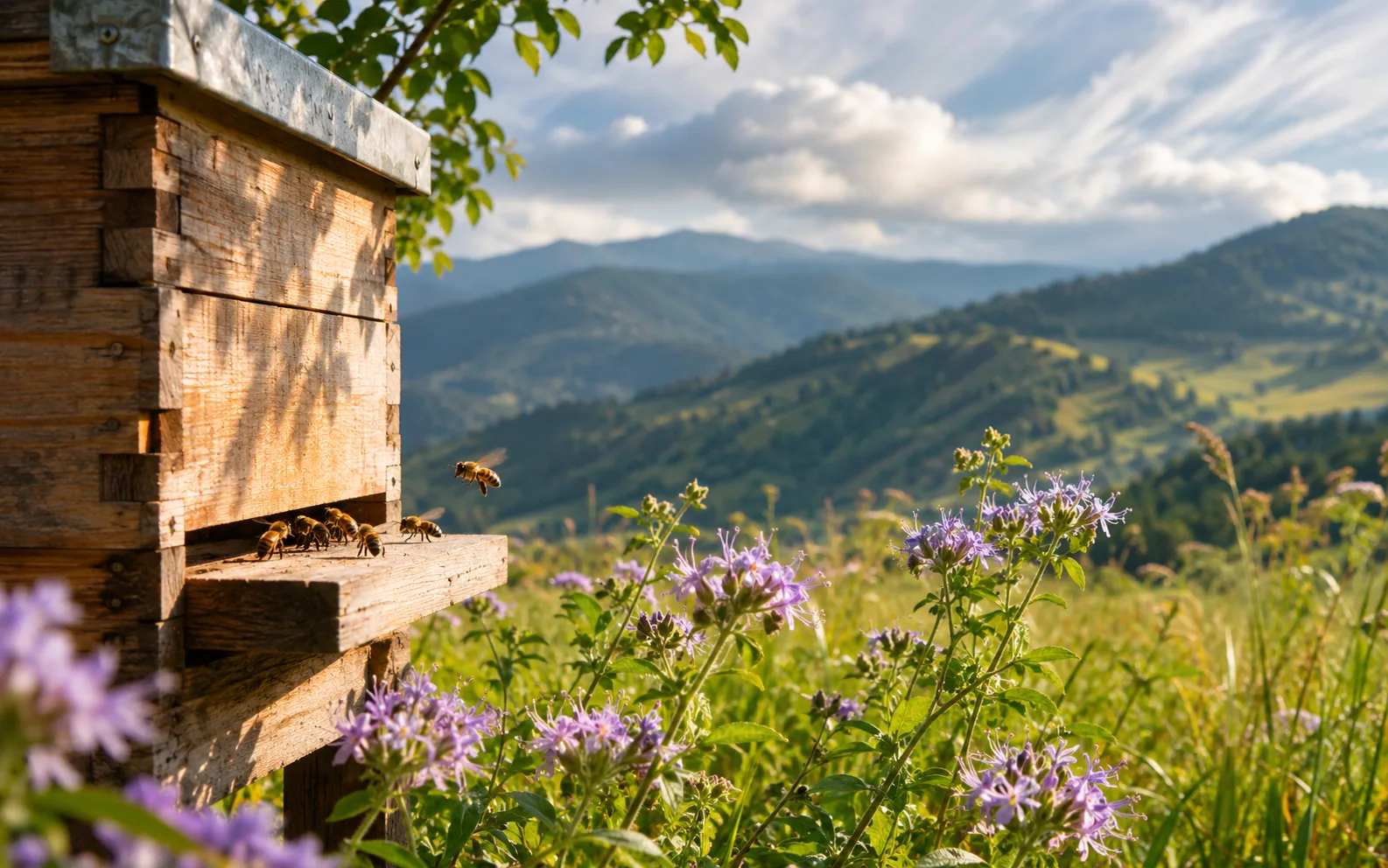
On a still spring morning in the foothills, the bees are out early. On a gusty one, the hive entrance is strangely quiet.
That quiet says a lot. Honeybees do not ride the wind to find flowers. They find them by sight, scent and the dances of their sisters back at the hive. Wind is something they work against, not with.
 Breezes don't steer bees. Past a point, they ground them.
What the studies say
- A gentle breeze is fine. In calm or light air, bees forage normally.
- As wind rises, efficiency drops. A 2025 review found that from roughly 6 to 24 km/h, bees fly less, visit fewer flowers and spend more energy doing it.
- In strong wind, foraging stops. The University of Maine's extension service puts the cut-off at about 24 km/h (15 mph).
- Take-off gets harder. In wind-tunnel work at the University of Sussex, bees grew hesitant to leave flowers as the airflow rose.
- The trip home is the hardest part. A bee loaded with nectar or pollen struggles to fly into a headwind.
So what do hill breezes do?
They set the working hours. A breezy afternoon means fewer trips. A sheltered fold in the hills, or a still morning, means more. That is one reason foothill bees often do their best work early, as the gentle slopes post describes.
It is also why beekeepers everywhere set hives behind something that breaks the wind: a hedge, a slope, a wall or a belt of trees. How a foothill apiary sits covers the rest of the checklist.
Does wind change the honey?
Not directly. Wind changes how much bees can gather on a given day, not what the nectar tastes like. The flavour still comes from the flowers. A windy season may simply mean a smaller harvest.
A myth worth clearing up
"Bees drift with the breeze from flower to flower." No. Bees steer hard to hold a straight line in wind. Strong wind does not guide them. It tires them, and it keeps them at home.
A windy-day ritual
When the wind rattles the windows, do what the bees do: stay in. Warm a cup of milk (not boiling), let it cool a little, and stir in a spoon of honey. Why not in boiling chai?
Common questions
At exactly what wind speed do bees stop? There is no single number. Studies give a range, and bees also weigh temperature, light and how far the flowers are. About 24 km/h is a common rule of thumb.
Does wind blow pollen into honey? Wind-borne pollen can settle on flowers and comb, which is why pollen from wind-pollinated plants sometimes turns up in honey analysis. It does not change the taste much.
Keep reading
Part of our guide to how bees make honey.
Where this comes from
- Wind efficiency falls from about 1.6–6.7 m/s (about 6–24 km/h): Review, 2025, PubMed
- Foraging stops above about 15 mph: University of Maine Cooperative Extension
- Bees hesitant to take off in rising wind (wind-tunnel study): University of Sussex news
- The bands in the illustration are approximate. Thresholds vary by study.
Raw, unfiltered honey, bottled as it is. Gathered on the still days.
Find your Kalka jar, from ₹499 for ½ kg · or see what is coming next.
Not Your Beesness, sold on āsthālaya. Delivered across India.


