
Know your honey · 4 min read
The gentle slopes: what really decides how long bees can work in the foothills
People sometimes say foothill bees work longer days. The truth is more interesting: bees work when it is warm and light enough, and the shape of the land can give them a head start, or cost them time.
By Akhil Verma, Co-founder, Not Your Beesness · · Updated
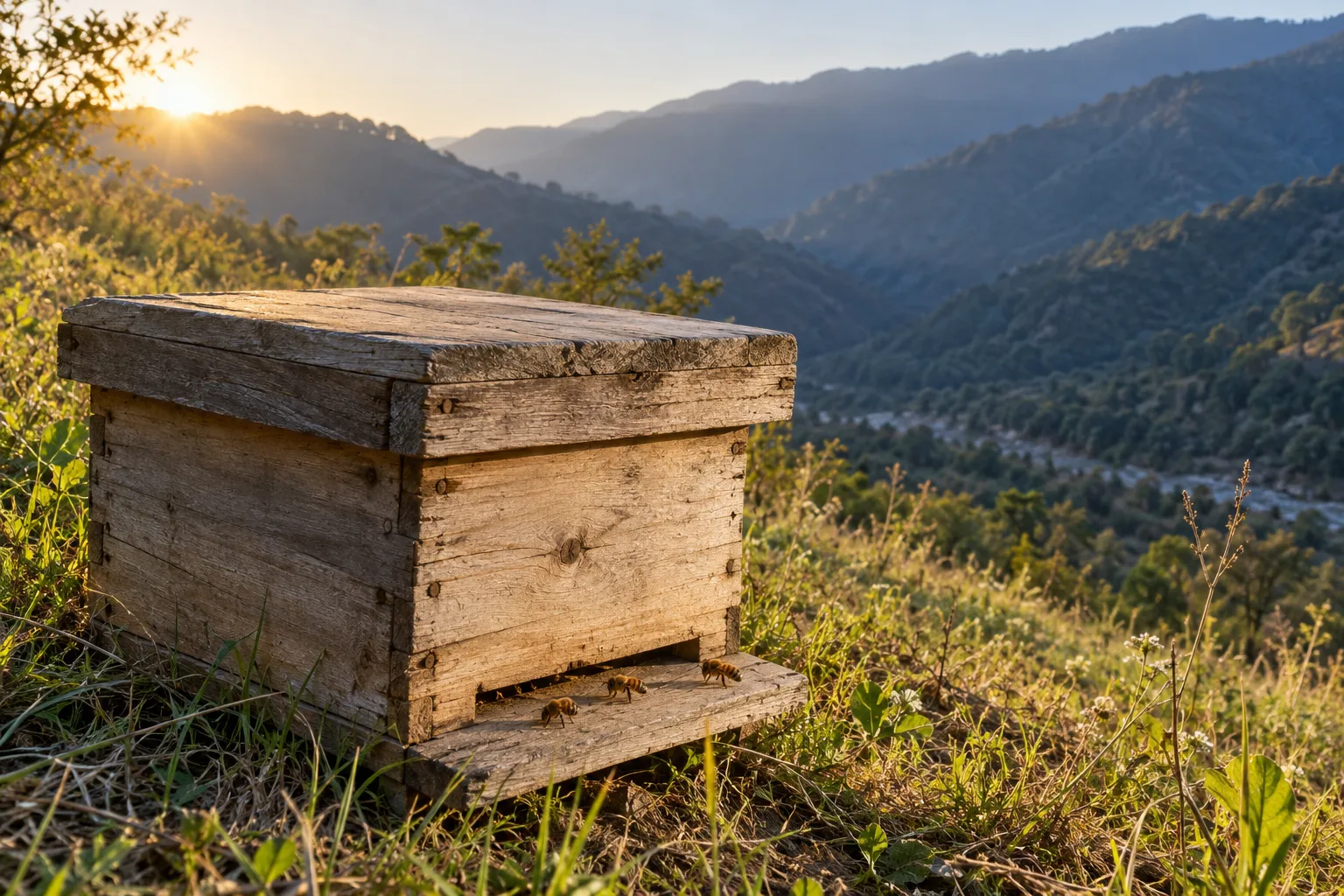
A honeybee does not keep office hours. Her working day starts when the air is warm enough and ends when the light or the heat says stop.
You may have heard that foothill bees "forage longer" because of the gentle slopes. We could not find any study that measured that. But the real story of what sets a bee's working day is worth telling, and the land does play a part.
 Bees fly when it is warm and light enough. A sunny slope can start their day sooner.
Rule one: warmth
Honeybees are cold-blooded flyers. Guidance from university extension services puts it roughly like this:
- Below about 12 to 13°C, few bees fly.
- Around 22 to 25°C is their sweet spot.
- Above about 38°C, activity starts to fall off.
So on a cold foothill morning in January, the bees wait. In May, the day may end early for the opposite reason: the heat.
Rule two: light
Bees navigate by the sun and need daylight to fly. Longer days in spring and early summer give them more hours, if the temperature cooperates.
Rule three: distance
A hive's usual foraging area stretches about 3 km in every direction, and bees sometimes go two or three times further. But long trips are expensive: they wear out wings and shorten a forager's life. Flowers close to home are worth more than flowers far away.
Where slopes come in
This is where the foothill landscape matters:
- A sun-facing slope warms up sooner in the morning. Flowers there open earlier, and the air reaches flying temperature sooner. That can give bees on that side a head start.
- A shaded slope stays cool for longer. Its flowers bloom later, which helps spread the bloom across the season. Spring climbs the hill.
- Within a 3 km circle, the foothills pack in a lot: plains-edge fields, scrub, orchards and forest, at different heights and facing different ways. That variety, more than the slope itself, is what makes the foothills generous.
What it means for your jar
Our Kalka jar comes from this mixed foothill landscape. The bees take whatever is in bloom within reach, which is why multiflora honey changes with the season and from batch to batch.
A myth worth clearing up
"Bees work from dawn to dusk." Not quite. They work when it is warm and light enough. On a cold, misty morning they may start late. The morning mist effect.
A sunny-morning ritual
Start a cold morning in the sun with a cup of warm water, nimbu and a spoon of honey, stirred in once it has cooled to sipping heat. Tradition, not medicine. (Why not boiling.) Honey is not for babies under one.
Common questions
How far do your bees fly? Like most honeybees, they typically forage within about 3 km of the hive, sometimes further.
Do foothill bees really get more hours than plains bees? We have not found a study that measures it. What we can say is that the foothills offer a long, varied bloom close together, and that matters more.
Keep reading
Part of our guide to how bees make honey.
Where this comes from
- Minimum flight temperature about 12–13°C, best 22–25°C, slowing near 38°C: University of Maine Extension
- Usual foraging area about 3.2 km, sometimes two or three times further, and the cost of long trips: Wikipedia, Forage (honey bee)
- Sun-facing and shaded slopes: general climate knowledge. The hill drawing is schematic.
Raw, unfiltered honey, bottled as it is. From a landscape that keeps flowering.
Find your Kalka jar, from ₹499 for ½ kg · or see what is coming next.
Not Your Beesness, sold on āsthālaya. Delivered across India.


