
Know your honey · 3 min read
The foothill beekeeping year: a season-by-season calendar
Beekeeping in North India's foothills runs to the rhythm of the flowers, the heat and the monsoon. Here is what a typical year looks like, from the spring rush to the lean monsoon months.
By Akhil Verma, Co-founder, Not Your Beesness · · Updated
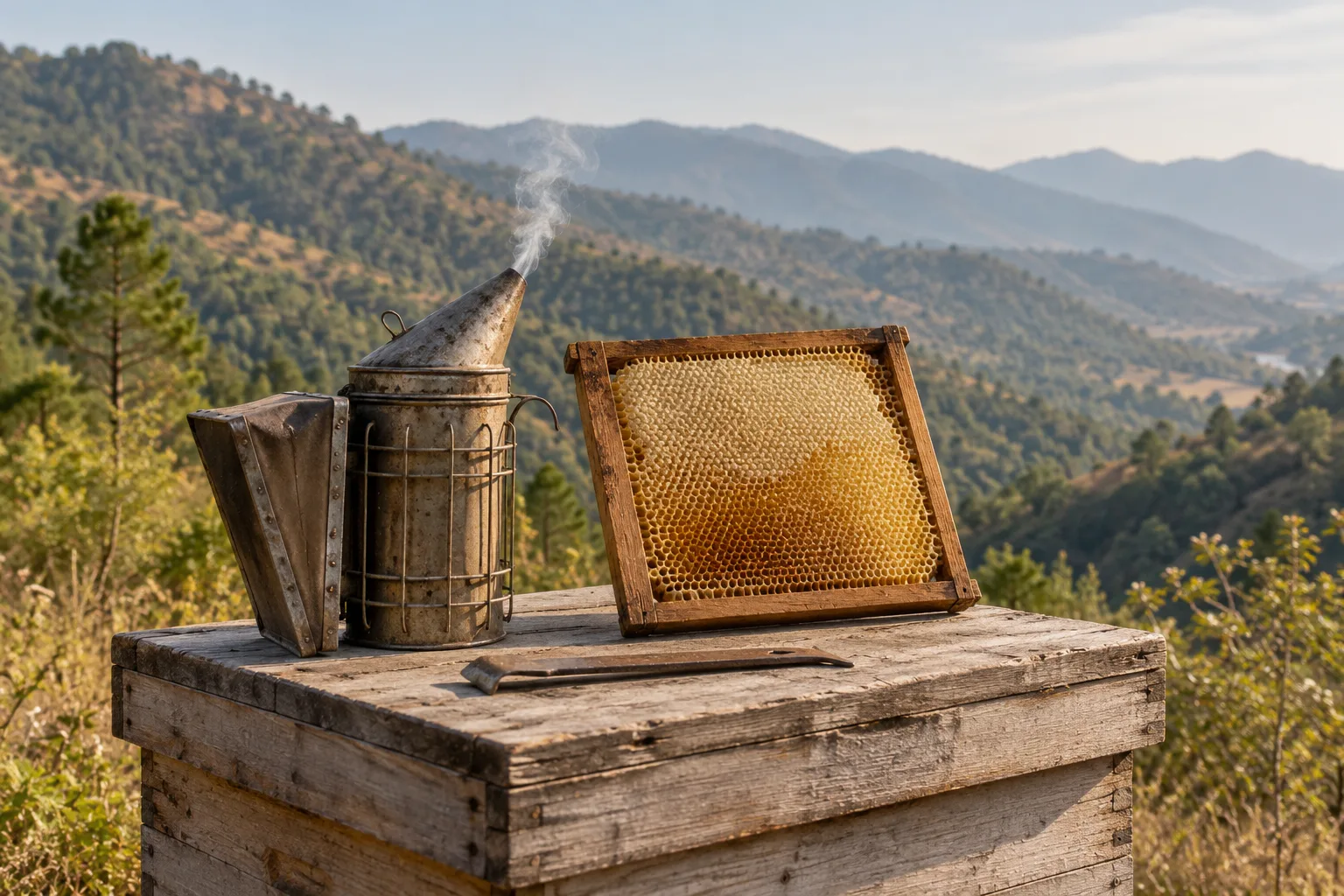
A beekeeper's calendar is not written in months. It is written in flowers.
In North India's foothills, the year swings between a generous spring, a punishing summer, a hungry monsoon and a quiet winter. Every beekeeper plans around that rhythm. This post shows a typical year. Every beekeeper's year differs with weather, place and plan.
 A typical foothill beekeeping year. Every beekeeper's year differs with weather, place and plan.
February to April: the main flow
This is the season everything builds towards. Mustard, basuti, mango, kachnar, eucalyptus and shisham bloom in waves. See the bloom calendar.
- Hives build up fast. Colonies are at their strongest around April.
- Extra boxes ("supers") go on to give the bees room to store honey.
- The first harvests come from comb the bees have sealed. What the first harvest looks like.
May and June: the heat
- Flowers thin out as temperatures soar.
- Shade and water become the beekeeper's main jobs. The bees use water to cool the hive. The May heatwave.
July to September: the monsoon gap
Studies describe a long summer and monsoon dearth across North India. In Haryana it can stretch from May to November.
- Little forage, wet days. Bees live off their stores.
- Many beekeepers move their hives to other states with better forage, or feed them to get through. A Punjab study found beekeepers migrating colonies to Rajasthan, Haryana, Himachal Pradesh, Jammu and Kashmir, and Madhya Pradesh. The monsoon wash.
September to November: autumn
- Ber and late flowers give the bees something to work again. The wild berry brush.
- Colonies rebuild after the lean months.
- Some beekeepers head to the plains to be ready for the mustard.
December and January: the cold
- Mustard on the plains gives the main winter forage. Beekeepers from as far as Kashmir bring their hives down to the mustard fields of Punjab and Rajasthan for the winter.
- Quiet days in the hills. Hives are checked and kept snug.
What it means for your jar
Our Kalka jar comes from the foothills, where the main honey season belongs to late winter and spring. That rhythm is why multiflora honey changes with the season.
A myth worth clearing up
"Bees make honey all year round." Not really. In the foothills, most honey is made in a few busy months. In the lean months, bees eat what they stored.
Common questions
Do your beekeepers move their hives? Practices vary between beekeepers. This calendar describes the region in general, not a single apiary.
Why do beekeepers feed bees? To keep colonies alive in the lean months. Careful beekeepers do not harvest honey while they are feeding.
Keep reading
- The pre-monsoon rush
- Kalka's May heatwave
- The Lahaul summer rush
- The beekeeping heritage
- The altitude gradient
Part of our guide to how bees make honey.
Where this comes from
- Colonies strongest in April; dearth from May to November in North India, May to August in Punjab: Munis Entomology & Zoology; Indian Journal of Entomology
- Punjab beekeepers migrating colonies during the dearth: Status and prospects of migratory beekeeping in Punjab
- Kashmir beekeepers moving to the plains for mustard in winter: Mongabay India; Scroll
- The calendar in the illustration is indicative and general.
Raw, unfiltered honey, bottled as it is. Made in the foothills' busiest months.
Find your Kalka jar, from ₹499 for ½ kg · or see what is coming next.
Not Your Beesness, sold on āsthālaya. Delivered across India.


