
Know your honey · 4 min read
The beekeeping heritage: from wall hives to wooden boxes in the Himachal hills
Long before wooden bee boxes and trucks, hill families kept bees in hollow logs and in hives built into the walls of their homes. Here is how beekeeping in the Himachal hills has changed, and what we still don't know about Lahaul's own story.
By Akhil Verma, Co-founder, Not Your Beesness ·
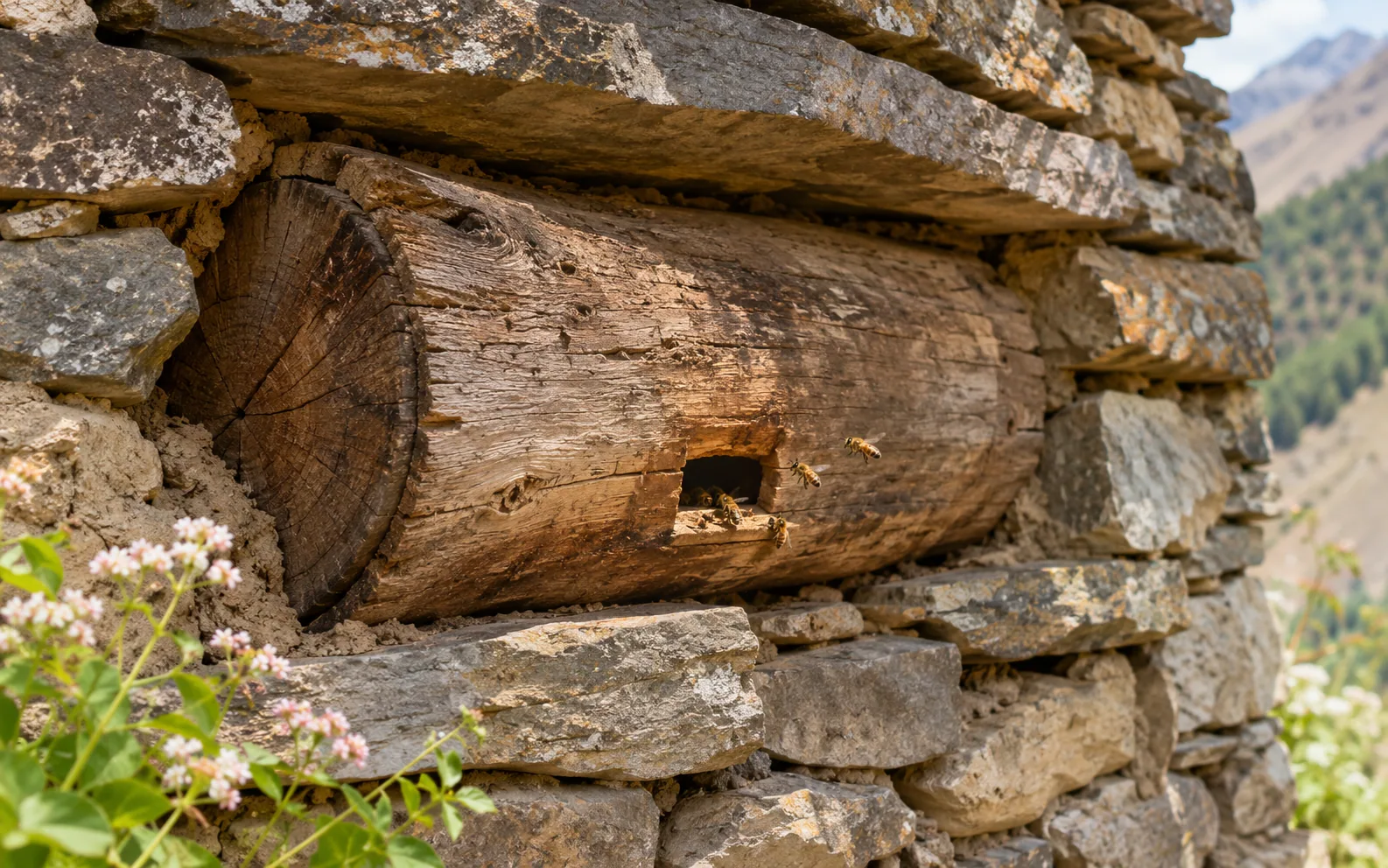
In some old Kullu villages, you can still find a small hole in a house wall with bees flying in and out. Behind it is a hive, built into the home itself.
Quick answer: Beekeeping history in Himachal runs from native bees kept in log and wall hives, to modern boxes in Kullu and Kangra in the 1930s, to the European honeybee from 1962. Wall hives still survive in some old Kullu villages.
Wall hives are one of the oldest ways of keeping bees in the Himalaya. They tell a story of how hill families lived alongside the native bee for generations, long before modern bee boxes arrived.
 From walls of homes to boxes on trucks.
The old ways
Traditionally, hill families kept the native Indian hive bee, Apis cerana, in three main ways:
- Wall hives: a cavity built into the thick wall of a house, with a small entrance outside and a door inside for harvesting.
- Log hives: a hollowed log, laid or hung near the house.
- Simple wooden boxes, made locally.
A 2023 study of the Kullu valley found all three still in use, though wall hives are now rare and found mainly in old villages.
The modern era
- Early 1880s: a popular account credits a British official, Louis Dane, with keeping native bees in modern hives in Kullu around 1883–84. We couldn't confirm it from a primary record.
- 1934–36: teaching materials date the start of modern native-bee keeping to Kullu (1934) and Kangra (1936).
- 1962: the European honeybee, Apis mellifera, was first brought to India at Nagrota Bagwan, in what is now Himachal.
- Early 1980s: a virus (Thai sacbrood) devastated native colonies. Today, the state says over 90% of managed colonies are European honeybees, except those still kept in wall hives.
And Lahaul?
We looked for a written history of beekeeping in Lahaul itself and found none. Its stories are still with the families who keep bees there, and that is where they should be told from. We'd rather wait to share real ones than invent them. The local apiary journals gives the national picture.
A myth worth clearing up
"Traditional beekeeping made better honey." Different, not better. Old methods often meant smaller harvests and pressed comb. Modern boxes let beekeepers take only ripe, capped honey and leave the colony intact. Good honey depends on care, whatever the hive.
A heritage ritual
If you visit an old hill village, ask whether anyone still keeps bees in the walls. Many elders remember. Their stories are a living archive worth recording.
Common questions about beekeeping history
Are wall hives still legal and safe? Yes. They are a traditional, low-cost way to keep native bees, and some programmes encourage them.
Why did beekeepers switch to European bees? They produce much more honey per colony, and the 1980s virus wiped out many native colonies.
Keep reading
Part of our guide to how bees make honey.
Where this comes from
- Log, box and wall hives in Kullu; wall hives rare but surviving in old villages: Studies on traditional Apis cerana beekeeping practices in Kullu valley (KrishiKosh)
- Over 90% of managed colonies Apis mellifera after Thai sacbrood virus, except wall hives: Himachal Pradesh Horticulture Department, eUdyan
- Louis Dane and Kullu, 1883–84 (popular account): The Wild Cone; 1934 Kullu and 1936 Kangra: Basics of apiculture, JVWU
- Apis mellifera first introduced at Nagrota Bagwan in 1962: Beekeeping presentation, SlideShare
- No source records a history of beekeeping in Lahaul.
Raw, unfiltered honey, bottled as it is. Part of a long hill tradition.
Find your jar: Lahaul from ₹799 or Kalka from ₹499, for ½ kg · or see what is coming next.
Not Your Beesness, sold on āsthālaya. Delivered across India.


