
Know your honey · 4 min read
The native bee advantage: Apis cerana, the Himalayan honeybee
India's own hive bee, Apis cerana, makes less honey than the imported Italian bee. But it's tougher against mites and better suited to the Himalaya's cold and swings. Here's the honest comparison.
By Akhil Verma, Co-founder, Not Your Beesness ·
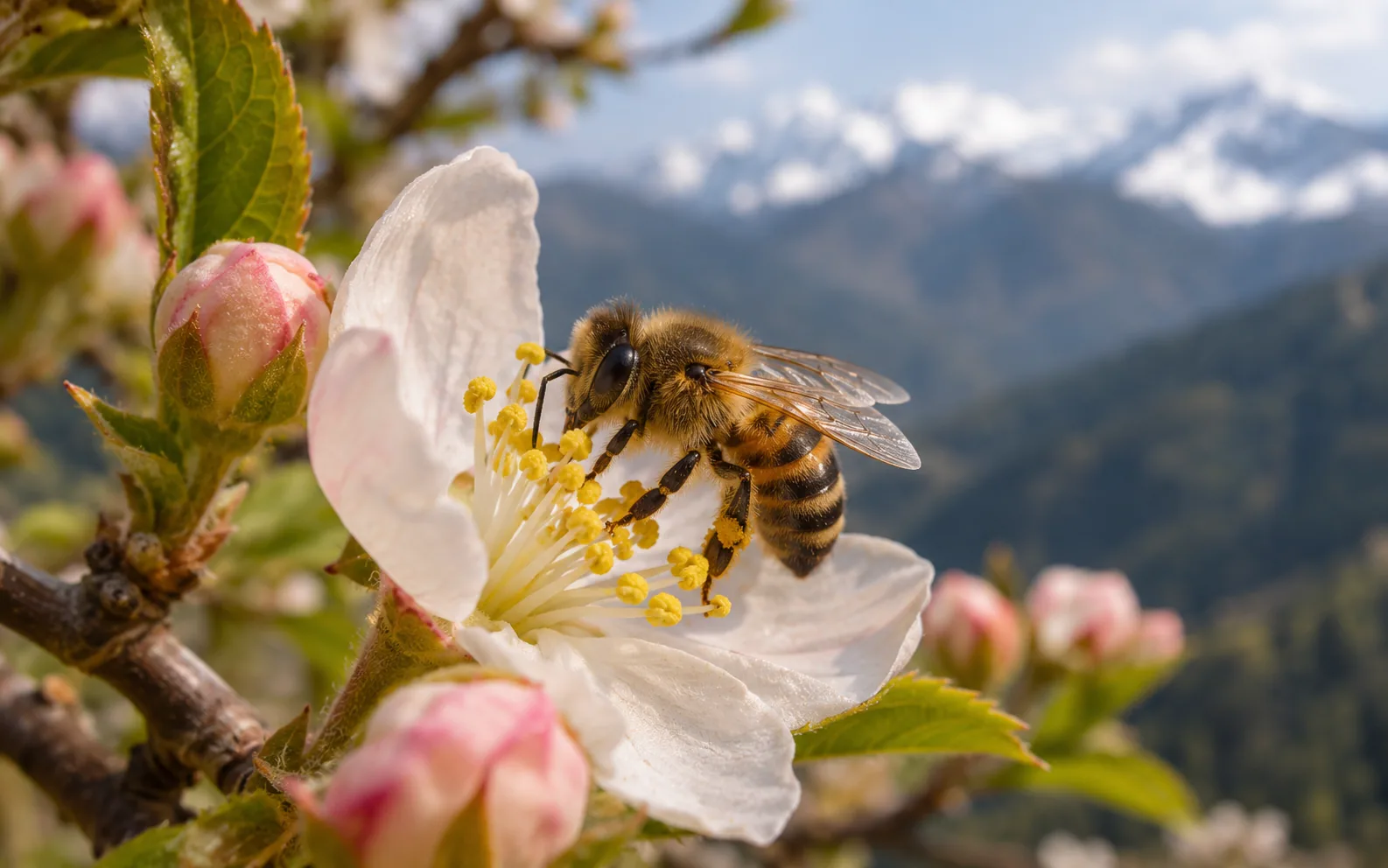
India has its own hive honeybee. It just doesn't make as much honey as the imported one.
Quick answer: Apis cerana, the Asian or Indian honeybee, makes several times less honey per hive than the Italian Apis mellifera. Its advantages are resilience: it keeps Varroa mites in check and copes with Himalayan cold and swings.
Two honeybees are kept in hives in Himachal: the native Asian honeybee, Apis cerana, and the Western or Italian honeybee, Apis mellifera, introduced in the state at Nagrota Bagwan in 1962. Both are found in Lahaul. Who keeps India's bees.
 Less honey, more resilience.
Where the native bee wins
- Mites. The Varroa mite, a major killer of Western bees worldwide, originally came from A. cerana, which keeps it in check: in its colonies, the mite breeds successfully mainly in drone cells.
- Housekeeping. A. cerana workers find and remove infested brood faster than Western bees, a trait linked to its better health.
- Cold and swings. It's adapted to the Himalaya, coping with low winter temperatures and big day-night swings. The sub-zero survival strategy.
- Old traditions. It's the bee of Himachal's wall hives and log hives. The beekeeping heritage.
Where the Italian bee wins
- Yield. Western bees build bigger colonies and make several times more honey per hive. Older estimates put A. cerana at a few kg up to about 10 kg a hive a year, and A. mellifera at 10–25 kg or more; figures vary a lot by place and method.
- That's why most commercial and migratory beekeepers use it. The nomadic keepers.
In Lahaul
A 2020 study sampled honey from both species in Lahaul and Spiti, and found A. cerana kept up to about 11,000 ft. The 11,000-foot challenge.
What we can't claim
The topic we were given says native bees "harvest more efficiently". On honey per hive, the evidence says the opposite. The native bee's advantage is resilience, not yield.
A myth worth clearing up
"Native bee honey is always better." Not automatically. Honey is shaped by flowers and handling. The bee's species affects how much there is, more than how good it is.
A beekeeper's ritual
If you visit a village apiary in the hills, ask which bee is in the boxes. A. cerana is smaller and darker-striped; A. mellifera is larger and more golden.
Common questions about Apis cerana
Is Apis cerana the same as the Indian rock bee? No. The rock bee is Apis dorsata, a wild, open-nesting giant honeybee.
Which bee makes our honey? We haven't published the species for each batch, so we don't claim one.
Keep reading
- The local apiary journals
- The beekeeping heritage
- The sub-zero survival strategy
- The nomadic keepers
Part of our guide to how bees make honey.
Where this comes from
- Varroa breeding successfully mainly in drone cells of A. cerana: Individual-level comparisons of hygienic behaviour (PMC); faster hygienic behaviour in A. cerana: University of Pretoria repository, "Go East for better honey bee health"
- Yield estimates for A. cerana (4–10 kg) and A. mellifera (10–25 kg): Bees for Development, 1994; later Indian studies report higher figures: Indian Journal of Extension Education
- A. mellifera introduced at Nagrota Bagwan in 1962; A. cerana in Lahaul to about 3,400 m (Parihar et al. 2020); A. cerana coping with cold: see sources in Who keeps India's bees, The 11,000-foot challenge and The sub-zero survival strategy
- Yield figures vary widely and are indicative only.
Raw, unfiltered honey, bottled as it is. From the hardiest hills in India.
Find your jar: Lahaul from ₹799 or Kalka from ₹499, for ½ kg · or see what is coming next.
Not Your Beesness, sold on āsthālaya. Delivered across India.


