
Know your honey · 5 min read
Kalka's early March nectar: what the first harvest of the year looks like
By early March, the foothill hives have been busy for weeks. Here is what a first spring harvest in the Kalka foothills typically looks like, from a sealed comb to the jar on your table.
By Akhil Verma, Co-founder, Not Your Beesness · · Updated
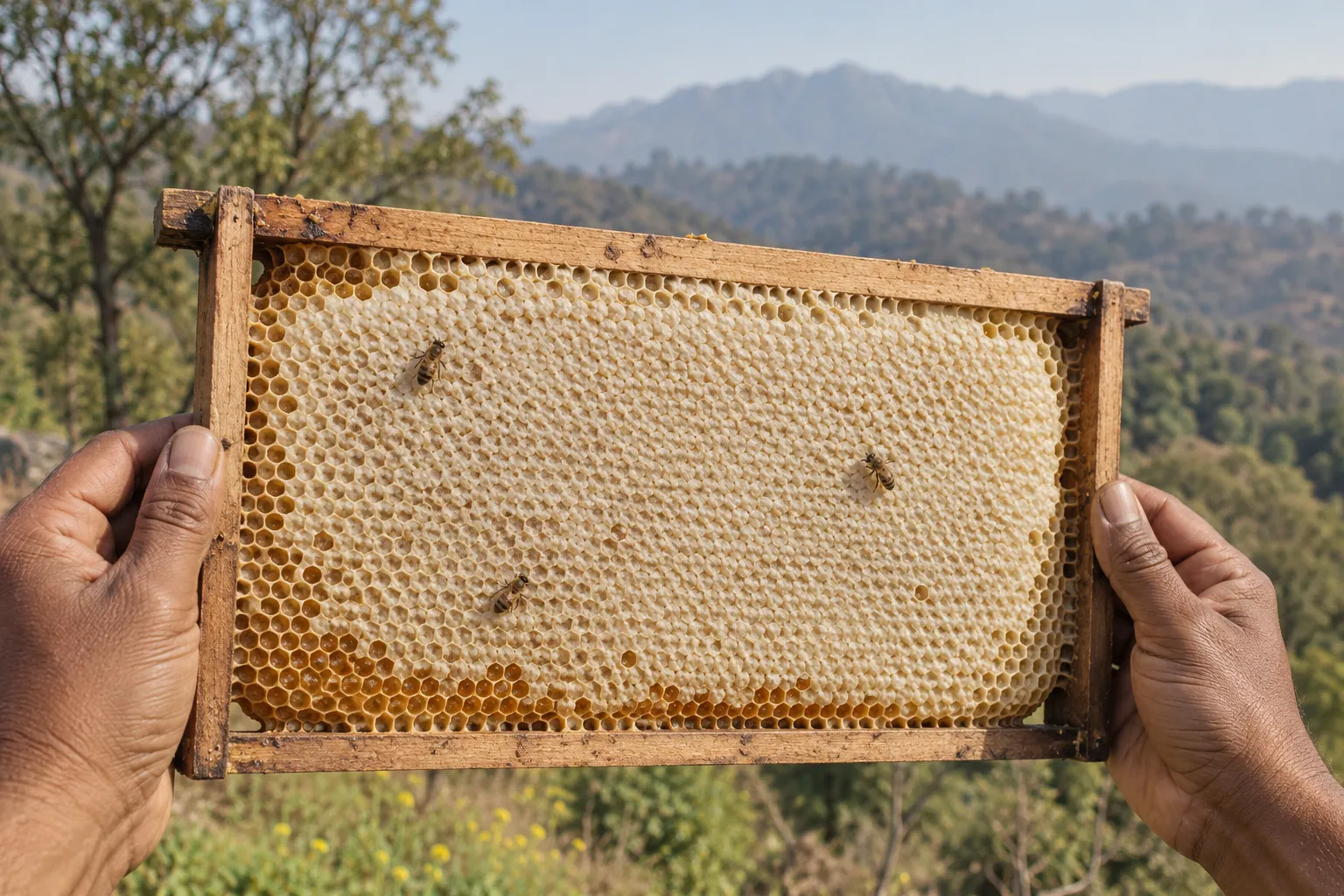
The first honey of the year smells like the month it was made in: mango blossom, warm scrub and the last of the mustard fields.
By early March, the Kalka foothills have been flowering for weeks. Basuti is out on the slopes, the orchards around Pinjore are heavy with mango baur, and kachnar is starting to colour the hills pink. Inside the hives, the bees have been working since the first warm days of February.
This is the season of the first harvest. Here is what it typically looks like, step by step.
 From the first bloom to the jar, in six steps. Timing and methods vary by beekeeper and by year.
1. The bloom builds
A spring harvest starts weeks before anyone opens a hive. As the days warm, the hives grow busy and strong, and the bees bring in nectar from whatever is blooming nearby. In the foothills that means basuti, mango blossom, early kachnar and the last of the mustard. Here is what flowers when.
2. The bees decide when it is ready
Nectar is not honey yet. The bees fan it for days to dry it out, and when it is ripe, they seal each cell with a cap of wax.
Those wax caps are the bees' own "ready" sign. A careful beekeeper waits for them. Honey taken too early is thin and watery, and can ferment in the jar. More on why ripe honey is thick.
3. Only sealed comb, and never all of it
On harvest day, a little smoke calms the bees. The beekeeper lifts out only the comb that is mostly sealed.
Just as important is what stays behind. In this part of North India, colonies are at their strongest around April. By June the flowers run out and hives can be left with no stores at all. A good beekeeper always leaves the bees plenty to live on. The first harvest takes the surplus, not the savings.
4. Spun out, not cooked
The thin wax caps are sliced off and the honey is spun out of the comb, with no heat at all. Heat is the shortcut factories use to make honey pour faster and stay runny on the shelf. It also dulls the flavour and aroma, which is most of what makes spring honey special.
5. One coarse strain, then a rest
The honey goes through one coarse strain to catch bits of wax. Then it rests. Over the next day or so, the tiny air bubbles from spinning rise to the top.
That is why raw spring honey often has a thin layer of foam. It is just air, and it is perfectly good to eat. More on foam.
6. Into the jar
Then it is bottled raw. One coarse strain, bottled raw is how we describe our own honey, and it is the whole idea: nothing added, nothing taken out but wax.
What early spring honey is like
- Colour: often on the lighter side when mustard and blossom lead, but it varies batch to batch.
- Texture: can set quickly in a cool kitchen. Mustard honey is known for setting fast. That is natural, not a fault. Here is why honey sets.
- Aroma: floral and fresh, strongest the moment you open the jar.
Two myths about fresh honey
"Fresh honey should be perfectly clear." Not true. Raw honey that has only been coarse-strained is slightly cloudy and may carry a thin foam. Crystal-clear honey has usually been heated and finely filtered.
"If it has set, it must be old." Not true. Some spring honey can set within a short time of bottling, especially if it is rich in mustard nectar. Setting tells you about the flowers and the cold, not the age.
A spring ritual for the first jar
Early March often means Holi. If you make thandai at home, try sweetening it with a spoonful of honey instead of sugar. Stir it into the cold milk well, since honey takes a moment to dissolve. It suits the floral, spiced flavours.
For the changing weather, there is always adrak aur shahad: a little fresh ginger juice with a spoon of honey. Tradition, not medicine, and always stirred in warm, never boiling. (Here is why.)
And honey is not for babies under one.
Common questions
When exactly is your Kalka honey harvested? The bees and the weather decide, not the calendar. We list the usual harvest months for our coming batches on the shop page. Eucalyptus, for example, is usually harvested between February and April.
Does spring honey taste different from honey later in the year? Yes. Our Kalka jar is multiflora, so it tastes of the weeks it was made in. A spring batch and an autumn batch from the same hills will not be identical. That is the point of raw honey.
Why don't you heat honey to keep it runny? Because heat changes it. Long, high heat darkens honey and dulls its flavour and aroma. If yours sets, a warm-water bath brings it back gently.
Keep reading
- The post-rain cleanse
- The toy train wildflower trail
- Springtime in Kalka
- The early freeze alert
- The spring equinox harvest
Part of our Kalka honey guide.
Where this comes from
- Colonies strongest in April and without stores by June in Haryana: Munis Entomology & Zoology
- Mustard honey sets fast: Honey notes, My honey has set. Is it spoiled?; Indian exporter listing
- "One coarse strain. Bottled raw.": Not Your Beesness, comb to jar
- Eucalyptus harvest months: Not Your Beesness shop
- The steps in the illustration show a typical foothill harvest. Timing and methods vary by beekeeper and by year.
Raw, unfiltered honey, bottled as it is. One coarse strain, and nothing else.
Find your Kalka jar, from ₹499 for ½ kg · or see what is coming next.
Not Your Beesness, sold on āsthālaya. Delivered across India.


