
Know your honey · 6 min read
The toy train wildflower trail: following the honey up the Kalka–Shimla line
The little train from Kalka climbs more than 4,600 feet to Shimla. Ride it in spring and you pass through three kinds of hillside, each in flower at its own time. Here is what to look for, and where our honey fits in.
By Akhil Verma, Co-founder, Not Your Beesness · · Updated
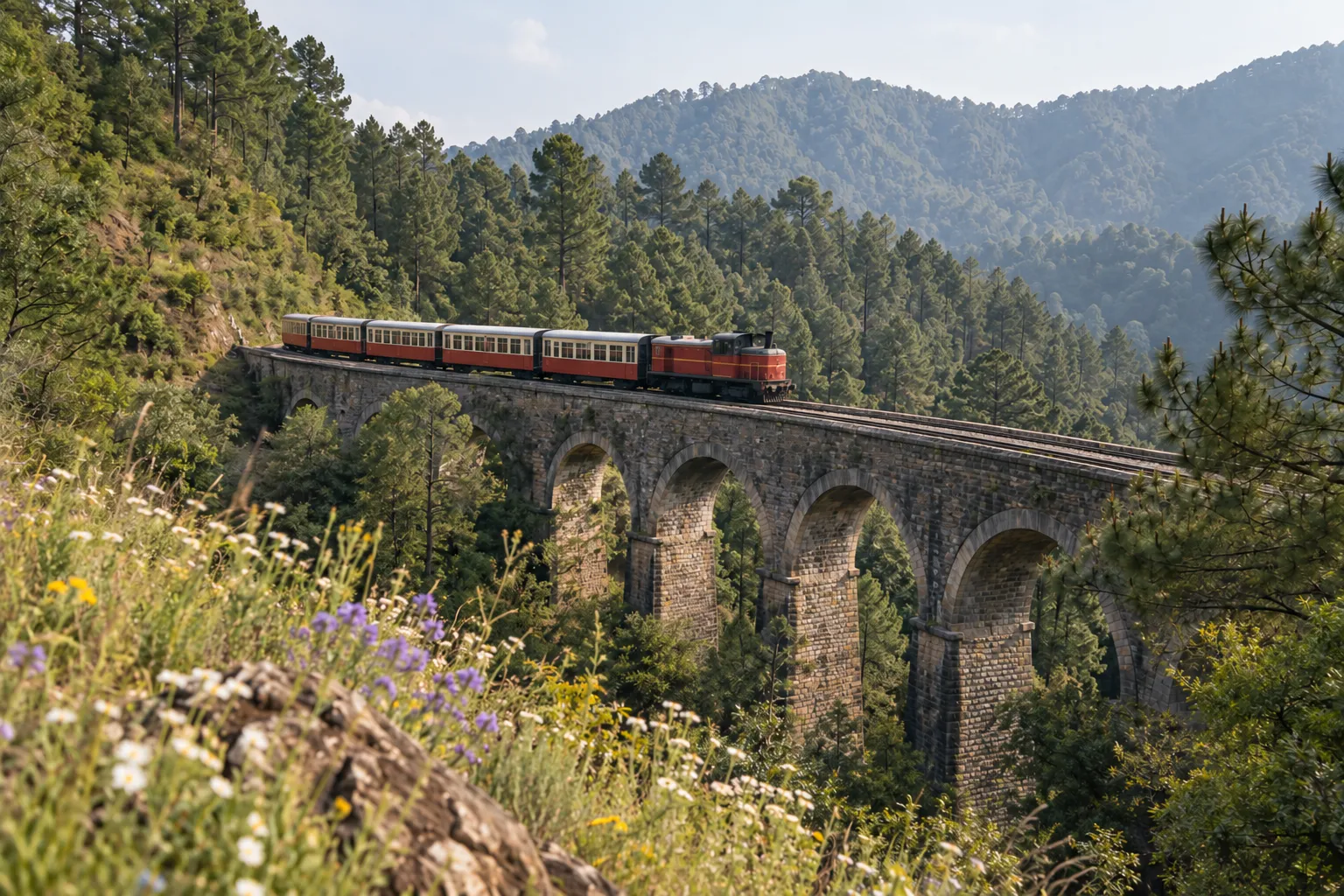
Every morning, a narrow-gauge train leaves Kalka station and spends the next five to six hours climbing into spring.
The Kalka–Shimla Railway opened in 1903 and has been a UNESCO World Heritage Site since 2008. It runs about 96 km through over a hundred tunnels and across hundreds of bridges, curving almost the whole way. Most people ride it for the views. We like it for something else: it is a moving window onto everything the bees see.
Our Kalka jar comes from the foothills where the line begins. The rest of the trail shows you how the land, and the flowers, change above it.
 One railway, three hillsides. Our Kalka jar comes from the first stretch.
Stretch one: the foothills, Kalka to Koti
About 2,150 feet and climbing. Best in February and March.
The train pulls out of Kalka and starts to wind almost at once. This is the Shivalik scrub our bees know best:
- Basuti (adusa), with its white, lipped flowers in the bushes beside the line.
- Kachnar, splashing the slopes with pink and purple.
- Semal, the tall bare trees carrying big red flowers with not a leaf in sight.
- Mango blossom in the orchards on the way into Kalka, which you will smell before you see.
This is where our Kalka honey comes from: a long, warm foothill season, with something always in bloom. Here is the full story of why that matters.
Stretch two: the middle hills, Dharampur to Solan
Dharampur station sits at about 4,860 feet. Best in March and April.
The air cools, the scrub thins and chir pine takes over the slopes. Pine makes for beautiful views, but it offers bees no nectar. So look for the small trees standing out in white:
- Kainth (wild Himalayan pear), covered in clusters of white blossom with dark red centres, on the edges of fields and forest.
A little after Dharampur, the train runs through the Barog tunnel, the longest on the line at about 1.1 km, and comes out just before Barog station.
Stretch three: the upper hills, Kandaghat to Shimla
Shimla station sits at about 6,810 feet. Best from late March into April.
The last stretch climbs through oak and deodar towards Shimla. Here, the star is unmistakable:
- Burans, the red tree rhododendron, glowing on the hillsides around Taradevi and the slopes near Shimla. Many hill families turn its petals into a bright red sharbat.
Up here, spring arrives weeks after it reached Kalka. By the time burans is at its peak, the foothill bloom down at the start of the line is already winding down.
The trail in one sentence: the toy train climbs about 4,600 feet in 96 km, and spring climbs with it, a few weeks behind at every turn.
Why this matters for your jar
A honey tastes of its stretch. The bees that made our Kalka honey worked the foothill scrub and orchards of stretch one. Honey from higher up would taste of different flowers. That is why we name the place on every jar and keep each batch apart.
Higher is not "purer." You may hear that honey from higher in the hills is automatically better. It is not. Altitude changes the flowers and the flavour. What makes honey real is how it is handled: no added sugar, no heavy heating, no fine filtering. Our Lahaul jar comes from above 10,000 feet and our Kalka jar from about 2,150 feet. Both are raw and unfiltered, and neither is "better." They are just different places. More on the two jars.
Taking honey on the journey
Honey is the perfect travel food: it needs no fridge and keeps for a very long time if you treat it well.
- Pack it in a well-sealed glass jar, inside a cloth bag in case of sticky surprises.
- Use a clean, dry spoon. A drop of water or chai in the jar is what spoils honey. Here is how to store it.
- Don't worry if it sets on a cold morning in the hills. That is natural. Here is why.
A daadi ka nuskha for the curves
The toy train curves so often that some passengers start to feel it. Many families pack the same small remedy for the journey:
- Adrak aur shahad. A thin slice of fresh ginger with a little honey, chewed slowly as the train winds uphill.
It is tradition, not medicine, but it has ridden a lot of hill trains. And, as always, honey is not for babies under one.
Common questions
When is the best time to ride for flowers? From late February to mid-April. Go early in that window for the foothills, late for burans near Shimla. Mid-March often gives you a little of everything.
Can I see bees from the train? Sometimes, in the flowering scrub near the stations on a sunny morning. Please enjoy them from the train or the platform: it is a working railway, and the tracks are not a footpath.
Do you make burans or wild pear honey? Not at the moment. Our two jars today are Kalka and Lahaul multiflora, with eucalyptus and jamun on their way.
Keep reading
Part of our Kalka honey guide.
Where this comes from
- Length (96.6 km), opening in 1903 and UNESCO listing in 2008: Wikipedia, Kalka–Shimla Railway; UNESCO nomination document
- Kalka at 656 m: UNESCO nomination document. Shimla at 2,076 m: Vajiram & Ravi. Dharampur at 1,482 m: Wikipedia
- Tunnel and bridge counts differ between sources, from 102 to 109 tunnels and from about 850 to 969 bridges: Bharatpedia, Google Arts & Culture, Outlook Traveller
- Wild pear (Pyrus pashia), flowering March to April at 1,200–3,300 m: ICIMOD
- Burans near Shimla, late March to April: Outlook, Curly Tales
- Bloom months in the illustration are indicative. The weather decides the exact week.
Raw, unfiltered honey, bottled as it is. From the foothills where the toy train begins.
Find your Kalka jar · or give both places in one box: the Diwali gift box, 1 kg Lahaul + 1 kg Kalka.
Not Your Beesness, sold on āsthālaya. Delivered across India.


