
Know your honey · 6 min read
The monsoon wash: how the rains change what the foothills offer bees
For us, the monsoon means relief from the heat. For bees in the Kalka foothills, it means the leanest weeks of the year. Here is what the rains do to the flowers, and why the wettest months make the best spring possible.
By Akhil Verma, Co-founder, Not Your Beesness · · Updated
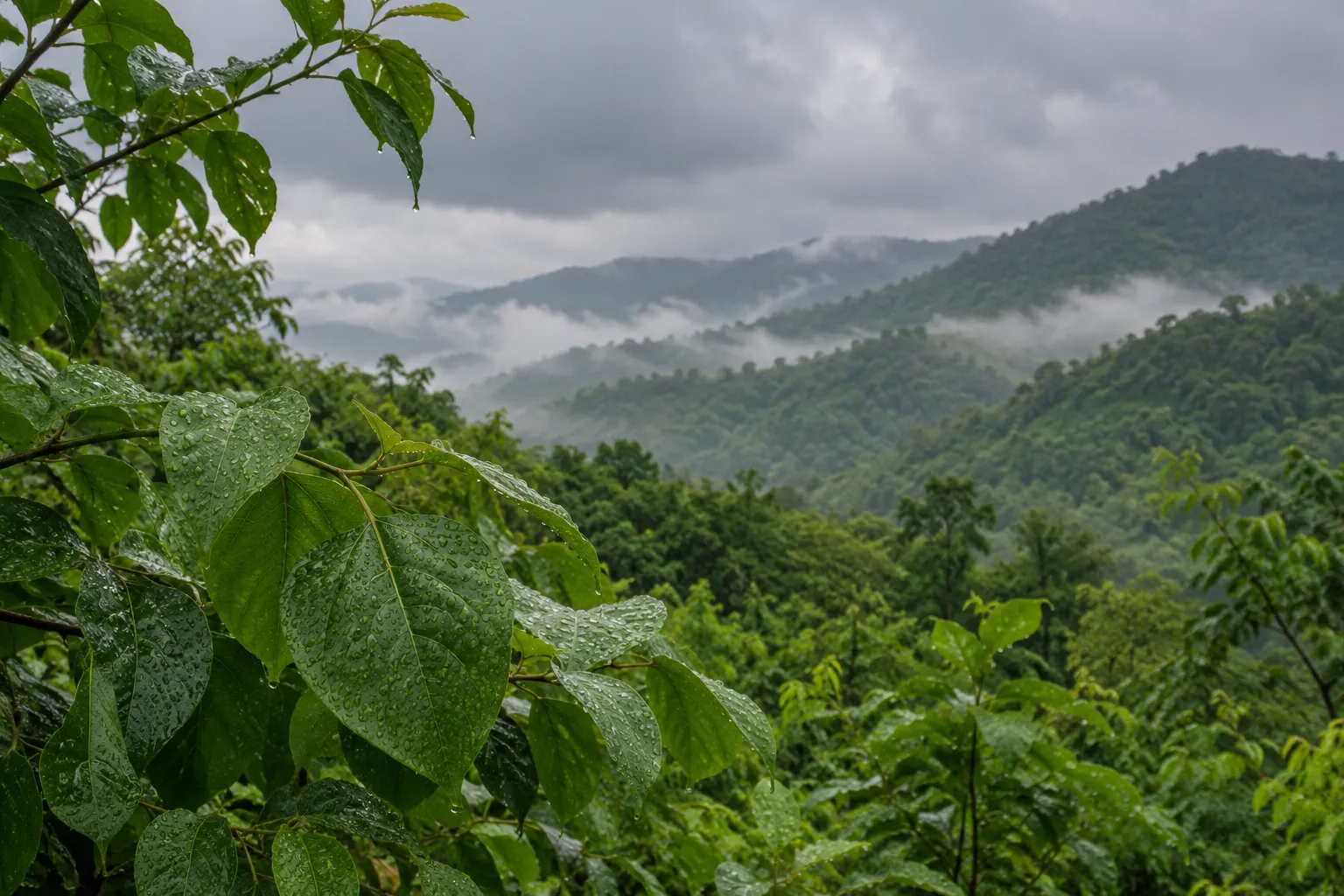
In July, the Kalka foothills are at their greenest, and the bees are at their hungriest.
It sounds backwards. The hills are soaked, every slope is lush, and yet for honeybees this is the hardest stretch of the year. Here is why the rains change everything, and why the bees, and the people who care for them, treat the monsoon as a season to get through, not a season to harvest.
 Rain at Chandigarh, the nearest major weather station to Kalka, set against the bees' year. About 82% of the rain falls from June to September.
The numbers: four wet months
At Chandigarh, the nearest major weather station to Kalka, an average year brings about 1,040 mm of rain. Some 850 mm of that, around 82%, falls from June to September. July and August are the heaviest, at about 275 mm each, spread over 10 to 11 rainy days a month.
The other eight months are dry by comparison. That pattern shapes the bees' whole year.
What the rain does to the bees' day
1. It keeps them at home. Bees don't forage in heavy rain. A string of wet days means a string of days with almost nothing coming into the hive.
2. It can wash the flowers out. Rain can dilute or wash away the nectar sitting in open flowers, and soak the pollen. A flower that has been rained on may have little left to give.
3. The big bloom is over. The great spring flow of mustard, basuti, mango blossom, kachnar and jamun has finished long before the rains arrive. Here is what flowers when.
Beekeepers across North India call this stretch the dearth: the lean months when bees use up more food than they bring in. A study near Kaithal in Haryana followed bees through the June-to-October dearth. It counted 71 kinds of plants, mostly weeds, garden flowers and crops, that kept them going with small amounts of nectar and pollen. Not a feast. Just enough.
Why good honey is not taken in the rains
Two reasons, and both are good news for your jar.
Damp air makes thin honey. Bees dry nectar into honey by fanning it. In the humid monsoon air, that drying is harder work, and honey pulls in moisture from damp air. Honey taken in the rains is more likely to be thin and to ferment. More on why ripe honey is thick.
The bees need every drop. In the leanest weeks, a colony lives off the honey it stored in spring. Some beekeepers even move their hives to other regions, or feed them, to keep them alive through the gap. This is exactly why careful beekeepers take honey from the spring flow, not from the monsoon. The jar should hold what the flowers gave, nothing else.
The rains pay for the spring
Here is the part that makes the monsoon worth it.
The rains soak the foothills for the year ahead. As the monsoon fades in September, the ber bushes burst into tiny green-yellow flowers, and the bees get their autumn feed. Meet the shrubs of the scrub. The winter that follows is dry, but the soil holds that water. When spring comes, the shrubs, orchards and trees have what they need to flower hard.
No monsoon, no spring flow. The lean weeks in July are the price of the sweet weeks in March.
Your jar in the monsoon
The monsoon is also when honey at home needs a little more care.
- Close the lid tightly after every use. Honey pulls moisture out of humid air.
- Always use a clean, dry spoon. One wet spoon is the most common way water gets in.
- Keep it in a cupboard, away from the stove and the steam of the kitchen.
The full guide to storing honey.
Two monsoon myths
"Honey goes bad in the monsoon." Not on its own. Honey keeps for a very long time as long as water stays out. It is the wet spoon and the open lid that cause trouble, not the season.
"If honey tastes sour or fizzy, it was fake." Not necessarily. A sour smell or bubbles that keep rising usually mean water got in and the honey has started to ferment. That is a storage problem, not proof of fake honey. Don't eat a jar that smells off. If it arrived that way, contact the seller.
A daadi ka nuskha for wet weather
When the rains bring sniffles, many homes reach for a monsoon kadha: tulsi, fresh adrak and a few kali mirch, simmered in water. Let it cool to warm, then stir in a spoon of honey. Never into the boiling pot. (Here is why.)
Tradition, not medicine. And honey is not for babies under one.
Common questions
When do the foothills make most of their honey? In the dry months before the rains, from late winter through spring. Our Kalka jar is raw multiflora from those foothills. More on the Kalka season.
Does a heavy monsoon mean a good spring? Often it helps, by soaking the soil. But spring also depends on the winter: a cold snap or unseasonal rain during the bloom can still cut a season short. The bees and the weather decide.
What about Lahaul? Lahaul sits in the rain shadow of the high Himalaya, so it barely gets a monsoon. Its bees have a different problem: a long winter and one short summer. Two places, two jars.
Keep reading
- Kalka's May heatwave
- The unpredictable year
- The October cleansing
- Two places, two jars
- The post-rain cleanse
Part of our guide to how bees make honey.
Where this comes from
- Monthly rainfall and rainy days at Chandigarh, IMD normals for 1991–2020: Wikipedia climate table, from IMD. June, August and September normals are also reported by The Tribune.
- The June–October dearth near Kaithal, and the 71 bee plants that bridge it: Rathee, Chaudhary and Dalal, Indian Journal of Entomology, 2023
- Colonies without stores by June in Haryana: Munis Entomology & Zoology
- Moving hives to other regions during the dearth: Status and prospects of migratory beekeeping in Punjab
- Lahaul in the rain shadow: Not Your Beesness, Our honeys
- The bee seasons in the illustration are indicative.
Raw, unfiltered honey, bottled as it is. From the foothills, where the honey season belongs to the dry spring.
Find your Kalka jar, from ₹499 for ½ kg · or give both places in one box: the Diwali gift box.
Not Your Beesness, sold on āsthālaya. Delivered across India.


