
Know your honey · 5 min read
Foot of the mountains: what really makes Kalka honey thick and smooth
People love how our Kalka honey pours: slow, golden and silky. It is tempting to credit the low hills. The truth is simpler, and you can check every part of it in your own kitchen.
By Akhil Verma, Co-founder, Not Your Beesness · · Updated
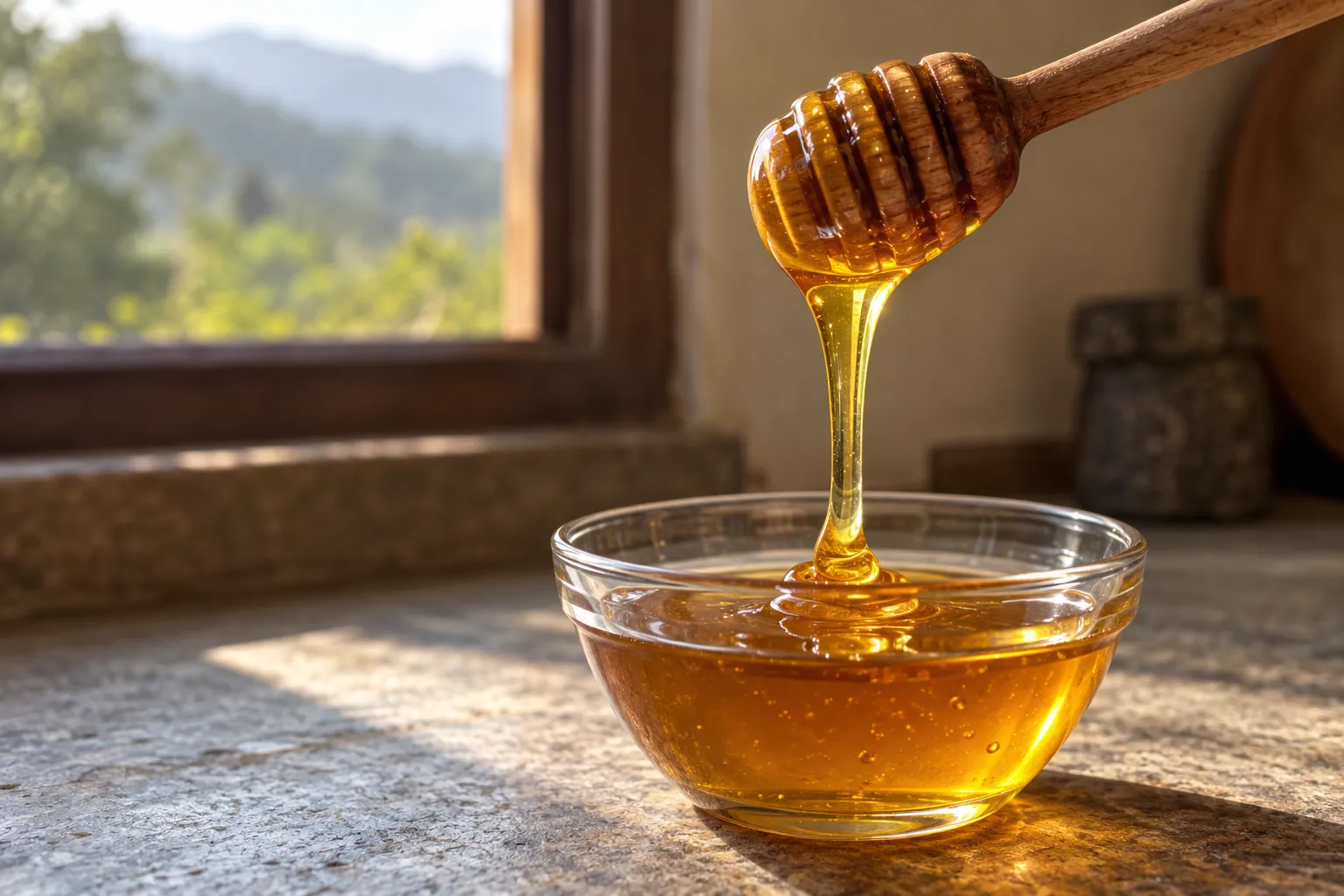
Hold a spoon of our Kalka honey over a bowl, and it does not drip. It folds, slowly, like a golden ribbon laying itself down.
That slow, silky pour is one of the first things people notice. A common guess is that it comes from where the honey is made, at the foot of the mountains. The low hills do play a part, but not the part most people think.
Altitude on its own does not make honey thick. Three everyday things do, and you can see every one of them at home.
 Water, warmth and flowers. All three show up in your kitchen.
Water: the bees do the thickening
Nectar straight from a flower is thin and watery. In the hive, bees fan their wings over it for days, drying it slowly until it turns into honey. When it is ready, they seal each cell with a wax cap.
The less water left in the honey, the thicker it pours. Ripe honey is less than a fifth water, which is also the most India's food standard allows.
See it at home: lift a spoonful and watch it fall. Ripe honey folds and stacks on itself before it sinks in. Watery honey splashes and runs flat.
That is why good beekeepers wait for the bees. Honey taken before the cells are sealed is thinner, and thin honey can ferment in the jar.
Warmth: the same jar, a different pour
Here is something every North Indian kitchen proves each year.
The same jar pours slowly on a December morning and runs freely in May. Nothing inside has changed. Honey is simply very sensitive to temperature. Food scientists who measure honey's thickness find that temperature matters more than anything else.
- Winter: thick and slow, and it may start to set. That is natural. Here is why.
- Summer: runny and quick off the spoon.
- Want it thinner today? Stand the jar in warm, not boiling, water for a few minutes.
Flowers: why some jars set like butter and others like ghee
When raw honey sets in the cold, its texture depends mostly on the flowers it came from and how cold it got:
- Some honeys set into tiny crystals, smooth and spreadable like soft butter.
- Others set into bigger grains, like ghee on a winter morning.
Both are natural and both are good. Our Kalka honey is multiflora, made from whatever the foothills had in bloom, so the way it sets can change a little from batch to batch. A few minutes in warm water brings either kind back to a smooth pour.
So where does the foot of the mountains come in?
Here is the honest answer: through the season, not the altitude.
Kalka's main honey season runs from January to April, through the dry, warm months before the monsoon. That is good weather for bees to ripen their nectar well. The long, rolling foothill bloom gives them plenty to work with. Here is what flowers when.
Then we keep out of the way: one coarse strain, bottled raw. No heating to make it pour faster, and no fine filtering. Whatever thickness the bees gave it is the thickness you get.
Two myths about thick honey
"Thick honey is pure honey." Not true. Many sugar syrups are thick too, and some adulterated honey is made thick on purpose so it looks convincing on the spoon. Thickness tells you about water and temperature, not purity.
"Runny honey must be fake." Also not true. Some genuine honeys are naturally more fluid, and any honey runs in a hot kitchen. A runny jar in May is just a warm jar.
Kitchen tricks cannot prove purity either way. Here is what can, and what cannot.
Keep it thick: one rule
Keep water out. Honey pulls moisture from damp air, and a wet spoon adds more. Close the lid after every use and always use a clean, dry spoon, especially in the monsoon. The full guide to storing honey.
Where a thick honey shines
- On a hot paratha or roti, where it melts slowly instead of running off.
- Over curd or a bowl of fruit, where it sits in a ribbon on top.
- Daadi's spoonful: a little honey with fresh ginger juice for a winter throat. Stir it in warm, never boiling. (Here is why.)
More ideas in five small ways with a spoon of honey. And as always, honey is not for babies under one.
Common questions
Is Lahaul honey thinner because it comes from higher up? No. Altitude does not decide thickness. Our Lahaul jar is deeper and more aromatic because of its alpine flowers, not because of its height. Any jar is thicker on a cold morning.
My honey has a thin foam on top. Is it too watery? No. Foam is tiny air bubbles that rise in raw honey, and it is safe to eat. More on foam.
Should I keep honey in the fridge to keep it thick? No. The fridge makes it set faster and harder to scoop. A cupboard at room temperature, away from the stove, is best.
Keep reading
- The spring equinox harvest
- The foothill gravity pull
- The Shivalik corridor
- The trans-Himalayan terroir
- The 11,000-foot challenge
Part of our real honey guide.
Where this comes from
- Temperature has the largest effect on honey's thickness, and thickness falls as water rises: Polish Journal of Food and Nutrition Sciences; Yanniotis et al., via FAO AGRIS
- Fine versus coarse crystals, and how storage temperature affects them: Foods, MDPI
- Honey moisture of 20% at most: FSSAI honey standard, Food Safety and Standards (Food Products Standards and Food Additives) Regulations, Reg 2.8.3
- Kalka's main season, January to April: Springtime in Kalka
Raw, unfiltered honey, bottled as it is. Thick because the bees made it that way.
Find your Kalka jar, from ₹499 for ½ kg · or give both places in one box: the Diwali gift box.
Not Your Beesness, sold on āsthālaya. Delivered across India.


