
Know your honey · 4 min read
The foothill gravity pull: what really dries honey, and what gravity actually does
Gravity doesn't dry honey, and neither does mountain air on its own. Bees do the drying. Gravity's real job comes later, in a quiet tank, where air and wax rise out of the honey.
By Akhil Verma, Co-founder, Not Your Beesness · · Updated
Honey in an open bowl on a monsoon day will quietly drink water from the air. That one fact explains most of this story.
Honey is hygroscopic. It trades water with the air around it. In dry air, it can give a little up. In humid air, it takes water in. Gravity has nothing to do with drying it. Its real job is simpler, and we'll get to it.
 Bees and air set the moisture. Gravity does the settling.
Who really dries honey
The bees. Nectar starts out watery. In the hive, bees fan their wings to move warm air over the comb and evaporate water. When the honey is ripe, they cap the cell with wax. How bees dry honey tells that story in full.
Once honey is capped, the wax keeps the air out. Once it is extracted, the air in the room matters again.
Honey and the air
An Australian laboratory study at 30°C found that honey:
- gave up water when the air was at about 51% relative humidity or drier;
- took up water when the air was at about 68% or more humid;
- held roughly steady in between.
The sugar that does most of the pulling is fructose, the main sugar in most honey.
In India, a humid monsoon kitchen is well above that upper line. That is why a closed lid matters.
Why moisture matters
Food standards, both Codex internationally and FSSAI in India, cap the water in most honey at 20%. Wetter honey can start to ferment, because yeasts that are always present can finally get to work.
What gravity does do
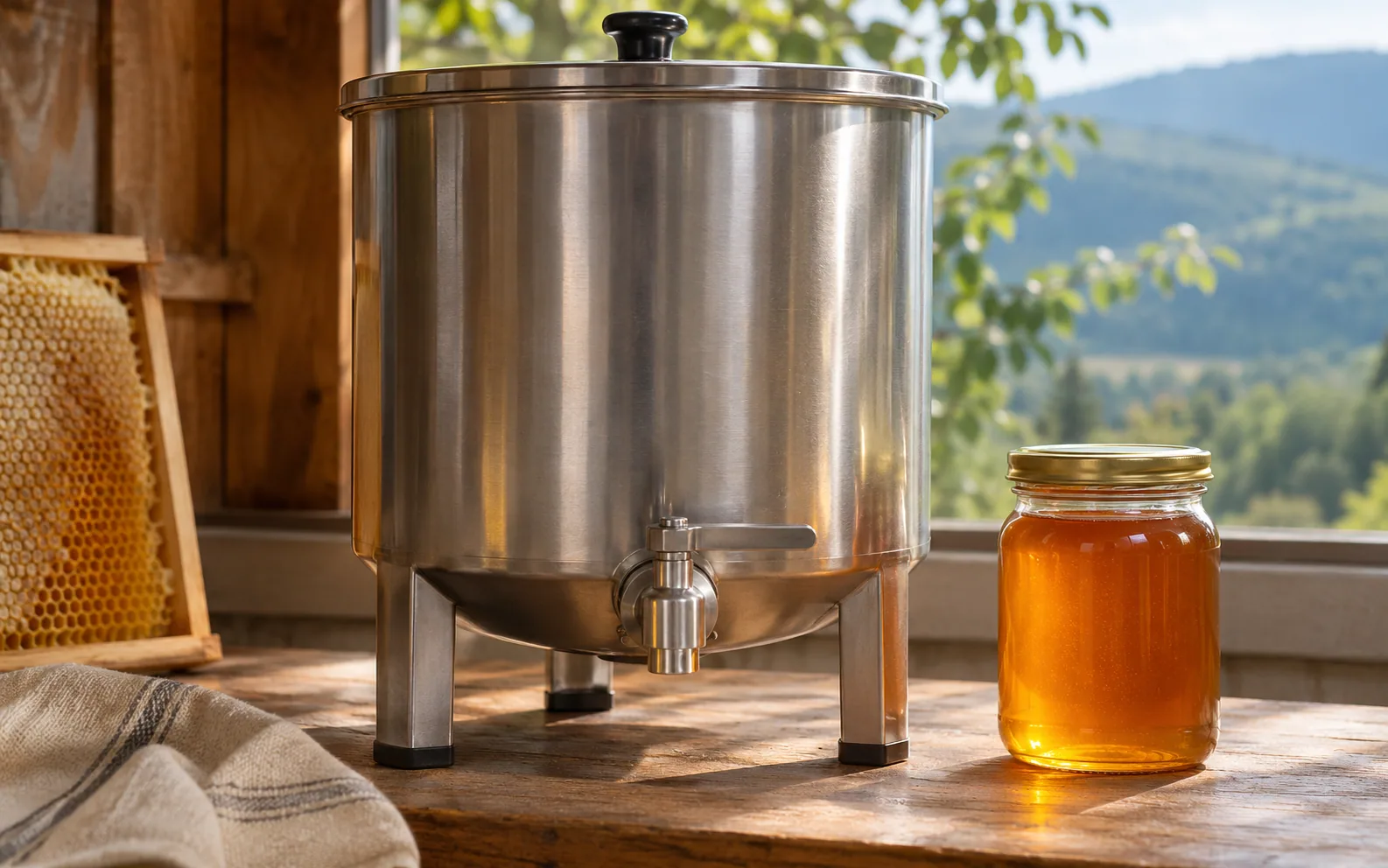
After extraction, raw honey carries tiny air bubbles and bits of wax. Left to rest in a tank, those rise to the top, because they are lighter than honey. The foam is skimmed off, and clear honey is drawn from a tap near the bottom. No heat needed, just time.
That is why a little foam on a jar of raw honey is normal. What is the foam on top?
A myth worth clearing up
"Mountain air makes honey thicker." Partly, through the bees. Dry, warm days help bees ripen honey quickly. But once the honey is in a jar, the only thing that keeps it right is a lid.
A kitchen ritual
Keep honey like you keep pickle: lid tight, clean dry spoon, away from the stove's steam. Never put a wet spoon in the jar. How to store honey has the rest.
Common questions
My honey is runnier in the monsoon. Is it fake? Not necessarily. Temperature changes how thick honey feels. If the lid was left open in damp weather, it may also have taken up a little water.
Should I put honey in the fridge? No need. Cold makes it set faster. A cool cupboard is fine.
Keep reading
- Foot of the mountains
- The spring equinox harvest
- The foothill wind currents
- The micro-batch system
- The great drying
Part of our real honey guide.
Where this comes from
- Honey gives up water at about 51.4% RH or below and takes it up at about 67.9% or above, at 30°C: Victoria University Research Repository
- Fructose as the main hygroscopic sugar in honey: Airborne Honey, information for manufacturers
- Codex 20% moisture and water activity in honey: Journal of Apicultural Science, 2022; FSSAI moisture limit of 20%: Food Safety and Standards (Food Products Standards and Food Additives) Regulations, Reg 2.8.3
- Settling of air and wax in a resting tank is standard honey-house practice. The tank in the illustration is schematic.
Raw, unfiltered honey, bottled as it is. Settled by time, not by heat.
Find your Kalka jar, from ₹499 for ½ kg · or see what is coming next.
Not Your Beesness, sold on āsthālaya. Delivered across India.


