
Know your honey · 6 min read
The Shivalik corridor: the climate that shapes Kalka honey
Kalka sits where the plains end and the first hills of the Himalaya begin. That small climb gives its bees a longer, warmer season, and gives the honey its character.
By Akhil Verma, Co-founder, Not Your Beesness · · Updated
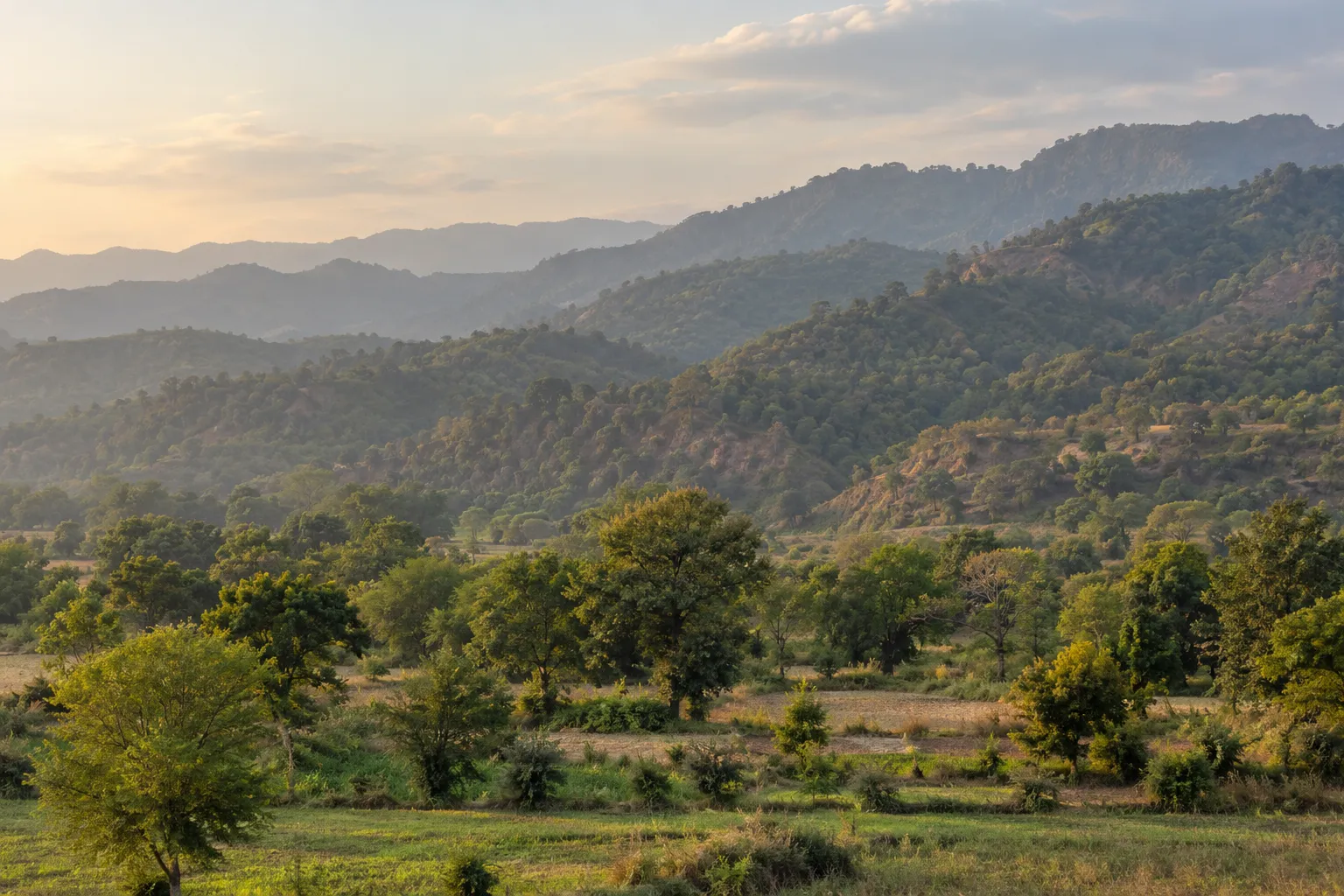
Twenty-five kilometres north of Chandigarh, the road begins to climb, and the honey begins to change.
That place is Kalka. It is where the plains stop and the Shivalik hills begin: the lowest, outermost range of the Himalaya, and the start of the old road and railway to Shimla. It is also where our second jar comes from.
People often ask why our Kalka and Lahaul honeys taste so different when both are raw multiflora. The short answer is place. Here is the longer one.
A corridor, not a single hill
Stand in Kalka at about 2,150 feet and look north. Within roughly 35 kilometres of winding road, the land rises past Dharampur to Kasauli, at about 6,300 feet. That is a climb of over 4,000 feet.
That climb packs three different worlds into one view:
- The plains edge, below Kalka. Hot summers, foggy winters, and fields of mustard and fodder, with eucalyptus planted along roads and canals.
- The Kalka foothills. Scrub and orchards on rolling slopes, with milder nights and more monsoon rain than the plains.
- The cool ridges above. Pine, wild pear and mountain flowers, where spring arrives late.
Our bees work the middle of that corridor. From there, they can reach the edges of the other two.
 From the plains to the ridges in one short climb. Kalka sits on the first step.
Spring climbs the hill
This is the heart of it, and it is simple once you see it.
Spring does not arrive everywhere at once. It starts on the warm plains and walks slowly uphill. Scientists studying the European Alps found that spring leaves open roughly three weeks later for every 3,300 feet of climb. The Shivaliks follow the same logic.
So a flower that is finishing on the plains may only be opening on the ridge above. For a bee in the foothills, that means the bloom does not end all at once. It rolls.
That is what we mean when we say Kalka bees work a longer, warmer season than the bees of the high valleys. In Lahaul, the summer is short and every bloom counts. In Kalka, the year is generous.
What the bees find in Kalka
The foothill scrub is full of plants every North Indian family half-knows:
- Basuti (adusa). The same shrub that goes into the cough kadha in many homes. It flowers in late winter and spring, and bees love its white blossoms.
- Ber, karonda, shisham and khair. Hardy foothill trees and shrubs, each with its own season.
- Mango and jamun. The orchards around Pinjore flower in spring.
- Mustard, from the fields just below the hills in winter.
None of these makes Kalka honey on its own. That is what multiflora means: the bees take whatever is in bloom, so each batch tastes of its season and its hillside. No two batches are quite alike, and that is a good sign.
Three things this means for your jar
1. It may set in winter, and that is natural. Mustard is one of the fastest-setting nectars there is, and a Delhi winter kitchen is the perfect temperature for it. If your Kalka jar turns pale and firm like ghee, nothing has gone wrong. Here is why honey sets, and how to make it runny again.
2. Colour and taste shift a little from batch to batch. A spring batch heavy with basuti and orchard blossom will not match an autumn batch. A darker jar is not burnt, and a lighter one is not watered down. Factory honey tastes the same every time because it is blended and processed to. Raw honey tastes of where it has been.
3. It is an everyday honey. The Kalka jar is warm, rounded and easy to love. It is the one for the morning glass of warm water, the roti drizzle, and the spoon in your chai once it has cooled to sipping heat. (Why not in boiling chai?)
"Himalayan" on a label is not a place
A gentle word on one of the most common labels in Indian honey.
Many jars say "Himalayan" with a picture of a snowy peak. The Himalaya covers thousands of kilometres, from foothill orchards to cold deserts above 10,000 feet. A mountain on the label tells you very little.
Ask three simple questions of any honey:
- Where exactly? A town or valley, not just a mountain range.
- Which kind? Multiflora or monoflora, and from which flowers.
- Which batch? Honey from one place, kept apart, not blended with honey from somewhere else.
Our answers: Kalka, in the Shivalik foothills. Raw, unfiltered multiflora. Kept apart from our Lahaul batch so each one tastes of its own place.
A winter ritual from the foothills
As the cold arrives, the old remedies come out of every kitchen. Two our families swear by:
- Adrak aur shahad. A little fresh ginger juice stirred into a spoon of honey, taken slowly for a scratchy winter throat.
- Warm haldi doodh. Let the milk cool from scalding to warm, then stir in honey instead of sugar.
Both are tradition, not medicine, and both work best with honey that has not been cooked. And a reminder for parents: honey is not for babies under one.
Common questions
Is Kalka honey "Himalayan"? Yes. The Shivaliks are the outermost range of the Himalaya, and Kalka sits at their foot. We would still rather tell you the town than the mountain.
How is it different from your Lahaul honey? Lahaul is a high cold desert above 10,000 feet with one short summer, and its honey comes out deeper, amber and intensely aromatic. Kalka's longer, warmer season gives a softer, more everyday jar. Same kind of honey, different place. Meet the Lahaul jar.
There is a thin foam on top of my jar. Is that okay? Yes. It is tiny air bubbles that rise in raw honey, and it is safe to eat. More on that here.
What about the eucalyptus and jamun honeys? Both come from the plains below the corridor. They are single-flower batches on their way: eucalyptus from the late-winter bloom, and jamun in the spring after.
Keep reading
- Springtime in Kalka
- The Pinjore border flora
- The warm brush bloom
- The Shivalik soil factor
- The toy train wildflower trail
Part of our Kalka honey guide.
Where this comes from
- Kalka and Kasauli elevations: Wikipedia, Kalka and Kasauli. Dharampur: Dharampur Himachal railway station, 1,482 m
- Spring arriving later with altitude, about 22 days per 1,000 m in today's Alps: Vitasse et al., PNAS, via PubMed Central
- Basuti (Adhatoda vasica) flowering February to April: KIRAN, Government of India
- The bee calendar in the illustration is indicative. The bees and the weather decide the exact week.
Raw, unfiltered honey, bottled as it is. Kalka multiflora, from ₹499 for a ½ kg jar.
Find your Kalka jar · or give both places in one box: the Diwali gift box, 1 kg Lahaul + 1 kg Kalka.
Not Your Beesness, sold on āsthālaya. Delivered across India.


