
Know your honey · 3 min read
The Shivalik soil factor: how much does soil really shape honey?
Wine lovers talk about terroir: the idea that soil shapes taste. Does the same hold for honey? A little, but not the way most labels suggest. Here is what soil really does.
By Akhil Verma, Co-founder, Not Your Beesness · · Updated
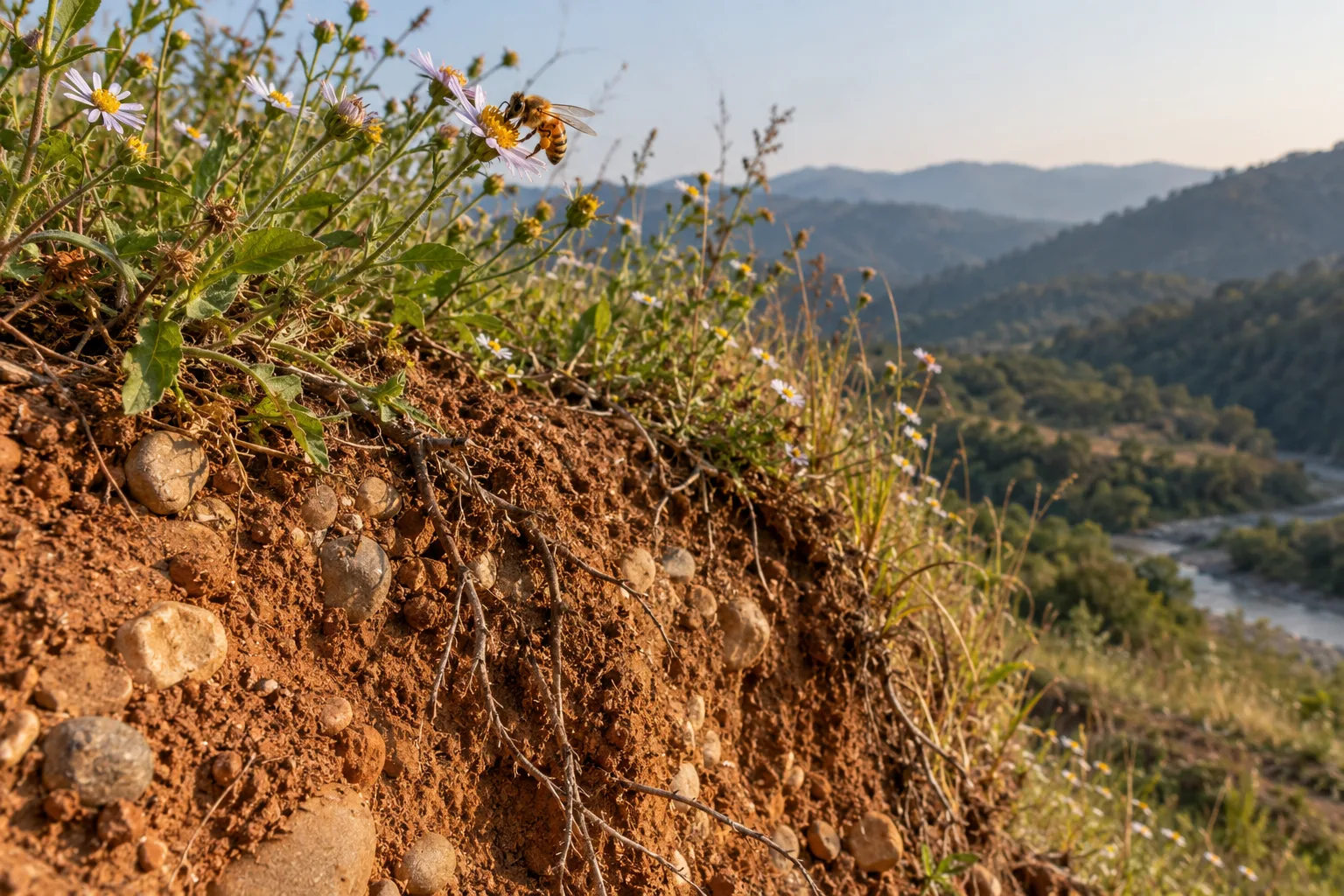
It is a lovely idea: that the red earth of the Shivaliks flows up through the flowers and gives Kalka honey a taste of the land.
There is some truth in it. But it is a much smaller truth than "mineral-rich soil changes the taste". Here is the honest version.
 Soil reaches honey only through the flowers, and only as a pinch of minerals.
How soil gets into honey
Bees never touch the soil for honey. The only route is a chain:
- Soil: minerals sit in the foothill earth.
- Plant: roots take some of them up.
- Nectar: a little of that ends up in the nectar.
- Honey: the bees concentrate the nectar, and the minerals with it.
Researchers agree that a honey's minerals depend on the plant it came from, the climate and the soil, and that the mineral pattern can even help identify where a honey came from.
How much is "a little"?
Very little. A study of Moroccan honeys found total minerals from about 200 mg per kilo in rosemary honey to about 660 mg per kilo in multiflora honey. Even the richest is well under a tenth of a percent of the honey.
The biggest single mineral is usually potassium, often a quarter to half of the total. And darker honeys usually carry more minerals than pale ones.
So does soil change the taste?
We found no study showing that soil minerals change honey's taste. What shapes the taste is mostly the flowers: their sugars and their aromas. That is why a honey from mustard tastes nothing like one from jamun, even from the same field. More on where dark honey comes from.
Soil matters more indirectly: it decides which plants grow on a hillside. The stony, well-drained soils of the Shivalik scrub suit basuti, ber, khair and dhawai. Those plants, and not the minerals, are what give foothill honey its character. Meet the shrubs.
What it means for your jar
Our Kalka jar tastes of the foothill flowers that grew in its soil. That is the real "terroir" of honey: place decides the plants, and plants decide the taste.
A myth worth clearing up
"Mineral-rich honey is a health food." Not really. Honey holds only a pinch of minerals. We sell honey as honey, not as medicine.
Tasting the place
Try our two jars side by side: Kalka, from the warm foothill scrub, and Lahaul, from alpine thyme and sea buckthorn. The difference in place is easy to taste. How to taste honey. Honey is not for babies under one.
Common questions
Is darker honey more nutritious? It usually has a little more mineral, but the amounts are tiny either way.
Does organic soil make better honey? Soil type alone doesn't make honey better or worse. What matters is the flowers and how the honey is handled.
Keep reading
Part of our real honey guide.
Where this comes from
- Minerals depend on botanical origin, climate and soil type; potassium is a quarter to a half of the total: Czech Journal of Food Sciences
- Moroccan honeys, about 201 to 661 mg of minerals per kg; potassium most abundant; darker honeys richer: PubMed Central
- Mineral pattern as a marker of origin: International Journal of Analytical Chemistry, via DOAJ
Raw, unfiltered honey, bottled as it is. Tasting of the foothill flowers, and the ground they grew in.
Find your Kalka jar, from ₹499 for ½ kg · or taste both places in the Diwali gift box.
Not Your Beesness, sold on āsthālaya. Delivered across India.


