
Know your honey · 4 min read
The wild mint carpet: the herbs bees love, and how to taste honey like a beekeeper
Tulsi in the angan, pudina by the stream, binda on the winter slopes: the mint family is everywhere in North India. Here are four herbs worth knowing, and a simple way to taste honey that might help you notice what the bees brought home.
By Akhil Verma, Co-founder, Not Your Beesness · · Updated
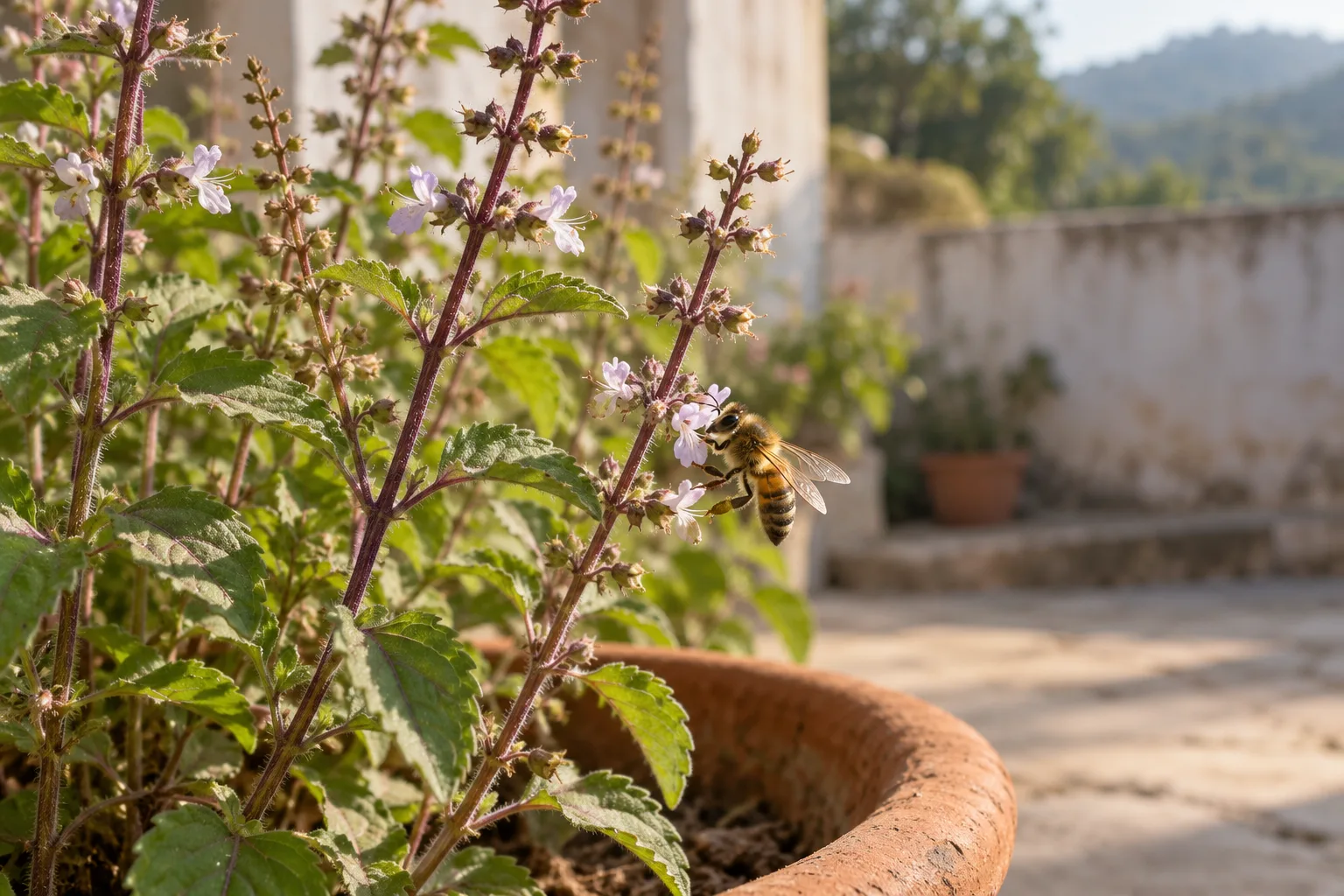
Rub a tulsi leaf between your fingers and you are holding one of the bees' favourite plant families.
The mint family (tulsi, pudina and their many wild relatives) is famous for small, tube-shaped flowers packed into spikes and whorls. Around Kalka, its members turn up in angans, on field edges, by streams and on dry winter slopes.
 Four herbs of the mint family, and a four-step tasting habit.
Four herbs to know
Binda (squirrel tail), December to April. Fuzzy white flower spikes on dry, open slopes, right through the coldest months, when almost nothing else flowers. More in the warm brush bloom.
Guma (Leucas, dronapushpi), after the rains. A small weed with white flowers arranged in neat rings up the stem, common on field edges across India. A study in Karnataka found its flowers visited by 21 kinds of bees and wasps, including honeybees. The researchers suggested planting it along field edges to help bees through the lean months. The one documented bee plant of the four.
Tulsi, most of the year. The holy basil of every angan, with purple-white flower spikes. Watch it on a sunny morning and you may see bees at work.
Wild pudina (wild mint), summer. Soft, grey-green leaves by streams and on damp ground. Its pale lilac spikes are worth watching for bees too.
So, does Kalka honey taste of mint?
We would love to tell you it does, but we can't promise a flavour we have not tested. Our Kalka jar is multiflora: it tastes of whatever the bees found in its weeks, and that changes batch to batch. A batch made while the herbs were flowering may carry a fresher note. Another may lean floral or fruity.
The best way to find out is to taste for yourself.
Taste honey like a beekeeper
- Room temperature, clean spoon. Cold honey hides its aroma.
- Smell it first. Hold the open jar or spoon to your nose before you taste. Most of the flavour is in the smell.
- Let it melt on your tongue. Don't chew or swallow straight away. Give it ten seconds.
- Notice the finish. After you swallow, what lingers? Floral, fruity, malty, herbal, a little tangy? There are no wrong answers.
Try it side by side with our Lahaul jar, from alpine thyme (another mint-family plant), sea buckthorn and clover. The difference between two places is easy to taste. Two places, two jars.
A herb-garden ritual
Tulsi and honey: a few fresh tulsi leaves crushed into a spoon of honey, taken slowly when the weather turns. Or pudina-nimbu paani in the summer, sweetened with honey. Tradition, not medicine. Honey is not for babies under one.
Common questions
Is there "mint honey"? Some countries make single-flower honey from mint-family plants such as thyme or lavender. We don't sell one. Our honey is multiflora.
Does honey carry the medicinal power of tulsi? No. Honey does not carry the medicine of the plants the bees visited. We sell honey as honey, not as medicine.
Keep reading
Part of our Kalka honey guide.
Where this comes from
- Guma (Leucas aspera) as a refuge for honeybees and other pollinators, with 21 hymenopteran visitors: FAO AGRIS; flowering after the rains: Wikipedia, Leucas aspera
- Binda flowering December to April: Flowers of India
- Lahaul's wild thyme, sea buckthorn and clover: Not Your Beesness, Our honeys
- Tulsi and wild pudina flowering months are indicative. "Watch for bees" means we found no study recording bee use.
Raw, unfiltered honey, bottled as it is. Taste it slowly. It changes with the season.
Find your Kalka jar, from ₹499 for ½ kg · or taste both places side by side in the Diwali gift box.
Not Your Beesness, sold on āsthālaya. Delivered across India.


