
Know your honey · 4 min read
The riverbed flora: what grows along the Shivaliks' seasonal streams
Most of the year, the streams of the Shivaliks are wide beds of sand and stones. In the monsoon, they roar. Along their beds and banks lives a tough band of plants: some that bees love, and some that give them nothing.
By Akhil Verma, Co-founder, Not Your Beesness · · Updated
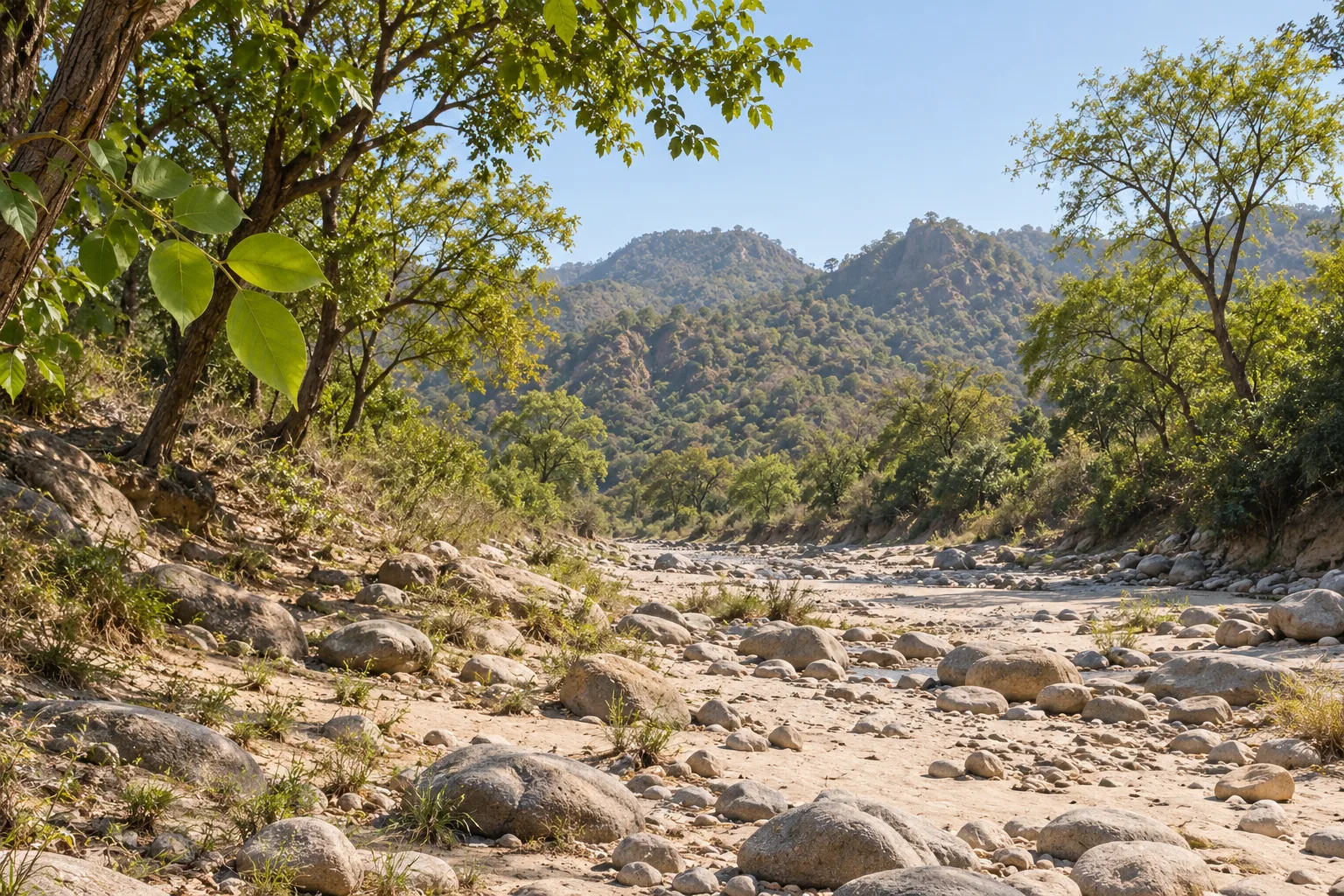
Cross a bridge near Kalka in April and the river below may be nothing but a wide, pale bed of sand and round stones. Cross it again in August and it is a brown, rushing torrent.
These are the seasonal streams of the Shivaliks, known in different places as choes or khols. They lie dry for most of the year and come alive only when the monsoon pours down the hills. The plants that grow along them have to survive both drought and flood.
 Dry for most of the year, a torrent in the monsoon. Shisham holds the banks.
On the banks: shisham
Shisham (Indian rosewood) is the classic tree of North Indian riverbanks, often one of the first to take hold on fresh sand and silt. Its roots help hold the banks together, and in March and April it carries clusters of small, pale flowers.
For bees, shisham matters: it is listed among the main bee plants of the region. Meet the other foothill trees.
On the higher terraces: khair
A little higher, on the old stony terraces above the stream, you will often find khair, the wild white acacia of the Shivaliks and the source of kattha. In forests across the Shivaliks, khair and shisham grow together, with sal on the moister slopes. Which acacia?
In the bed: grasses
In the dry bed itself, tall, tough grasses take over. They are beautiful when their feathery plumes catch the light. But grasses are wind-pollinated: they offer bees no nectar and little useful food. A riverbed full of grass is not a honey pasture.
What the streams really give bees
- Water. On hot days, bees need water to cool their hives, and the damp edges of a stream or a lingering pool are a lifeline. What a heatwave does to bees.
- Trees that hold the banks, like shisham, that flower in spring.
- Damp-ground plants along the edges, such as wild mint.
Do you source honey from the riverbeds?
No, not specifically. Our Kalka jar is raw multiflora from the Kalka foothills. Bees forage about 3 km around their hive, so in a landscape crossed by streams, the riverbank trees can be part of the mix, alongside the scrub, orchards and forest. We name the place, not the stream.
A word of care
Seasonal streams are dangerous in the monsoon. A dry bed can fill in minutes after heavy rain upstream. Enjoy them from the banks and bridges, especially from July to September.
A riverside ritual
Pack a small, well-sealed jar of honey for a winter picnic by the stream, with warm rotis and a little ghee. Tradition, not medicine. Honey is not for babies under one.
Common questions
Which streams are near Kalka? Several seasonal streams run down from the Shivaliks around Kalka and Pinjore. Local names vary from village to village.
Is riverbed honey different? We can't say. Multiflora honey reflects everything the bees found, and riverbanks are only one part of a hive's range.
Keep reading
Part of our Kalka honey guide.
Where this comes from
- Seasonal rivulets (khols) that stay dry most of the year in the Shivaliks, and khair–sal forests: Haryana Tourism, Kalesar; Gokulam Seek IAS
- Mixed sal, khair and shisham forests in the Shivaliks: UP Ecotourism, Shivalik (Mohand)
- Shisham among riverine species: Researchers Links, Bhimber survey
- Shisham among the main bee plants: Status and prospects of migratory beekeeping in Punjab
- Stream flow months follow Chandigarh's monsoon rainfall (IMD 1991–2020 normals). The cross-section is schematic.
Raw, unfiltered honey, bottled as it is. From the foothills, streams and all.
Find your Kalka jar, from ₹499 for ½ kg · or see what is coming next.
Not Your Beesness, sold on āsthālaya. Delivered across India.


