
Know your honey · 5 min read
The acacia influx: which 'acacias' bloom around Kalka, and what 'acacia honey' really is
Drive the road into Kalka in the warm months and you will see trees frothing with pale, fluffy flowers. Most people call them acacias. Some are, some are not, and the famous 'acacia honey' on shop shelves comes from a different tree altogether.
By Akhil Verma, Co-founder, Not Your Beesness · · Updated
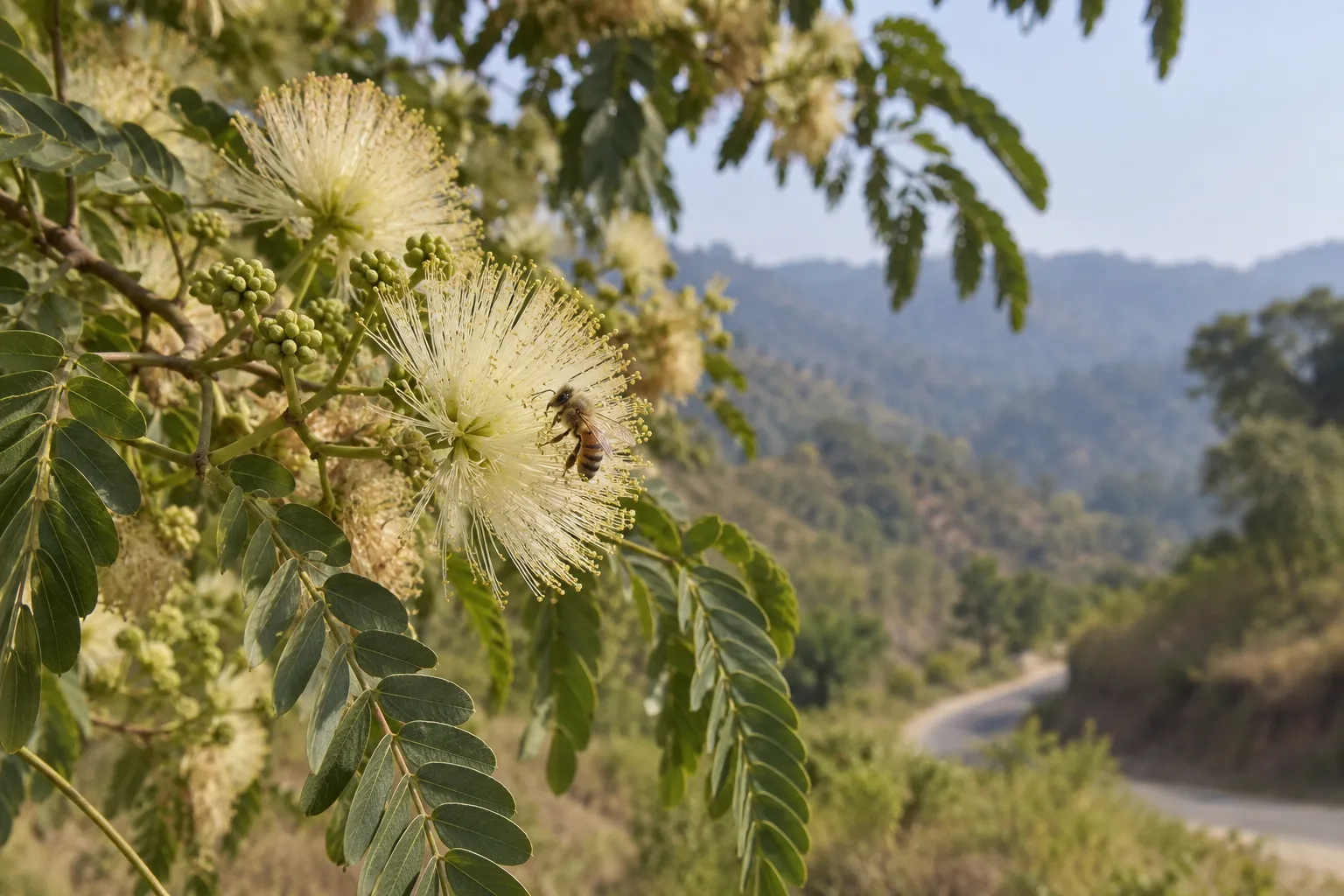
Ask ten people on the road into Kalka what that pale, fluffy flowering tree is, and at least half will say "acacia".
They are not entirely wrong. The foothills and plains around Kalka are full of trees from the acacia family, and in the warm months several of them flower at once. But "acacia" is one of the most confused names in the honey world. Here is how to tell the trees apart, and what each one means for bees.
 Four trees people call "acacia". Only two are, and the famous "acacia honey" comes from neither.
Khair: the wild white acacia of the Shivaliks
A true acacia, wild in the scrub around Kalka.
If there is one tree that deserves the name "wild white acacia" here, it is khair. It grows across the outer Himalaya and the Shivalik foothills, and carries spikes of small white to pale-yellow flowers, fluffy with stamens, that bees visit for nectar and pollen.
You already know khair even if you have never seen it. Its heartwood is the source of kattha, the red-brown paste in a paan.
Look for: a thorny, scrubby tree with feathery leaves and pale, bottlebrush-like flower spikes.
Siris: the sweet-scented cousin
An acacia cousin, flowering in April and May.
Siris is a big shade tree, common along roads and in parks across the region. In spring it covers itself in creamy powder-puff flowers with a soft, sweet scent on warm evenings. Later it rattles with long, flat, papery pods.
It is not a true acacia, but it belongs to the same branch of the family, and from the road it looks the part.
Look for: fluffy cream "puffs" and, later, bunches of flat, straw-coloured pods that rattle in the wind.
Kikar: the golden one
A true acacia, of the plains and dry scrub below the hills.
Kikar (babool) is the acacia most North Indians grew up with, even if they never called it that. Its flowers are bright golden-yellow pom-poms, not white. Its twigs are the babool datun that a generation of grandparents used to clean their teeth.
Look for: sharp white thorns in pairs and small yellow balls of flowers.
Black locust: the "acacia honey" tree
Not an acacia at all.
Here is the surprise. The pale, mild "acacia honey" sold in shops around the world mostly does not come from acacias. It comes from black locust (Robinia), a North American tree with white, hanging clusters of pea-like flowers. The big producers are in Europe, especially Hungary, Romania and Bulgaria. In India it grows mainly in cooler hills such as Kashmir, where it is common enough to have a local name.
So when you see "acacia honey" on a label, it almost always means black locust honey, not honey from the khair or kikar near Kalka.
What it means for your jar
We do not sell an "acacia honey". Our Kalka jar is raw multiflora: the bees take whatever is flowering nearby. Around Kalka, that can include khair, siris and kikar alongside the scrub shrubs and spring blossoms. No single tree defines it, which is why no two batches are quite alike.
One label rule worth knowing: under FSSAI rules, a honey can only be named after one flower if that plant makes up a large share of the pollen in it. So a single-flower name on a jar should be backed by a lab check. It is the standard our coming eucalyptus and jamun batches have to meet.
Two acacia myths
"Acacia honey comes from acacia trees." Mostly not. It usually comes from black locust, as explained above.
"Acacia honey never sets, so honey that sets is fake." Not true. Black locust honey is known for staying runny a long time. Many other real honeys, including raw multiflora, set in the cold. Here is why.
Acacias in the Indian kitchen and home
- Kattha in paan, from khair.
- Babool datun, from kikar twigs.
- A spring evening walk under flowering siris, when the air smells sweet.
And on the honey side: a spoon of raw honey with adrak for a scratchy throat, stirred in warm, never boiling. Tradition, not medicine. (Here is why not boiling.) Honey is not for babies under one.
Common questions
When do the khair trees around Kalka flower? In the warm months, but the exact weeks shift with the year and the altitude. We would rather not promise a date the trees will not keep.
Is the pale honey I bought as "acacia" fake? Not necessarily. It is very likely black locust honey, which is naturally pale and slow to set. Check the label for where it came from.
Will you sell a single-flower acacia honey? Not at the moment. Our single-flower batches coming next are eucalyptus and jamun.
Keep reading
Part of our Kalka honey guide.
Where this comes from
- Khair: white to pale-yellow flower spikes, in the sub-Himalayan tract and outer Himalaya: eFlora of India; Feedipedia; Easyscape
- Siris flowering April to May: Flowering Trees of India
- Kikar's golden-yellow flower heads: Tropical Forages
- "Acacia honey" from black locust, and its main producers: Honey Traveler; black locust in Kashmir: Flowers of India, eFlora of India
- FSSAI rule for single-flower names (at least 45% of the pollen): Food Safety and Standards (Food Products Standards and Food Additives) Regulations, Reg 2.8.3
Raw, unfiltered honey, bottled as it is. Whatever the foothills had in bloom, khair and all.
Find your Kalka jar, from ₹499 for ½ kg · or see what is coming next.
Not Your Beesness, sold on āsthālaya. Delivered across India.


