
Know your honey · 5 min read
The Indian laburnum cycle: what the golden amaltas really gives the bees
When the heat arrives, the amaltas trees hang out their golden chandeliers along roads from Kalka to Delhi. They look like a honey tree. They are not quite, and the real story is better.
By Akhil Verma, Co-founder, Not Your Beesness · · Updated
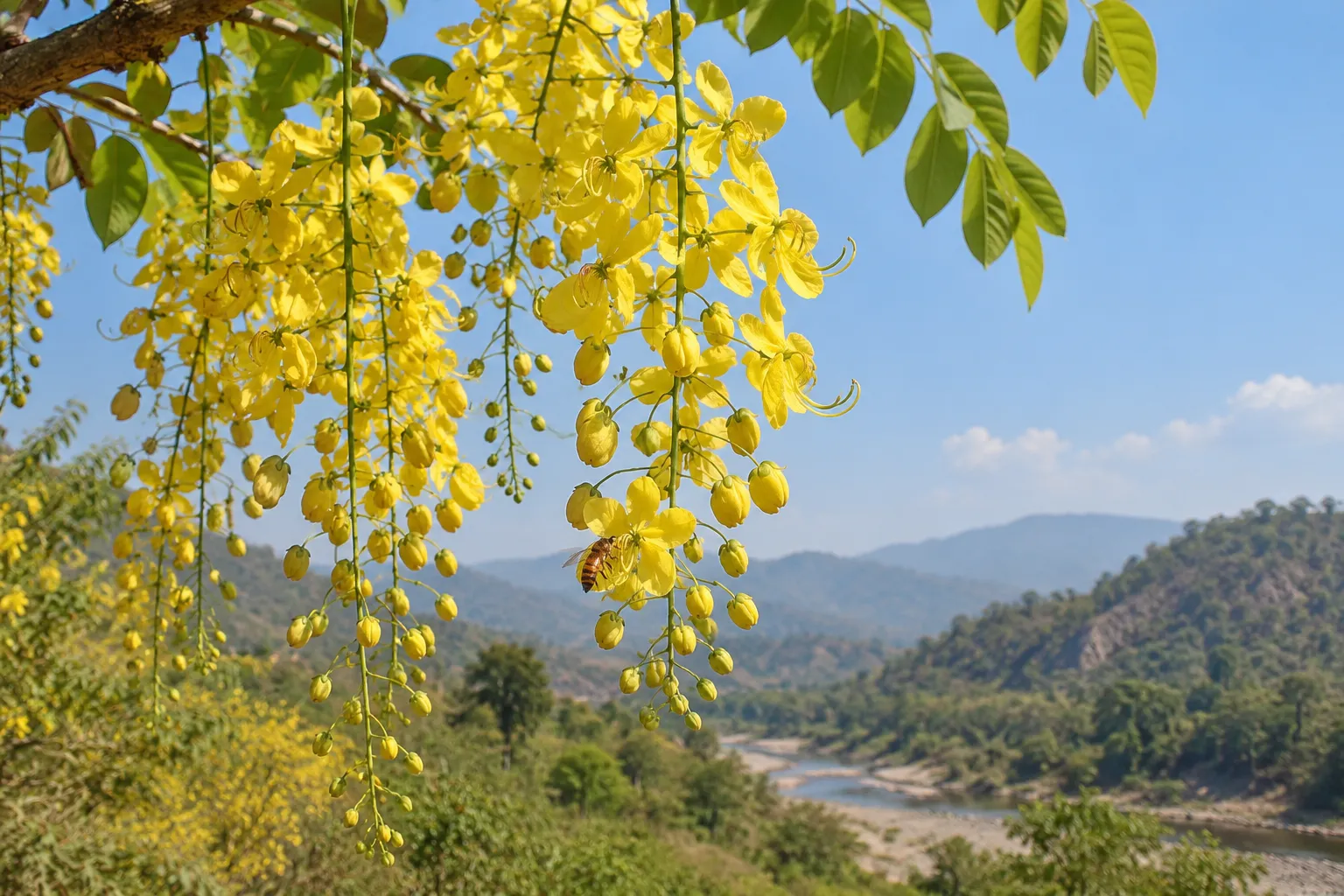
In May, when everything else is wilting, the amaltas trees hang out long chains of pure gold.
Drive anywhere from Kalka to Delhi in early summer and you will see them: amaltas, the Indian laburnum, dripping with yellow flowers along roads, in parks and on the edges of fields. It looks like the most generous honey tree imaginable.
The surprise is that amaltas gives bees very little nectar. What it gives them instead is just as important, and it explains a lot about how a hive survives the North Indian summer.
 Amaltas feeds the hive with pollen, not honey, just as the spring flow fades into the heat.
Two things a flower can give a bee
- Nectar is the sweet liquid in a flower. Bees fan it dry and turn it into honey, the hive's energy store.
- Pollen is the golden dust on the flower's stamens. Bees pack it into "bee bread", the protein food used to raise young bees.
A hive needs both. Honey keeps the colony fuelled, and pollen is how it grows.
Amaltas is a "pollen flower"
Amaltas flowers are built differently from most. Their pollen sits inside tube-like anthers that open only at the tip. Big carpenter bees land on the flower and vibrate their wing muscles, shaking the pollen loose. Scientists call this buzz pollination.
Flowers like this usually offer pollen instead of nectar. Their reward to the bee is the pollen itself. So amaltas is, at most, a small nectar source. Its real gift to bees is pollen.
Why the timing matters
Amaltas blooms mostly in April and May, often lingering into early summer. That is exactly when the foothills' big spring flow of mustard, basuti, mango, kachnar and jamun is fading. Here is what flowers when.
As the heat builds and nectar thins out, amaltas keeps pollen coming in. That helps hives keep raising young bees going into the hard months ahead: the heat and then the monsoon, when flowers are scarce.
One thing is changing: amaltas is flowering earlier. Citizen scientists have recorded trees blooming as early as February in some places, instead of the usual April–May.
What it means for your jar
There is no such thing as a big "amaltas honey". Bees do not make honey from pollen, and amaltas offers little nectar. So be wary of any jar sold as amaltas honey.
What amaltas does give is stronger, healthier hives, and strong hives are what make a good spring harvest possible the following year. Our Kalka jar is multiflora: it comes from the nectar flowers of the foothills. Amaltas plays its part behind the scenes, in the hive.
Two golden myths
"Golden flowers make golden honey." Not true. Honey's colour comes from the nectar or honeydew, not the colour of the petals. And amaltas gives very little nectar at all. How to read honey colour.
"Every flower bees visit becomes honey." Not true. Many visits are for pollen, which feeds the young bees rather than going into the honey jar.
Amaltas in Indian life
- In Kerala, amaltas is kani konna, the state flower and a centrepiece of the Vishu kani arranged at dawn.
- Across North India, it is the tree that turns summer avenues gold.
For a summer refresher with honey: a glass of nimbu paani sweetened with a spoon of honey instead of sugar. Stir it in well, since honey takes a moment to dissolve in cold water. Tradition, not medicine. And honey is not for babies under one.
Common questions
Do honeybees visit amaltas? Mostly for pollen, and amaltas is listed among the regional bee plants. The big buzzing visitors you see on it are usually carpenter bees, the large black ones, which are best at shaking its pollen loose.
Is amaltas honey real? Bees cannot make much honey from a flower that offers little nectar. A jar sold as "amaltas honey" deserves a close look at its label and source.
When will I see it bloom near Kalka? Usually April to May, sometimes earlier now. The weather decides the exact week.
Keep reading
- The flame of the forest
- The acacia influx
- Golden hour in the Shivaliks
- The Shivalik sheesham tree
- The golden rod transition
Part of our Kalka honey guide.
Where this comes from
- Amaltas flowers offer pollen as the reward, and buzz pollination: AoB Plants, via PubMed Central; most flowers of this group produce no nectar: SciELO; carpenter bees as key pollinators: Nature in Focus. One outreach source reports nectar feeding: IMSc. So we say "little", not "none".
- Amaltas among the main bee plants in Punjab: Status and prospects of migratory beekeeping in Punjab
- Flowering in April and May, and earlier blooming recorded by SeasonWatch: Wikipedia, Cassia fistula; ClarityUPSC
- Kerala state flower and Vishu: Onmanorama
- The month strip in the illustration is indicative.
Raw, unfiltered honey, bottled as it is. From the nectar of the foothills, with a little help from the golden trees.
Find your Kalka jar, from ₹499 for ½ kg · or give both places in one box: the Diwali gift box.
Not Your Beesness, sold on āsthālaya. Delivered across India.


