
Know your honey · 3 min read
The flame of the forest: who really visits the palash bloom
When the palash flowers, whole hillsides look as if they are on fire. You might expect the trees to be humming with honeybees. Watch closely and you will see that the palash has other guests in mind.
By Akhil Verma, Co-founder, Not Your Beesness · · Updated
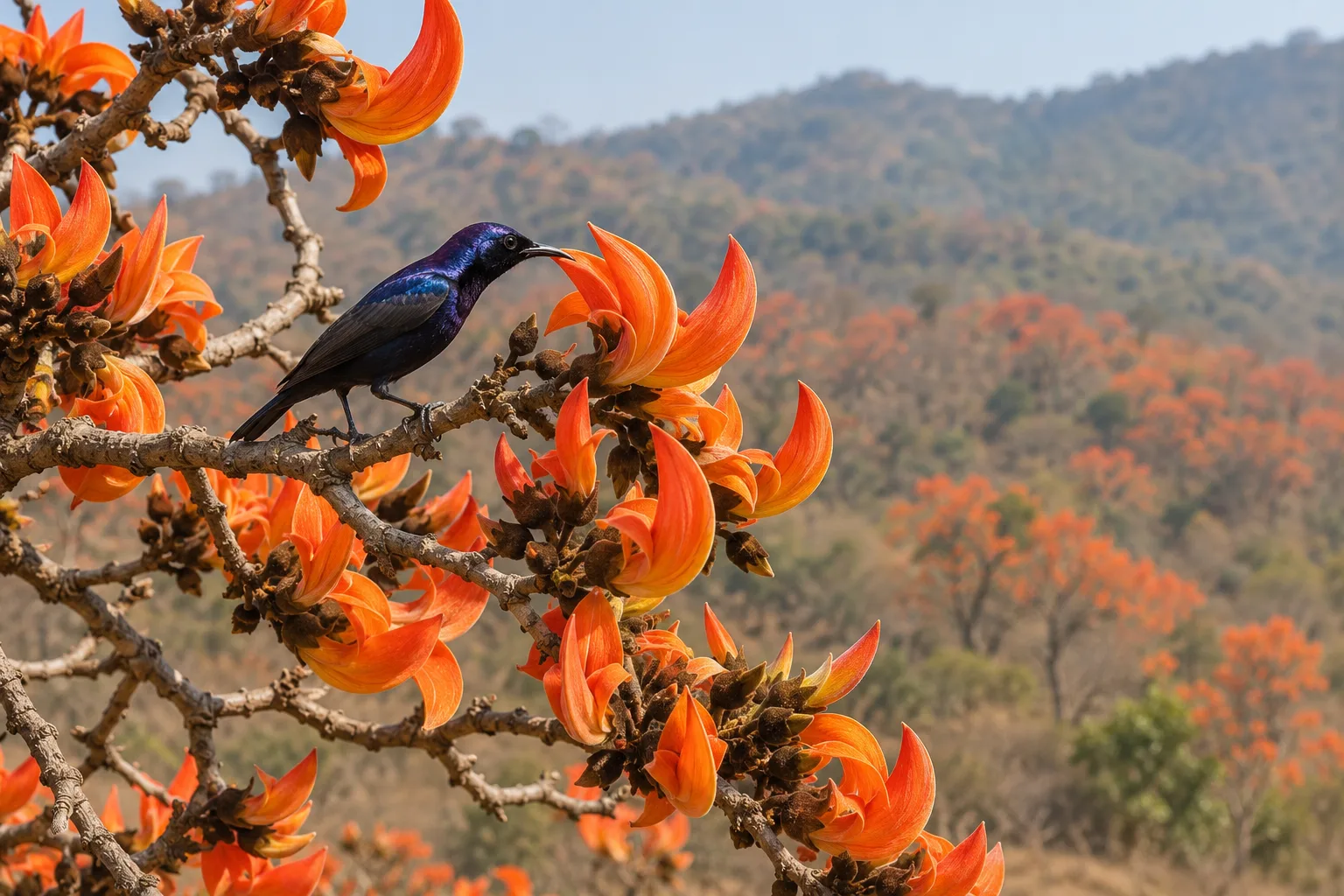
From late February, the dry Shivalik scrub catches fire. Bare palash trees burst into thousands of curved, flame-orange flowers, and the hills glow for weeks.
It is the most dramatic bloom of the foothill year, and the obvious question for a honey brand is: are the bees all over it?
The honest answer is: not really. The palash was built for birds.
 Palash is built for birds. Honeybees are minor guests at this party.
A flower designed for beaks
Everything about the palash flower says "bird":
- Big, bright orange-red flowers, the colour birds see best.
- Plenty of watery nectar, a welcome drink in the dry season.
- Flowers on bare branches, easy to reach and see from the air.
A careful study in a dry forest near New Delhi watched who came to drink. Seven bird species visited the flowers, but only one, the small, shimmering purple sunbird, reliably moved pollen from flower to flower. Three-striped squirrels turned out to be pollinators too, picking up pollen as they drank.
A 2025 survey in Maharashtra's Tadoba reserve recorded 43 bird species using palash trees in a single April, for nectar, insects, nesting and roosting.
And the honeybees?
Insects do visit palash. But the studies are clear that birds and squirrels do the real work, and honeybees are minor guests here. So we would not call palash a big honey tree, and we would be wary of any jar that claims to be "palash honey".
Its true gift is to the birds of the dry season, which is no small thing.
Tracking the bloom
- When: roughly February to April, at its most vivid around Holi.
- Where: dry scrub and open slopes in the foothills. See it on the Shivalik bloom calendar.
- What to watch for: sit quietly near a flowering tree in the morning and look for the flash of a purple sunbird hovering at the flowers.
- One surprise: palash does not flower every year on every tree. A winter that is too cold, too dry or too wet can skip a season.
Palash in Indian life
- Tesu ka rang: palash flowers soaked overnight make the soft saffron colour of a traditional Holi.
- "Flame of the forest": the name every school child learns, and a sight that announces the end of winter.
For the jar, a spring ritual: sweeten your Holi thandai with a spoon of honey instead of sugar, stirred in well. Tradition, not medicine. Honey is not for babies under one.
Common questions
Is there palash honey? Not in any meaningful amount that we know of. The flowers are pollinated mainly by birds and squirrels.
Does palash matter for your Kalka honey? Very little directly. Our Kalka jar comes from the nectar flowers the bees do work: the scrub, the orchards and the spring trees. Meet the trees of the foothills.
Keep reading
Part of our Kalka honey guide.
Where this comes from
- Palash pollination by the purple sunbird and three-striped squirrel, with seven bird species visiting (New Delhi): Tandon, Shivanna and Mohan Ram, Annals of Botany, 2003, via PubMed Central; ATREE
- 43 bird species using palash in April 2025: Tadoba Andhari Tiger Reserve palash survey
- Flowering February to April, and not every year: Wikipedia, Butea monosperma
Raw, unfiltered honey, bottled as it is. Made from the flowers the bees really work.
Find your Kalka jar, from ₹499 for ½ kg · or give both places in one box: the Diwali gift box.
Not Your Beesness, sold on āsthālaya. Delivered across India.


