
Know your honey · 4 min read
The sub-tropical canopy: a guide to the trees that feed bees in the Kalka foothills
The Shivalik foothills around Kalka are covered in dry deciduous forest: trees that drop their leaves in the dry season and flower in waves. Here are ten of them, when they bloom, and where to read more about each.
By Akhil Verma, Co-founder, Not Your Beesness · · Updated
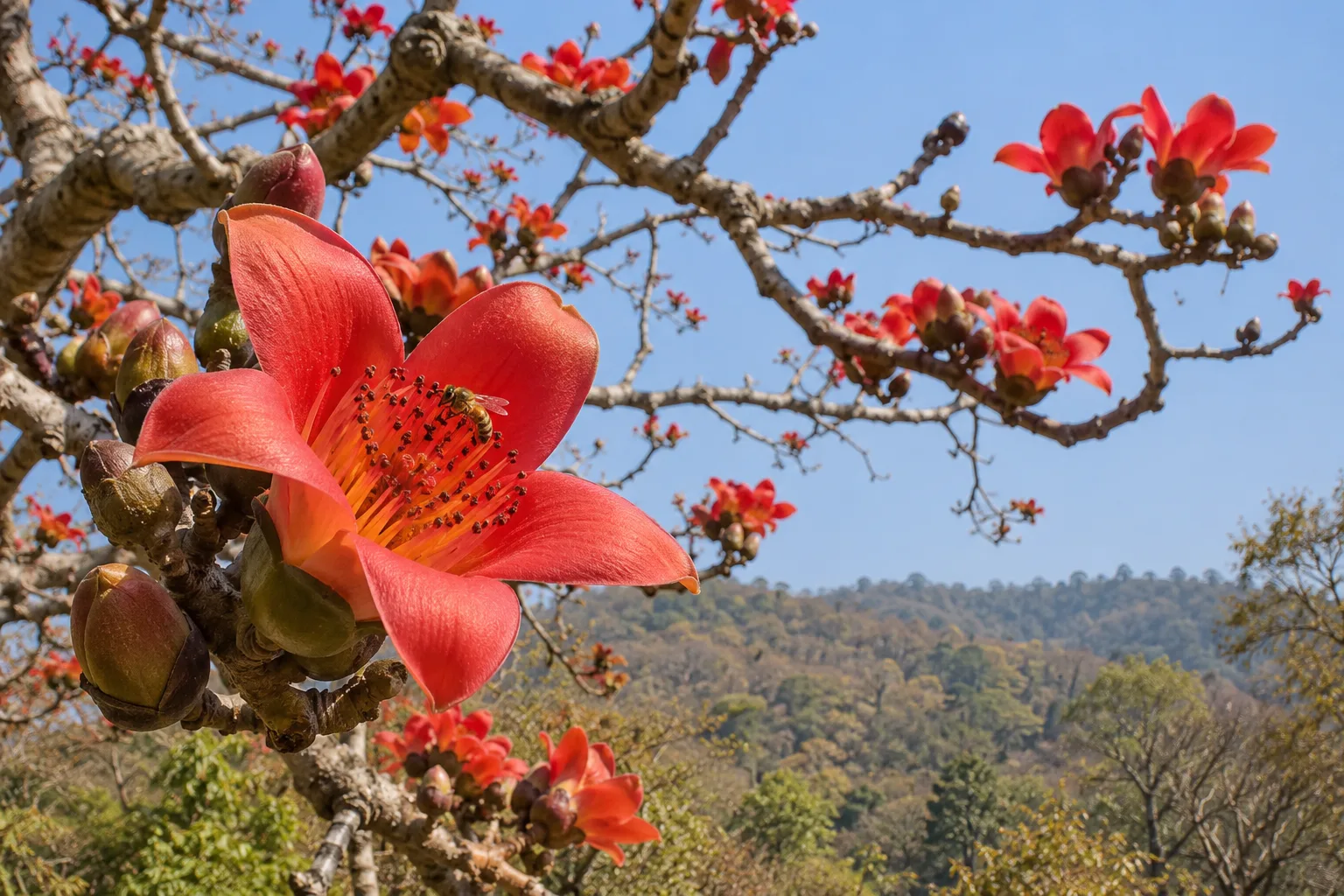
Look up from the scrub around Kalka and you are standing under one of India's great working forests: the dry deciduous woods of the Shivaliks.
Botanists describe the forests of this part of the Shivaliks as tropical dry deciduous and northern dry mixed deciduous. In plain words: many trees drop their leaves in the dry season, and many flower on bare branches in late winter and spring, just when bees are building up.
This post is a field guide. Each tree has its own story, and where we have written one, we link to it.
 Ten trees of the Kalka foothills and when each one flowers. Months are indicative.
The late-winter openers
- Semal (silk cotton), January to March. Huge red flowers on bare branches. Birds crowd it as much as bees. Springtime in Kalka.
- Mango, February to March. The orchards around Pinjore fill the evening air with the scent of baur.
- Eucalyptus (safeda), February to April. Planted widely on the plains below, and listed among the main bee plants of the region. Our coming eucalyptus honey comes from this bloom.
The spring show
- Kachnar, February to April. Pink and purple, like an orchid that grew into a tree. Its buds go into kachnar ki sabzi.
- Palash, February to April. The flame of the forest. Spectacular, but pollinated mainly by birds.
- Shisham, March to April. Small pale flowers, easy to miss, and one of the main bee plants of the region. It also lines the riverbeds.
- Jamun, March to May. Small pale blossoms that make one of the darkest honeys there is. Our jamun honey is on its way.
Into the heat
- Siris, April to May. Creamy, sweet-scented powder puffs. An acacia cousin. Which acacia?
- Amaltas, April to June. Golden chandeliers that feed bees mostly pollen, not nectar. The amaltas cycle.
- Khair. The wild white acacia of the Shivaliks, and the source of kattha. We have not confirmed its exact flowering months, so its strip in the picture is left blank.
Why so many trees flower together
In the dry deciduous forest, many trees flower before or as their new leaves arrive, in the dry, sunny weeks between winter and the monsoon. That is the same window when the foothills' honey is made. It is why late winter and spring are the bees' main season here, and why the monsoon is such a lean time.
What it means for your jar
Our Kalka jar is multiflora: the bees take whatever is in bloom. Some of these trees will be part of any given batch, alongside the shrubs of the scrub. Which ones, and how much, changes with the weeks. That is why no two batches are quite alike.
Common questions
Which of these trees are in my Kalka jar? We can't say for any single batch. Multiflora honey is a blend of what the bees found.
Which are best for bees? Of these ten, shisham and eucalyptus are listed among the main bee plants of the region. Palash and amaltas matter less for honey: one is for birds, the other gives mostly pollen.
Keep reading
Part of our Kalka honey guide.
Where this comes from
- Shivalik forest types, and Morni's tropical dry deciduous forest at 400–800 m: Journal of Threatened Taxa; Forestry Studies
- Shisham and eucalyptus among the main bee plants: Status and prospects of migratory beekeeping in Punjab
- Each tree's flowering months: see the linked posts and their sources. Months in the illustration are indicative.
Raw, unfiltered honey, bottled as it is. From the foothills under the canopy.
Find your Kalka jar, from ₹499 for ½ kg · or see what is coming next.
Not Your Beesness, sold on āsthālaya. Delivered across India.


