
Know your honey · 3 min read
The silk cotton bloom: semal's short, intense spring in the foothills
For a few weeks at the turn of the year, the bare semal trees around Kalka hold up hundreds of huge red cups of nectar. Birds crowd in, and so, it turns out, do the bees.
By Akhil Verma, Co-founder, Not Your Beesness · · Updated
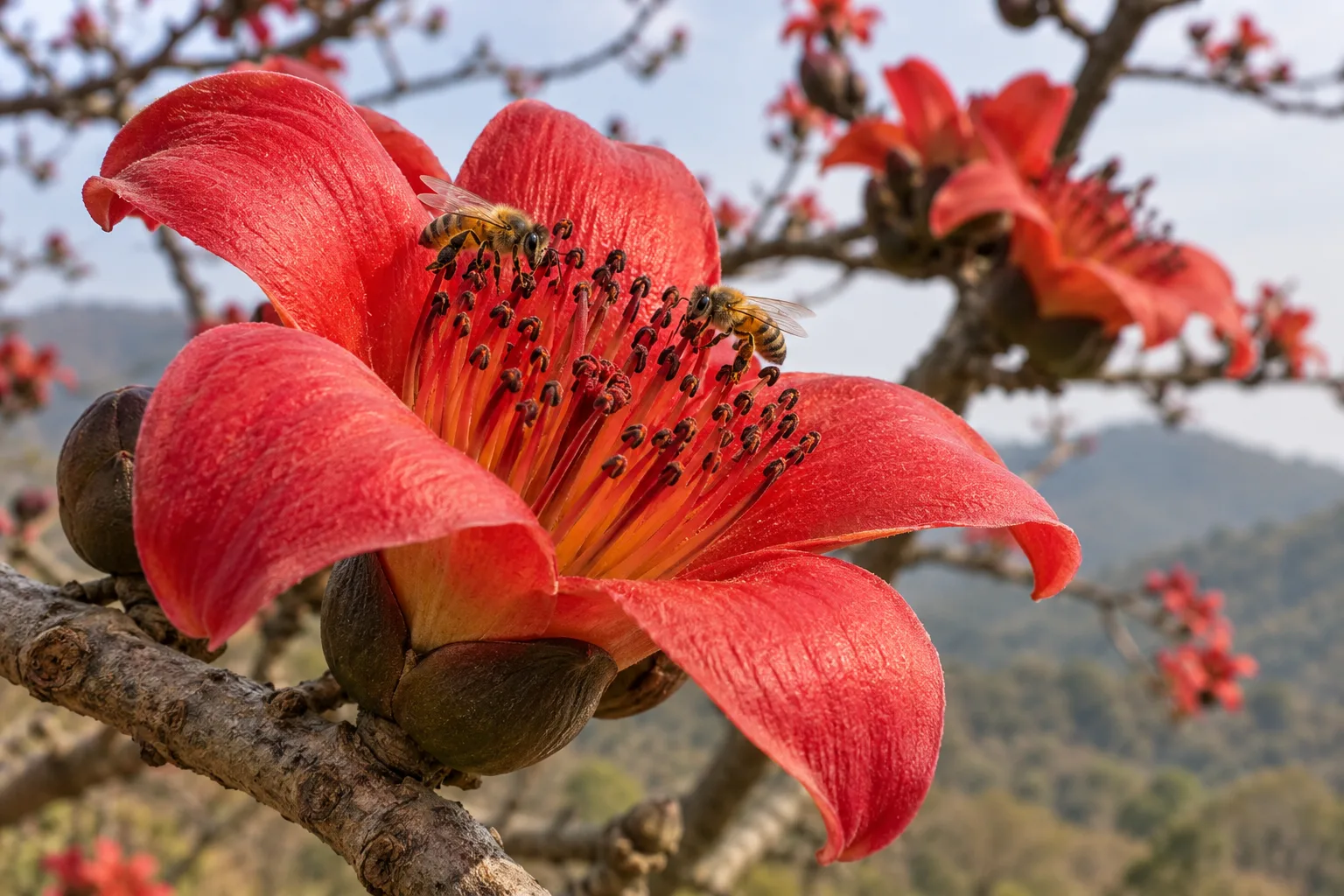
In January, when most trees in the foothills are bare and grey, the semal lights up like a lamp.
Its leaves are gone. In their place, every branch holds big, waxy, red cup-shaped flowers, brimming with nectar. For a few weeks, the semal is the busiest tree on the hillside.
 Birds pollinate semal best, but honeybees come in numbers for its nectar and pollen.
A short, intense bloom
Semal flowers from around January to March in North India, on bare branches. Then the leaves return, the pods ripen and split, and the soft white fluff that gives it the name silk cotton drifts on the wind. The flowering window is short, and generous while it lasts.
A tree built for birds
Big, red, open, nectar-rich flowers on bare branches are a classic bird flower. A study in north-east India found 13 bird species and a squirrel feeding on semal, and concluded that birds do most of the pollinating. Semal mostly cannot set seed with its own pollen, so it needs those visitors.
But the bees come too
Here is the surprise. Researchers in India's Eastern Ghats list bees, birds and bats among semal's pollinators. A study in China counted visits to red-flowered semal and found about 100 honeybee visits an hour, against about 79 from birds. The bees were there for the nectar and the pollen.
So semal is a rare case: a bird-pollinated tree that honeybees still love.
Why it matters for the hive
Semal blooms in late winter, when few other trees are flowering. For hives building up towards the spring flow, that early nectar and pollen is welcome. See where semal sits in the bloom calendar.
What it means for your jar
Our Kalka jar is multiflora. In years when the bees work semal hard, it can be part of an early-spring batch, alongside mustard and the first scrub flowers. We can't say how much for any one batch.
A myth worth clearing up
"Bird flowers are no use to bees." Not always. Semal is pollinated best by birds, but its open cups give honeybees easy access to nectar and pollen.
Semal in Indian life
- The silk cotton fluff once stuffed pillows and quilts in many homes.
- The red flowers carpet the roads in February, a sure sign that spring is near.
For a late-winter morning: adrak aur shahad, ginger juice with a spoon of honey for a scratchy throat. Tradition, not medicine. Honey is not for babies under one.
Common questions
Is there semal honey? We know of no single-flower semal honey sold in North India. Its bloom is short and shared with many other early flowers.
Where can I see semal near Kalka? Along roads and on the plains edge, from late January. Look for the tallest bare tree with red flowers.
Keep reading
Part of our Kalka honey guide.
Where this comes from
- Birds as main pollinators, 13 bird species and a squirrel, mostly self-incompatible (north-east India): Springer, Brazilian Journal of Botany
- Bees, birds and bats as pollinators (Eastern Ghats): BioOne, Ornithological Science
- Visit rates on red-flowered trees, about 100 honeybee and 79 bird visits per hour (China): Biodiversity Science, 2019
- Flowering January to April: WCC herbarium; January to March in the north: SeasonWatch via RoundGlass Sustain
Raw, unfiltered honey, bottled as it is. From the trees that wake the foothills in spring.
Find your Kalka jar, from ₹499 for ½ kg · or see what is coming next.
Not Your Beesness, sold on āsthālaya. Delivered across India.


