
Know your honey · 3 min read
The Shivalik sheesham tree: Indian rosewood, and what its spring flowers give bees
Sheesham is the tree of north Indian roadsides, canal banks and furniture shops. In March and April it puts out small, pale, scented flowers that honey bees visit. Here's what we know, and what we can't claim.
By Akhil Verma, Co-founder, Not Your Beesness ·
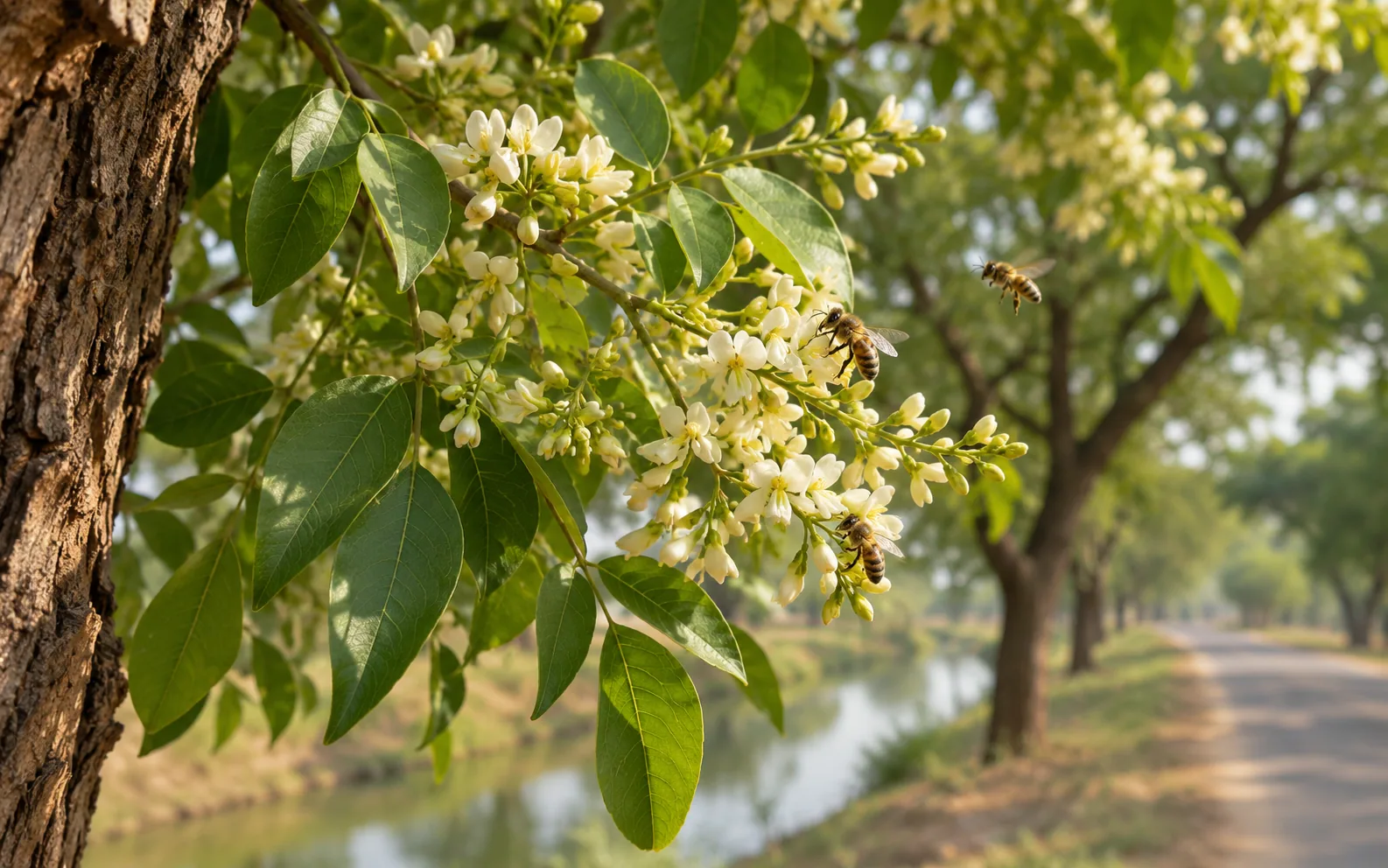
Drive from Chandigarh to Kalka in April and you pass hundreds of sheesham trees. Stop under one and you may hear it humming.
Quick answer: The sheesham tree (Dalbergia sissoo, Indian rosewood) flowers in March and April with small, pale, scented blooms. Honey bees are among its pollinators, but no study measures its share in Kalka-area honey.
Sheesham, or shisham, is Dalbergia sissoo, also called Indian rosewood. It grows wild along rivers in the Himalayan foothills, and it has been planted along roads, canals and field edges across the north Indian plains for over a century, for shade and for its hard, handsome timber.
 Small, pale and scented, among the new leaves.
A spring flower
Sheesham flowers in March and April, at the same time as its fresh leaves. The flowers are small, pale yellowish-white and fragrant, shaped like tiny pea flowers, in loose clusters. By early summer they've turned into flat, papery pods.
What bees get from it
- A study of sheesham's pollination in Chandigarh found that honey bees, along with beetles, butterflies and thrips, visit and pollinate its flowers.
- Studies of migratory beekeeping in Punjab list sheesham among the region's bee plants, alongside mustard and eucalyptus.
- Bee-flora tables describe it as a source of both nectar and pollen.
It flowers in the busiest stretch of the foothill spring, when bees are also working mustard's last fields, basuti and kachnar. Springtime in Kalka.
What we can't claim
The topic we were given says sheesham blooms "add depth to Kalka jars". We can't say that:
- No study has measured sheesham's share in Kalka-area honey.
- Our Kalka honey is multiflora: no one flower makes up most of it, and we don't name one. What multiflora means.
What we can say is that sheesham is part of the spring the bees work.
A myth worth clearing up
"Sheesham honey is a dark, woody honey, like its timber." No. A tree's wood has nothing to do with its nectar. Honey colour comes from what's in the nectar. What honey colour tells you.
A roadside ritual
On an April drive, pull over under a flowering sheesham on a still, sunny morning. Listen first, then look up. Count the bees on one cluster, and notice the scent, faint and sweet.
Common questions about the sheesham tree
Is sheesham the same as rosewood furniture? Sheesham is sold as Indian rosewood. Other rosewoods come from different Dalbergia species.
Does sheesham flower every year? Usually, in spring with the new leaves, though the exact weeks shift with the weather.
Keep reading
Part of our Kalka honey guide.
Where this comes from
- Dalbergia sissoo, native to the Himalayan foothills, flowering in March–April with new leaves: World Agroforestry, tree database; FAO
- Honey bees, beetles, butterflies and thrips pollinating sheesham in Chandigarh: Vasudeva & Sareen, Indian Forester, 2009
- Sheesham among the bee plants of Punjab: Status and prospects of migratory beekeeping in Punjab
- No source measures sheesham's share in Kalka-area honey. The drawing is schematic.
Raw, unfiltered honey, bottled as it is. From a foothill spring full of trees.
Find your Kalka jar, from ₹499 for ½ kg · or see what is coming next.
Not Your Beesness, sold on āsthālaya. Delivered across India.


