
Know your honey · 3 min read
The polyfloral balance: what multiflora honey really means
'Multiflora' on a label can sound like second best next to 'acacia' or 'mustard'. It isn't. It simply means many flowers, with none in charge. Here's how the line is drawn, and why a multiflora jar is a whole season in a spoon.
By Akhil Verma, Co-founder, Not Your Beesness ·
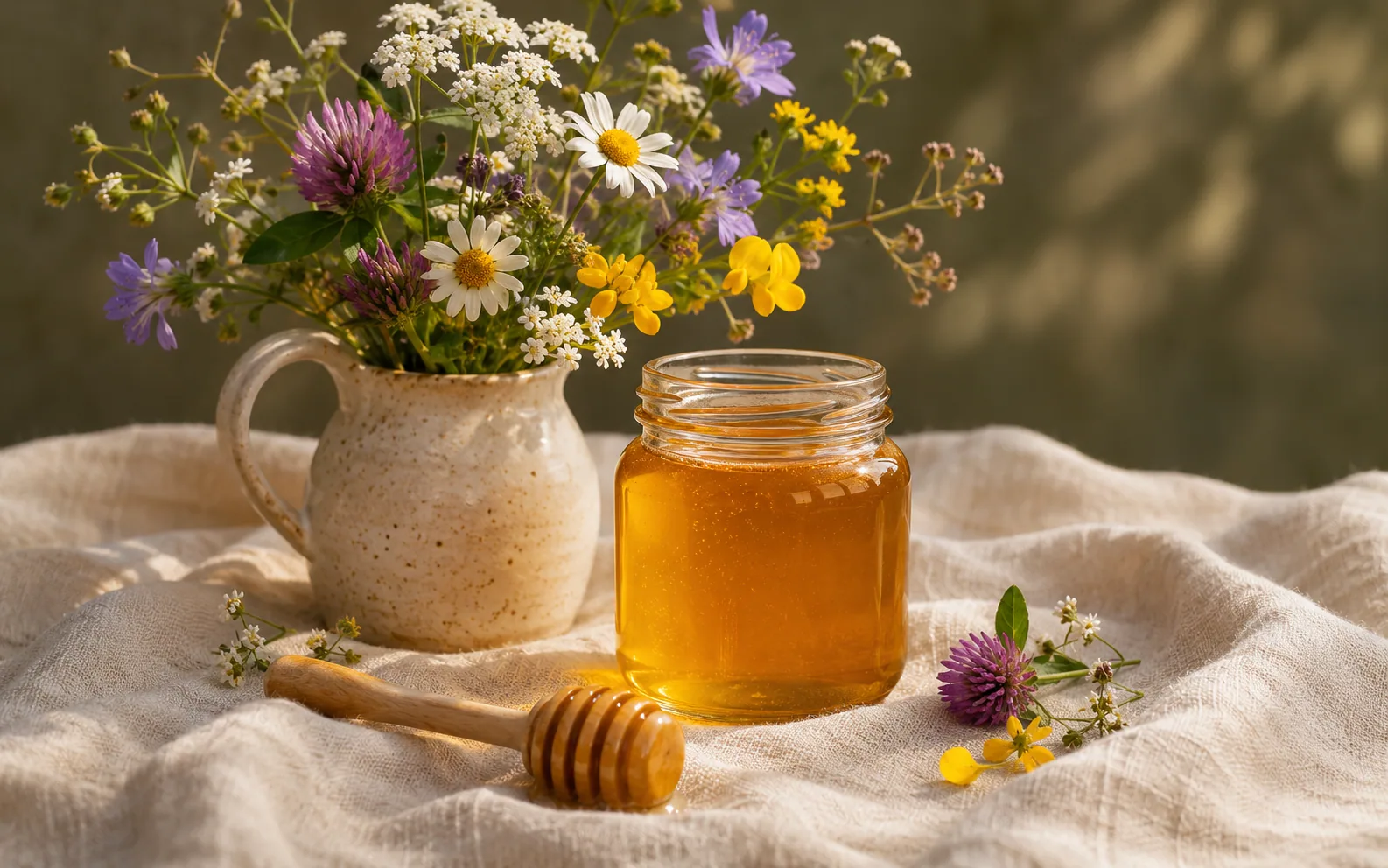
Read enough honey labels and you'll see two kinds: ones named after a flower, and ones called "multiflora". The difference comes down to one number.
Quick answer: Multiflora honey comes from many flowers, with no single plant making up 45% or more of its pollen; above that line, Indian rules allow a single-flower name. It isn't lesser honey, just a whole season in one jar.
That number is 45%. Under India's food rules, a honey can be named after one flower only if that plant makes up at least 45% of its pollen. Below that, it's multiflora. How pollen analysis works.
 Single-flower: one plant leads. Multiflora: many share.
What multiflora means
A multiflora (or polyfloral) honey comes from many flowers, with none above 45% of its pollen. It's not a lesser honey. It's the honey of a whole landscape over a season: trees, shrubs, herbs and field flowers, all in one jar.
A single-flower (monofloral) honey has one plant leading, usually because bees were placed near a big crop or forest of it, like mustard fields or acacia groves.
Why multiflora varies
Flowers lead in turn as the seasons change. A study of honeys from the Shimla hills found that autumn and summer honeys were led by different flowers. So each multiflora batch shifts a little. Why honey tastes different each batch.
Our two jars
Both our honeys are multiflora. We name them for their place, Lahaul and Kalka, never for a single flower. We haven't pollen-tested them for a single-flower claim, and we don't make one. The single-origin mandate.
A myth worth clearing up
"Single-flower honey is always better." Different, not better. Single-flower honeys have a distinctive, predictable taste. Multiflora honeys have depth and change with the seasons. It's a matter of preference.
A tasting ritual
Taste a single-flower honey, like a shop-bought mustard or acacia, beside a multiflora one. The single-flower honey often tastes cleaner and narrower; the multiflora, rounder and more layered.
Common questions about multiflora honey
Is "wild forest honey" multiflora? Usually, yes, unless pollen tests show one plant above 45%.
Can a honey change from multiflora to single-flower? Only if a batch happens to be led by one plant above 45%, shown by testing.
Keep reading
Part of our real honey guide.
Where this comes from
- FSSAI rule for single-flower names (at least 45% of the pollen): Food Safety and Standards (Food Products Standards and Food Additives) Regulations, Reg 2.8.3
- Autumn and summer honeys led by different flowers in the Shimla hills: see sources in The October cleansing
- The pollen shares in the illustration are illustrative, not measurements of any honey.
Raw, unfiltered honey, bottled as it is. A whole season of flowers in every jar.
Find your jar: Lahaul from ₹799 or Kalka from ₹499, for ½ kg · or see what is coming next.
Not Your Beesness, sold on āsthālaya. Delivered across India.


