
Know your honey · 3 min read
The pollen count: what microscopes can and can't tell you about honey
Pollen analysis can tell you which flowers a honey came from, and roughly where. It can't, by itself, prove a honey is pure. When India's top brands were tested in 2020, most passed the standard tests and most failed an advanced one.
By Akhil Verma, Co-founder, Not Your Beesness ·
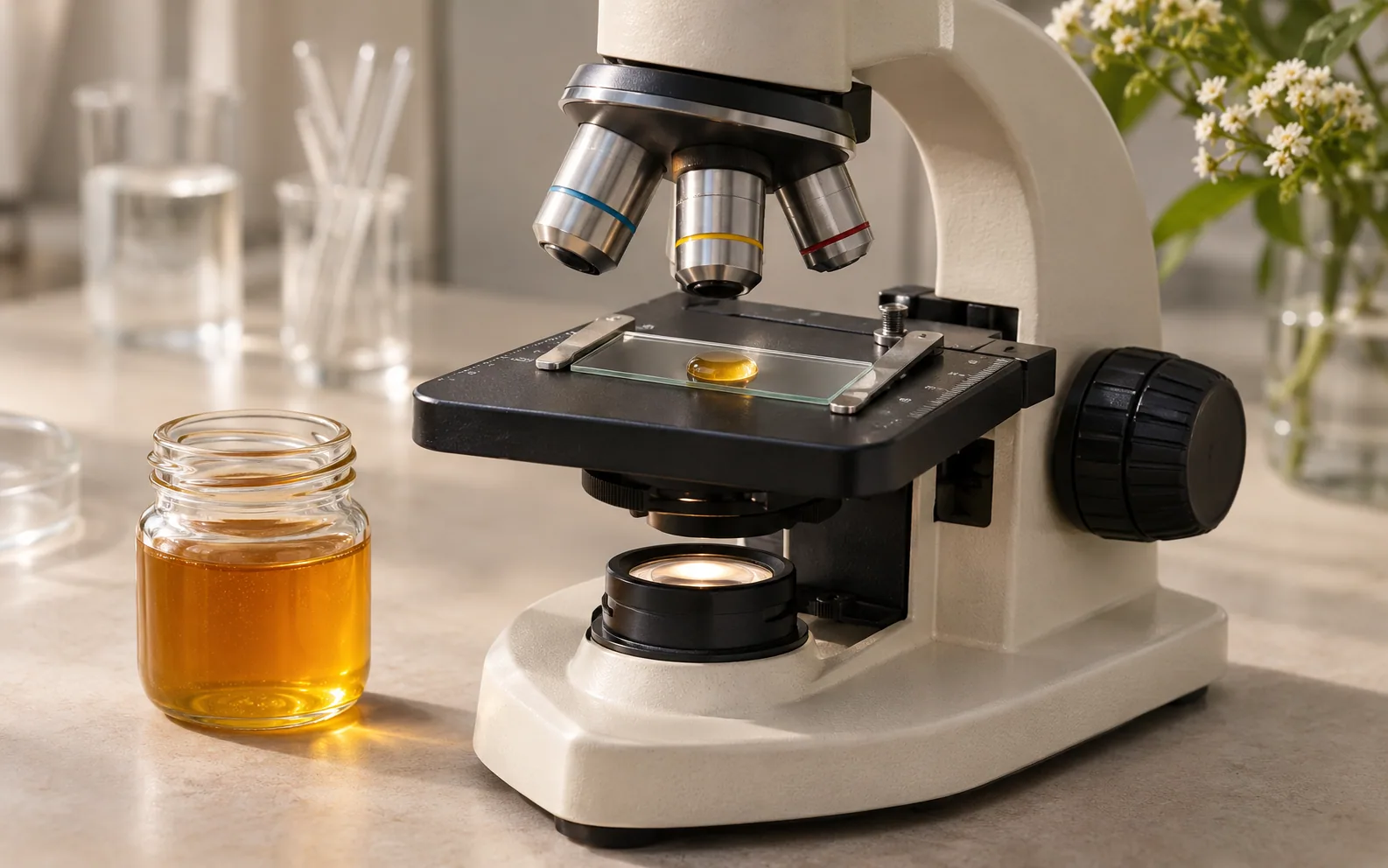
Put a drop of honey under a microscope and you'll see pollen grains: a fingerprint of the flowers the bees visited. It's a powerful tool. It just answers a different question from the one most people ask.
Quick answer: Pollen analysis shows which flowers and region a honey came from, but it can't prove purity alone: syrup carries no pollen. In a 2020 study, 17 of 22 Indian samples failed an advanced NMR test.
The topics we were given ask what microscopes reveal about "Lahaul Valley purity" and "Kalka Shivalik authenticity". The honest answer: pollen counts speak to origin, not purity.
 Pollen tells you where. Other tests tell you whether it's pure.
What pollen analysis can tell
- Which plants the bees visited, and roughly in what shares.
- Whether a single-flower name is justified, under the 45% rule. The polyfloral balance.
- Clues to the region, since plants differ from place to place. A study of 34 honeys from the Shimla hills, for example, identified which flowers led each season's honey. Autumn honey.
What it can't tell alone
- Whether syrup was added. Sugar syrup carries no pollen, so honey diluted with syrup still shows the original honey's pollen, just less of it.
- Whether honey was heated. That needs tests for freshness markers like HMF and diastase. Does heat damage honey?
- "Purity" overall. That takes a set of lab tests.
When India's honey was tested
In 2020, India's Centre for Science and Environment tested leading honey brands. Most big brands passed the standard Indian tests for cane and rice sugar. But when the same samples were sent for an advanced NMR test abroad, 17 of 22 samples failed. The study found suppliers selling syrups designed to slip past the standard tests.
The lesson: no single test, pollen or otherwise, proves purity on its own.
And Lahaul and Kalka?
We found no published pollen study of Lahaul honey. For the Kalka side, the nearest study is from the Shimla hills. We haven't published pollen tests of our own jars, and we don't make claims that would need them.
A myth worth clearing up
"Lots of pollen means pure honey." Not on its own. Pollen shows real honey is present. It doesn't rule out added syrup. And raw honey's pollen can be removed by fine filtering, which is why our honey gets only a coarse strain.
A buyer's ritual
When a brand claims "tested pure", ask: tested for what, by which lab, and when? A good seller will tell you which tests, not just "tested".
Common questions about pollen analysis of honey
What's an NMR test? A lab technique that reads a honey's chemical fingerprint and can detect many kinds of added sugar syrup.
Can I see pollen at home? Not reliably. It needs a microscope, preparation and training.
Keep reading
Part of our real honey guide.
Where this comes from
- 17 of 22 samples adulterated; most brands passed Indian C3/C4 tests but failed NMR; syrups marketed to bypass tests: Centre for Science and Environment, 2020 report; The Week
- Pollen analysis of 34 Shimla-hills honeys: see sources in The October cleansing
- No source records a pollen study of Lahaul honey.
Raw, unfiltered honey, bottled as it is. Coarse-strained, so the pollen stays in.
Find your jar: Lahaul from ₹799 or Kalka from ₹499, for ½ kg · or see what is coming next.
Not Your Beesness, sold on āsthālaya. Delivered across India.


