
Know your honey · 3 min read
The single-origin mandate: why we keep Lahaul and Kalka honey apart
Our two honeys come from two named places, and they're never blended. Here's what single origin means, what it takes in principle, and why it matters for taste and honesty.
By Akhil Verma, Co-founder, Not Your Beesness ·
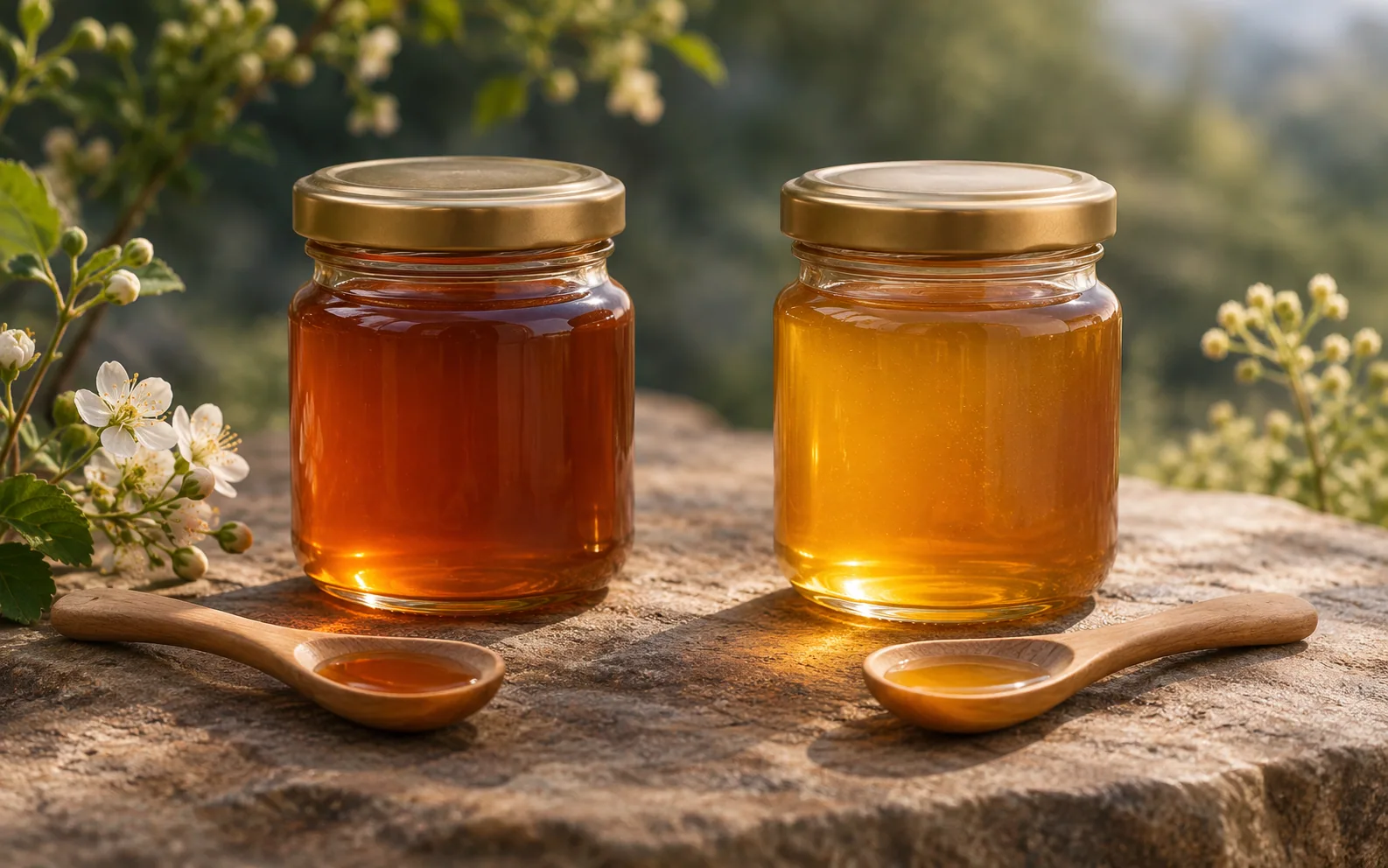
Most honey on supermarket shelves is a blend from many places, sometimes many countries. Ours isn't. Each jar comes from one named place.
Quick answer: Single-origin honey comes from one identifiable place rather than a blend of many. Our Lahaul (Batch 01) and Kalka (Batch 02) honeys are kept apart and never blended, so each keeps its own character.
We sell two honeys: Lahaul, from the cold desert beyond Rohtang, and Kalka, from the Shivalik foothills. They're kept apart from start to finish, and labelled as separate batches: Batch 01 (Lahaul) and Batch 02 (Kalka).
 Two places, two paths, never mixed.
What "single origin" means
A single-origin honey comes from one identifiable place, rather than being blended from many sources. It isn't the same as a single-flower honey: our jars are single-origin but multiflora, made from many flowers of one place. The polyfloral balance.
What it takes, in principle
Keeping two honeys apart is simple to describe and needs care to do:
- Harvested separately, from each place.
- Kept in separate containers, never topped up from the other.
- Strained and settled apart.
- Jarred with its own batch name.
- Labelled with its place.
These are the general principles. The detail of how and where our beekeepers work is theirs to share.
Why it matters
- Taste. Blending smooths every jar into the same flavour. Keeping origins apart lets each place's character show. Two places, two jars.
- Honesty. Blending can hide where honey came from. Naming the place is a promise you can hold us to.
- Seasonality. A single-origin honey varies with its place's year. Why honey tastes different each batch.
What it can't prove alone
A label saying "Lahaul" is a claim, not proof. In India, the national Madhukranti portal aims to trace honey back to its beekeeper and region. Records and lab tests are what back up an origin claim. The local apiary journals.
A myth worth clearing up
"Blended honey is fake honey." No. Blending is legal and common. It just means you can't know where your honey came from, and the taste is averaged out.
A side-by-side ritual
Taste a spoon of Lahaul and a spoon of Kalka honey, one after the other, at the same temperature. That difference is what single origin protects.
Common questions about single-origin honey
Do you ever mix Lahaul and Kalka honey? No. The two are kept apart and sold separately. Our gift boxes hold one jar of each, side by side.
What's the difference between single-origin and single-flower? Single-origin is about place. Single-flower is about one plant leading the pollen.
Keep reading
Part of our real honey guide.
Where this comes from
- Lahaul as Batch 01 and Kalka as Batch 02; two named places, kept apart: Not Your Beesness, Our honeys
- Madhukranti, the national honey traceability portal: see sources in The local apiary journals
- The steps in the illustration are general principles, not a record of our operations.
Raw, unfiltered honey, bottled as it is. Two places, never blended.
Find your jar: Lahaul from ₹799 or Kalka from ₹499, for ½ kg · or give both in the Diwali gift box.
Not Your Beesness, sold on āsthālaya. Delivered across India.


