
Know your honey · 3 min read
The Jispa valley harvest: why two batches from one valley never taste the same
Jispa is a small village on the Bhaga river, north of Keylong. Nobody has profiled the honey of one Lahaul village. But anyone can understand why two batches from the same valley taste different, and why that is a good sign.
By Akhil Verma, Co-founder, Not Your Beesness ·
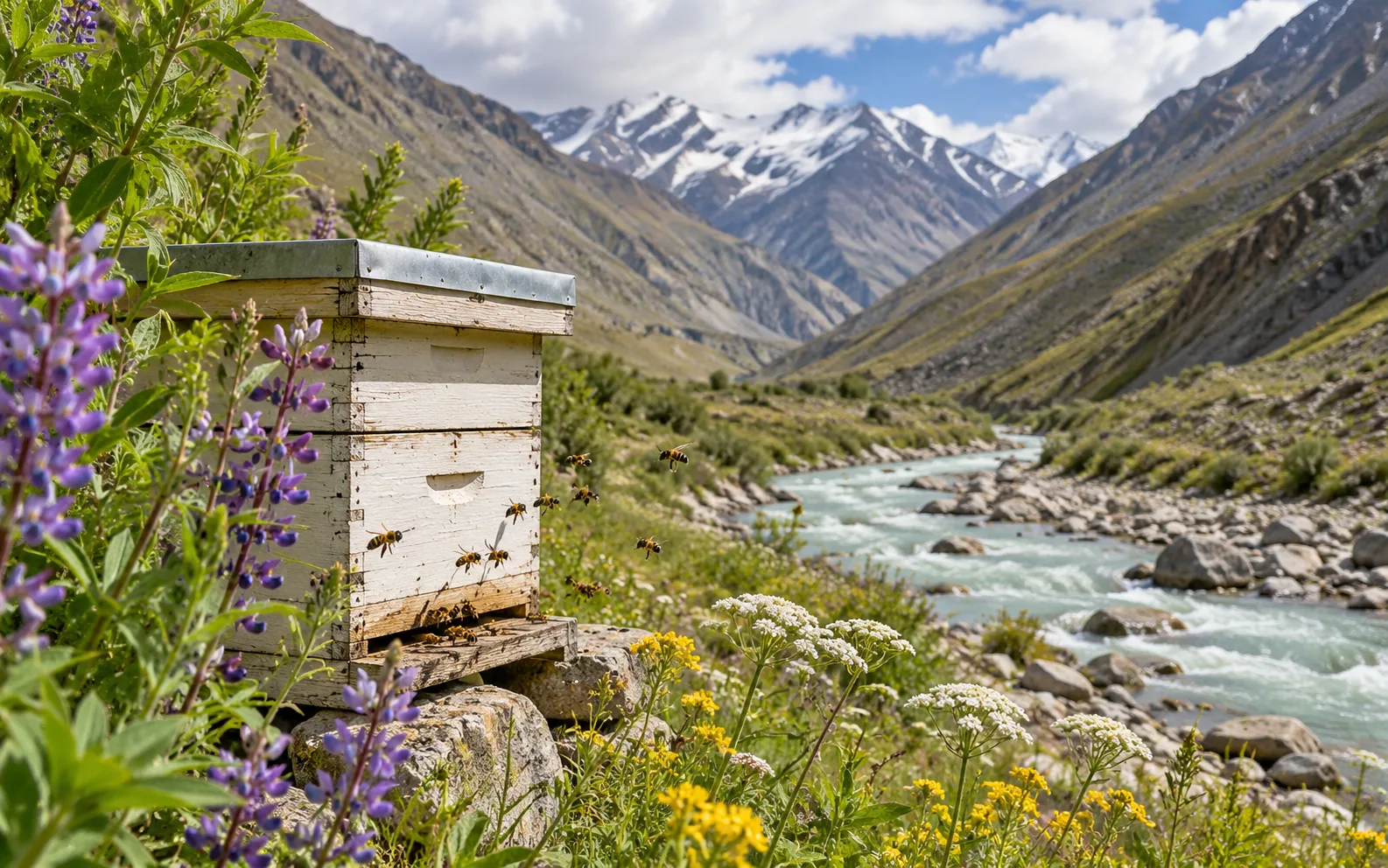
Two jars of honey from the same valley, a year apart, can look and taste noticeably different. That is not a fault. It is the clearest sign you are eating real, unblended honey.
Quick answer: Raw honey tastes different each batch because the flowers, the summer's weather, where bees flew and when it was harvested all change. Variation is a sign of unblended honey, not a fault.
This post takes its name from Jispa, a village on the Bhaga river in upper Lahaul. We found no study describing honey from Jispa, and we won't invent tasting notes for it. What we can do is explain why every honest multiflora honey varies.
 Same valley, different summers, different jars.
Jispa, in brief
Jispa sits at about 10,500 feet, on the banks of the Bhaga, roughly 14 miles north of Keylong on the road towards Ladakh. Travellers know it as a place to rest and adjust to the altitude before the high passes.
Why batches differ
1. Which flowers led. In a short mountain summer, flowers come in waves. A harvest a few weeks earlier or later can be led by different plants. The alpine meadow magic.
2. The summer's weather. A late snowmelt, a dry spell or a cold snap changes what blooms and how many hours bees can fly. The Lahaul summer rush.
3. Where the bees flew. Bees work within about two miles of the hive. A site near fields, one near willow rows and one near a damp meadow each give a different mix. The glacial stream nectar.
4. When it was taken. Riper honey holds less water, so it is thicker and often deeper in flavour. The trans-Himalayan terroir.
Why variation is a good sign
Big brands often blend honey from many sources and heat it so every bottle looks the same. Raw, single-origin honey can't do that. Some variation from batch to batch tells you the honey has been left as the bees made it.
That is why we call our Lahaul honey seasonal and limited. Two places, two jars.
A myth worth clearing up
"If my new jar looks different, it must be fake." No. Colour, thickness and taste all shift with the season. Setting like ghee in winter is normal too. Why honey sets.
A collector's ritual
Keep a spoonful from each jar you finish, in a tiny labelled bottle. After a few seasons, line them up in daylight. You will see the years in their colours.
Common questions: why honey tastes different
Is your Lahaul honey from Jispa? We don't claim any one village. Our Lahaul jar is from the valley, kept apart from Kalka and never blended.
Will every batch be darker or lighter? There's no fixed direction. Each summer writes its own jar.
Keep reading
- The isolated hive project
- The wild mustard drift
- The Miyar valley excursion
- The monastic gardens
- The single-origin mandate
Part of our real honey guide.
Where this comes from
- Jispa at about 3,200 m (10,500 ft) on the Bhaga river, about 22 km (14 mi) north of Keylong: Wikipedia, Jispa
- Usual foraging area of about 3.2 km (2 mi): Wikipedia, Forage (honey bee)
- No source profiles the honey of Jispa. The reasons batches vary are general beekeeping knowledge, covered with sources in the posts linked above.
Raw, unfiltered honey, bottled as it is. Never blended, so every summer shows.
Meet the Lahaul jar, from ₹799 for ½ kg · or see what is coming next.
Not Your Beesness, sold on āsthālaya. Delivered across India.


