
Know your honey · 3 min read
The glacial stream nectar: how snow and ice water Lahaul's flowers
Lahaul gets almost no monsoon rain. Its fields and village greenery are watered by snow and glacier melt, led by hand along channels called kuhls. Where that water goes, flowers grow, and that is where the bees work.
By Akhil Verma, Co-founder, Not Your Beesness · · Updated
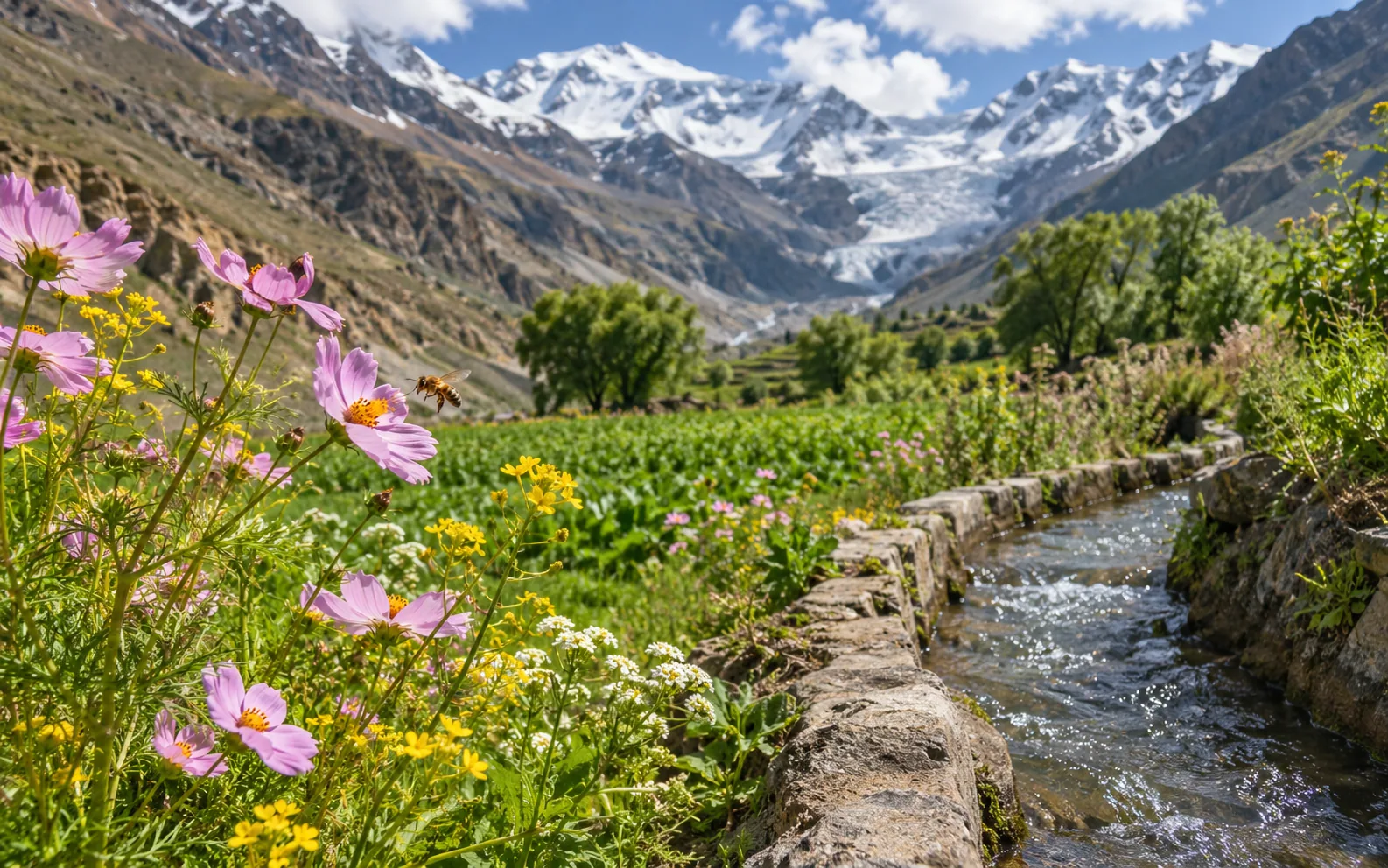
In most of India, the monsoon waters the flowers. In Lahaul, the glaciers do.
Lahaul lies in the rain shadow of the Pir Panjal. Summer rain is scarce. Yet in July, the villages are surrounded by green fields, willow rows and flowering field edges. All of it is watered by melting snow and ice.
 In Lahaul, the flowers grow where the meltwater is led.
The kuhl: water by hand
For centuries, Lahauli farmers have led meltwater from streams to their fields through kuhls: narrow channels dug along the slopes. As one local farmer put it to a reporter, Lahaul is a cold desert where farming would not be possible without irrigation.
Every spring, villagers clear the kuhls of rocks and glacier debris left by winter. Some years they have even had to cut through glacier ice to get the water flowing again.
Why it matters for bees
Bees go where flowers are, and in Lahaul, flowers are thickest where the water reaches:
- Field crops and their weedy edges around the villages
- Willows planted along the kuhls and terraces
- Damp meadows below snowfields and along streams
Away from the water, the slopes are dry and sparse. So, in a real sense, much of the nectar near Lahaul's villages is meltwater nectar.
A changing water supply
- Rain is scarce and unreliable. In 2022, the district got about 107 mm of rain from June to late August, against a state average of 569 mm for that period.
- Glaciers are retreating. In the Chandra basin, glacier area fell from about 603 to 588 square kilometres since 2001, according to state climate studies cited by the Tribune.
- Snowfall is shifting. Farmers report less snow and earlier melt, which can leave fields short of water later in summer.
What that means for flowers and bees in the long run is not yet studied. It is worth watching.
A myth worth clearing up
"Glacier water gives honey special minerals." There's no evidence for that. Water helps plants grow and flower. What reaches the honey is nectar, made by the plant, not the stream.
A water-saving ritual
Lahaul treats water as precious. Borrow the habit: rinse your empty honey jar with a little warm water and use that sweet water in your next lemonade or chai. Nothing wasted.
Common questions
What does "kuhl" mean? It is the local name, across much of the western Himalaya, for a hand-built irrigation channel.
Does glacier retreat threaten Lahaul honey? It could, if fields and meadows get less water. Nobody has studied the effect on bees yet.
Keep reading
Part of our Lahaul honey guide.
Where this comes from
- Lahaul's farming relies on snowmelt and glacier-fed kuhls; June–August 2022 rainfall of 107 mm vs 569 mm state average: Mongabay India, 2022
- Tandi farmer: farming not possible without irrigation, one cropping season a year: The Tribune
- Chandra sub-basin glaciers shrinking from 603.26 to 588 sq km; farmers' worries over melt: The Tribune
- Villagers cutting through glacier ice to reach water: The Tribune
- Willows planted along kuhls and terraces: Rawat & Everson, 2013, Journal of Mountain Science
Raw, unfiltered honey, bottled as it is. From flowers watered by snow.
Meet the Lahaul jar, from ₹799 for ½ kg · or see what is coming next.
Not Your Beesness, sold on āsthālaya. Delivered across India.


