
Know your honey · 3 min read
The Sissu waterfall corridor: how water draws a green line down a dry mountain
Just beyond the Atal Tunnel, a tall waterfall pours down above Sissu village. Around it, a strip of green cuts through the dry slope. That green line is the real lesson of Sissu for anyone curious about Lahaul's flowers and bees.
By Akhil Verma, Co-founder, Not Your Beesness ·
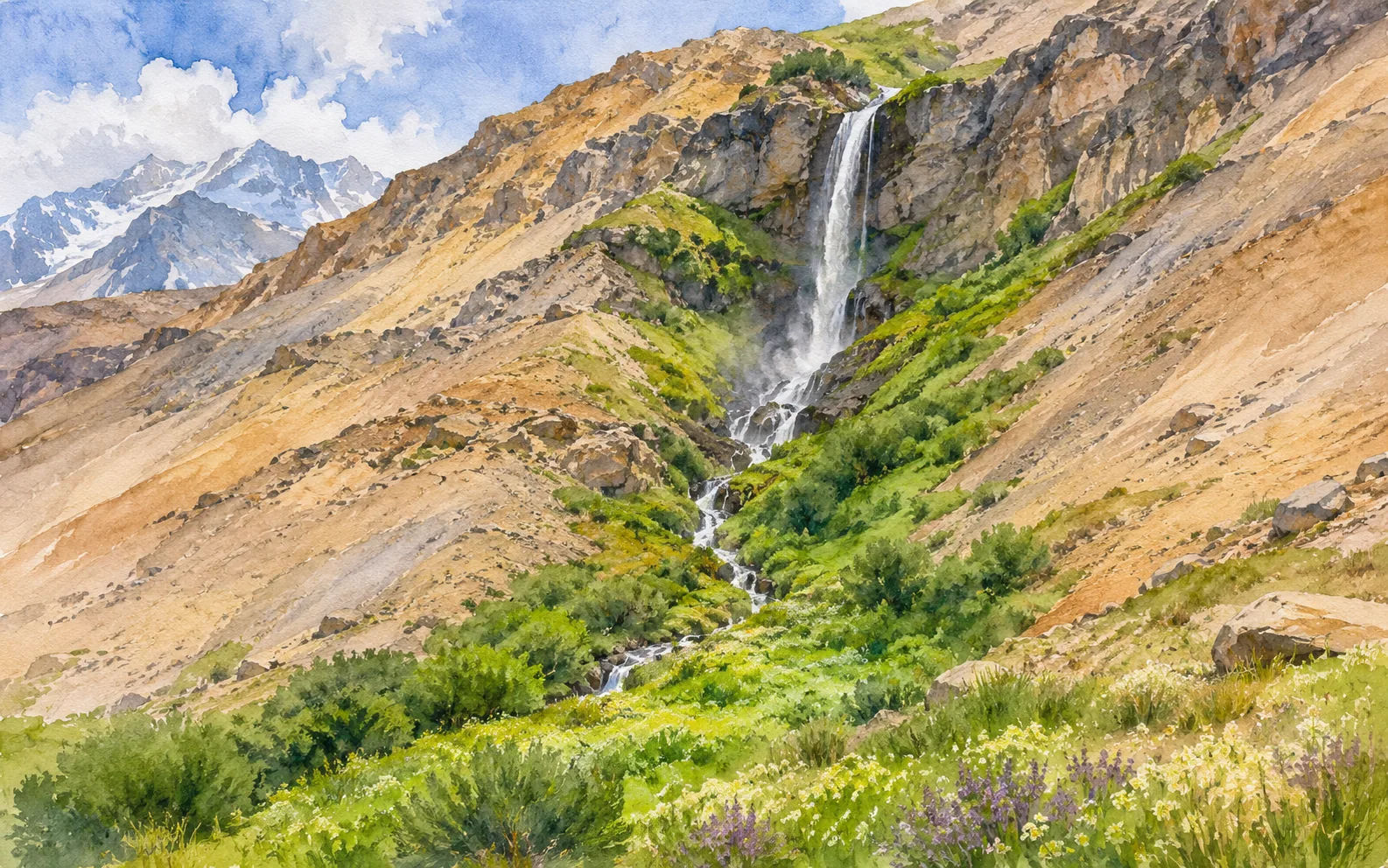
Drive out of the Atal Tunnel into Lahaul and one of the first things you see is water falling down a mountainside. That is Sissu.
Quick answer: The Sissu waterfall, above a village at about 10,250 ft on the Chandra river, keeps a strip of dry slope damp and green. In Lahaul, flowers and bees follow water; no one has studied special 'mist' blooms.
Sissu is a small village on the Chandra river, at about 10,250 feet. Above it, a waterfall drops down the slope, and travel guides describe it falling over 160 feet. Around the falling water, something simple and important happens: the dry slope turns green.
 Water draws the green line. Flowers follow it.
Why water makes the difference
Lahaul is a cold desert. Most slopes are dry and stony, with sparse plants. But wherever water runs or seeps, plants can grow:
- Spray and seepage keep the ground beside the falls damp.
- Streams and channels carry that dampness downhill.
- Plants follow the water, so a green strip forms along it, with wildflowers in summer.
It is the same rule that shapes the whole valley. The glacial stream nectar explains how meltwater, led by hand, waters Lahaul's fields.
What about the "micro-blooms"?
The topic we were given suggests special flowers growing in the waterfall's mist, giving honey a unique character. We'd love that to be true. But:
- No one has studied the plants around Sissu's falls.
- No one has studied whether bees there make honey with a distinct taste.
- A narrow strip of damp ground is small compared with the area bees forage, roughly two miles around the hive.
So we won't claim Sissu "micro-blooms" in our honey. What we can say is that wherever water reaches in Lahaul, flowers and bees follow.
A myth worth clearing up
"Honey from near waterfalls is wetter." No. Bees dry nectar in the hive and cap it when it's ripe, wherever they live. Damp air near a waterfall doesn't make ripe, capped honey watery. How bees dry honey.
A traveller's ritual
If you stop at Sissu, walk towards the falls and notice where the green begins and ends. You'll see, in one view, how water writes the map of a dry valley.
Common questions about the Sissu waterfall
Is Sissu in Lahaul? Yes. It is one of the first villages on the Lahaul side after the Atal Tunnel.
When is the waterfall at its strongest? Usually in summer, when snow and ice above are melting fastest.
Keep reading
- The high-altitude sun
- The Lahaul summer rush
- The glacial stream nectar
- The tree line boundary
- The Gondhla castle corridor
Part of our Lahaul honey guide.
Where this comes from
- Sissu village at about 3,120 m (about 10,250 ft) on the Chandra river: Outlook Traveller
- Waterfall described as falling over 50 m (over 160 ft): TravelTriangle
- Usual foraging area of about 3.2 km (2 mi): Wikipedia, Forage (honey bee)
- No source studies the plants or honey of Sissu's waterfall. That gap is why the post makes no such claim. The drawing is schematic.
Raw, unfiltered honey, bottled as it is. From a valley where water decides everything.
Meet the Lahaul jar, from ₹799 for ½ kg · or see what is coming next.
Not Your Beesness, sold on āsthālaya. Delivered across India.


