
Know your honey · 3 min read
The Lahaul summer rush: a short season between long winters
Lahaul's year is mostly winter. Summer is short, bright and busy, for farmers, flowers and bees alike. People talk of a frantic four-week honey window. The season is real; the exact window has never been measured.
By Akhil Verma, Co-founder, Not Your Beesness · · Updated
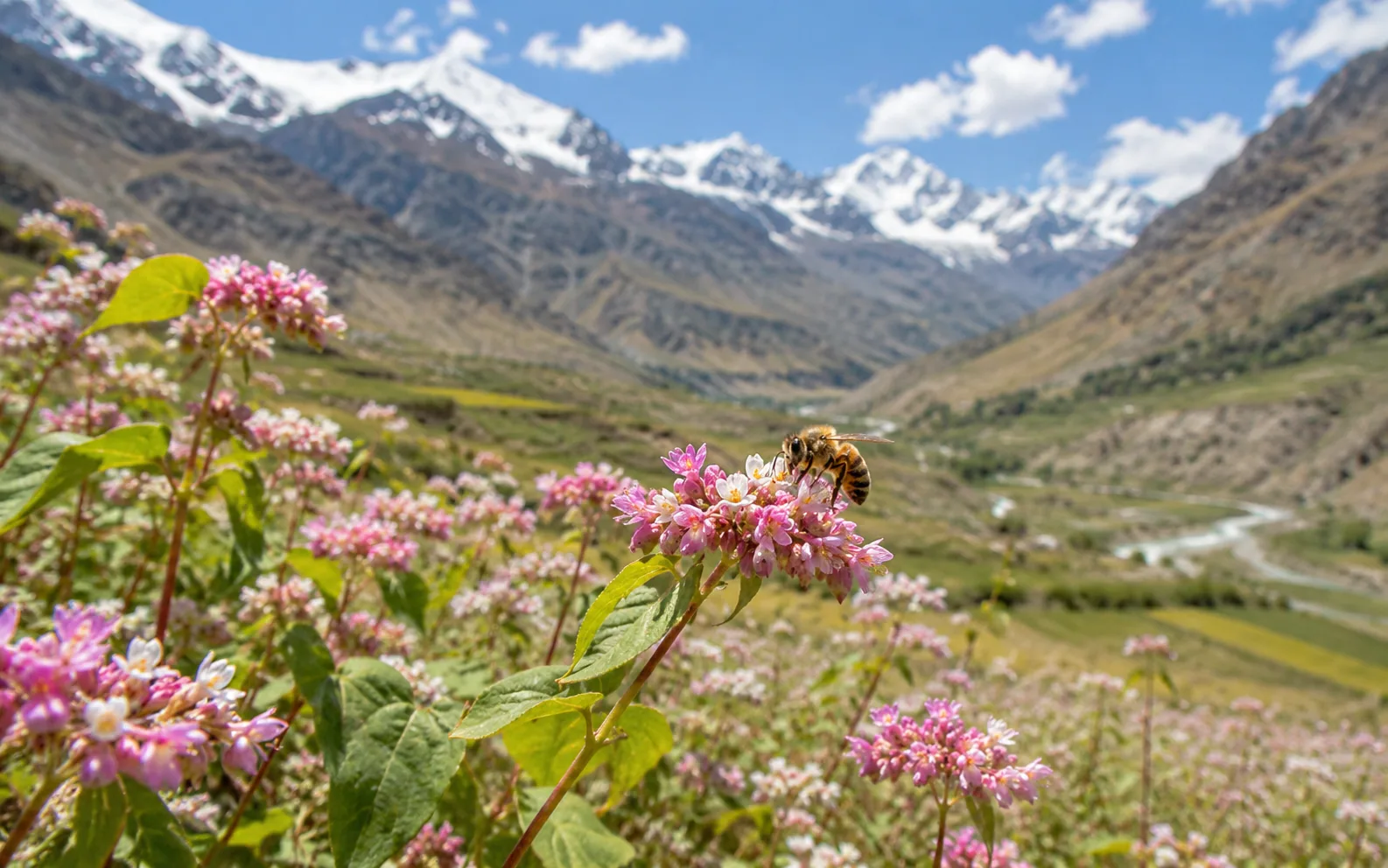
In Lahaul, summer doesn't arrive gradually. It bursts in, gets everything done, and leaves.
Snow covers the valley for much of the year. When it melts, farmers sow, flowers race to bloom, and bees work every warm hour they get. It is a real rush. But it is worth being honest about how much we actually know.
 A long winter, then a short, busy summer.
The shape of the year
- Winter (roughly December to March): deep snow and a quiet valley.
- Spring (April and May): the snow pulls back, kuhls are cleared, and fields are sown. There is little rain at sowing time.
- The road: the route over Rohtang is open from about May to November. The Atal Tunnel now keeps the valley reachable for most of the year.
- High summer (July and August): across the western Himalaya, this is when alpine flowering peaks. The alpine meadow magic.
- Autumn: frost returns and the season closes.
Farmers here speak of having only one cropping season in the year. Bees, in effect, have only one too.
The "four-week window"
You may read that Lahaul honey is made in a frantic four-week window. We looked for evidence and found no study measuring one. The season is short, but its length shifts every year with the snow and the weather.
So we won't give you a number. What we can say is that Lahaul's bees have a few short summer months, and the busiest stretch probably falls around July and August, when most flowers are open.
Why the season is short
- Snow lingers into spring and comes back early in autumn.
- Nights stay cold, even in summer, so bees start late each day.
- Height shortens everything. In Himalayan meadow studies, the growing season gets shorter as you go higher.
Why it matters for your jar
A short season means limited honey. When a Lahaul batch is gone, the next one waits for next summer. That is why we call it seasonal and limited. Two places, two jars.
A myth worth clearing up
"Honey made in a rush is lower quality." No. Bees don't cut corners when the season is short. They still dry the nectar and cap the comb before it counts as honey. How bees dry honey.
A seasonal ritual
Mark the summer: when your Lahaul jar arrives, note the date on the label with a marker. Next year, compare. A small way to follow a faraway valley's seasons from your kitchen.
Common questions
When is Lahaul honey harvested? After the summer flow, once the comb is ripe and capped. The exact timing changes each year.
Why is Lahaul honey more expensive than Kalka? A shorter season, a harder climate and a longer journey to market all add up.
Keep reading
- The Sissu waterfall corridor
- The glacial stream nectar
- The pre-monsoon rush
- The foothill beekeeping year
- The gentle slopes
Part of our Lahaul honey guide.
Where this comes from
- One cropping season in Lahaul; little rain at sowing in April–May: Mongabay India, 2022; The Tribune
- Road over Rohtang open about May to November; Atal Tunnel since 2020: Wikipedia, Rohtang Pass
- July–August peak flowering and a shorter season at greater height: Indian Forester, Valley of Flowers phenology
- No source measures a "four-week" honey window in Lahaul. Months in the illustration are indicative.
Raw, unfiltered honey, bottled as it is. One summer's work, once a year.
Meet the Lahaul jar, from ₹799 for ½ kg · or see what is coming next.
Not Your Beesness, sold on āsthālaya. Delivered across India.


