
Know your honey · 3 min read
The high-altitude sun: does strong mountain UV change nectar?
At Keylong's height, sunlight carries roughly a third more UV than at sea level. It burns skin fast. But does it change the nectar bees collect? The studies say: a little, if at all, and no one has tested it in Lahaul.
By Akhil Verma, Co-founder, Not Your Beesness ·
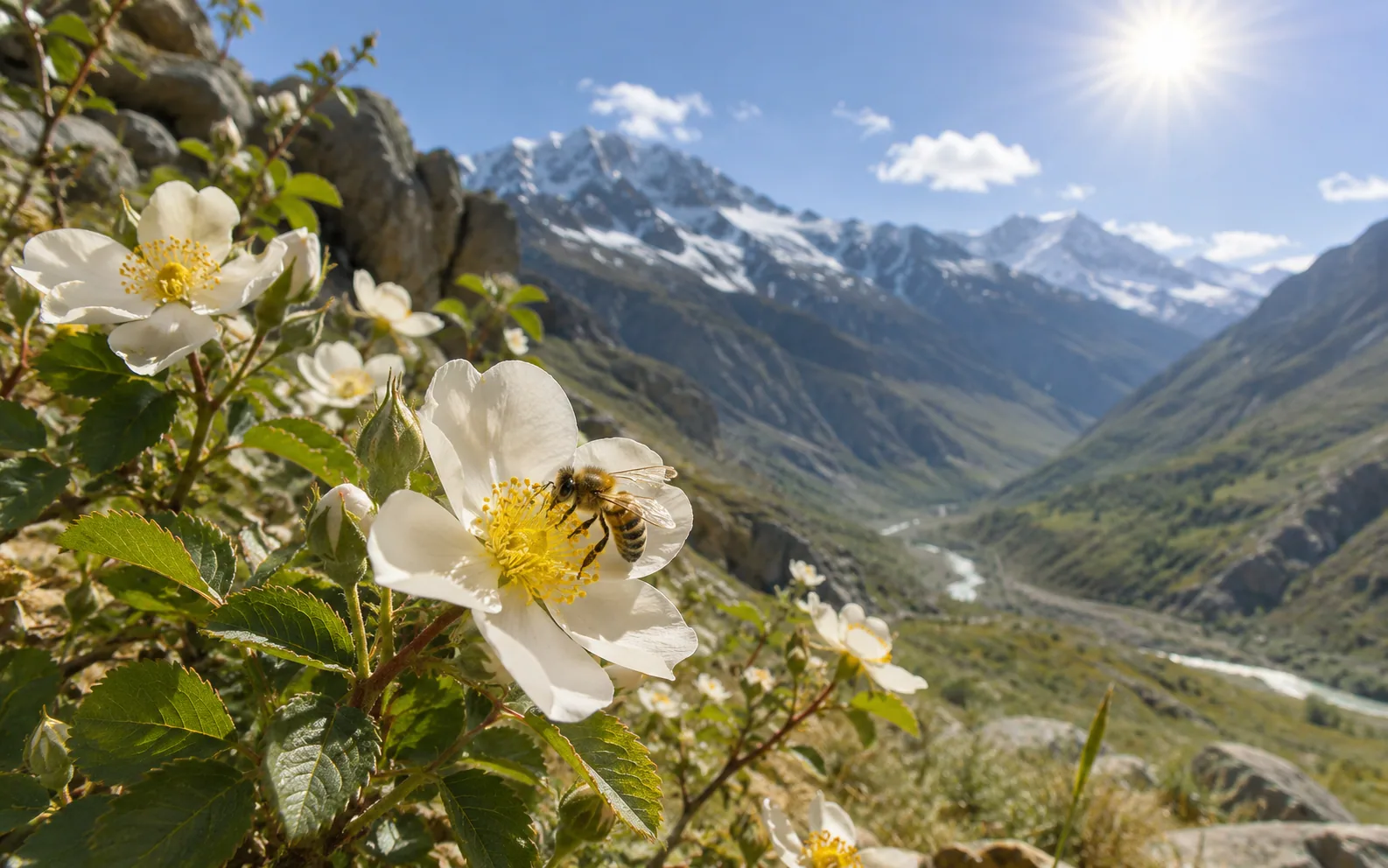
Spend a sunny day in Lahaul without sunscreen and you will know about it by evening. The mountain sun is fierce.
Quick answer: Altitude UV is stronger, about 10% more per 1,000 m, so Keylong gets roughly 31% more than sea level. But studies find UV-B barely changes nectar's sugar strength, and no one has tested Lahaul honey.
That is real physics. The thinner the air above you, the less ultraviolet light it filters out. So it is natural to wonder whether that strong sun changes the nectar in Lahaul's flowers, and with it, the honey. We looked at the research.
 More UV up high. Little sign it changes the nectar.
How much more UV?
The World Health Organization's rule of thumb: UV rises by roughly 10% for every 1,000 metres of height. By that measure:
- Kalka (about 2,150 ft): about 7% more than sea level
- Manali (about 6,730 ft): about 21% more
- Keylong (about 10,100 ft): about 31% more
Fresh snow can nearly double UV exposure by reflecting it back up. These are rough estimates, not measurements.
What the studies say about nectar
- A 2024 field study of two sage species found that UV-B affected the mix of sugars (the sucrose level) but not how much nectar the flowers made. Soil temperature mattered more.
- A 2003 review of UV-B and CO₂ experiments across twelve plant families found that nectar's sugar strength was the least affected trait. No UV-B study had found a consistent drop in nectar.
- More broadly, sunlight as a whole helps plants make nectar, which is one reason sunny slopes and edges are busiest with bees.
So, does Lahaul's sun change its honey?
No one has tested it. The evidence suggests UV has, at most, a small effect on nectar sugars, and honey's character comes far more from which flowers the bees visit. We won't claim a special "UV sugar profile" for our Lahaul jar.
What the sun certainly does is give Lahaul's short summer its bright, clear days, and bees fly best in warm sunshine. The Lahaul summer rush.
A myth worth clearing up
"Sunlight-rich honey is more nutritious." No evidence for that. Honey's nutrition is mostly sugar, with small traces of other compounds that depend on the flowers.
A mountain ritual
Before a day out in Lahaul: sunscreen, sunglasses, a hat, and a small jar of honey in the bag for energy on the trail. Honey needs no fridge.
Common questions about altitude UV and honey
Do bees see UV? Yes. Bees see ultraviolet light, and many flowers have UV patterns that guide bees to their nectar.
Does UV damage honey in the jar? Strong sunlight and heat can slowly degrade honey. Store it in a cool cupboard. How to store honey.
Keep reading
- The Chenab river origins
- The Sissu waterfall corridor
- The high altitude pressure
- The tree line boundary
- The solar lifecycle
Part of our Lahaul honey guide.
Where this comes from
- UV rises about 10% per 1,000 m of altitude: World Health Organization, UV radiation (French); 10–12% and fresh snow nearly doubling exposure: Cancer Council Australia
- UV-B affected sucrose level but not nectar productivity in two Salvia species: Agriculture, 2024 (DOAJ)
- Nectar-solute concentration least affected by UV-B or elevated CO₂: Davis, 2003 (AGRIS)
- Solar radiation's influence on nectar production: Frontiers in Plant Science, 2025
- UV percentages in the illustration are rule-of-thumb estimates.
Raw, unfiltered honey, bottled as it is. Made under a bright mountain sun.
Meet the Lahaul jar, from ₹799 for ½ kg · or see what is coming next.
Not Your Beesness, sold on āsthālaya. Delivered across India.


