
Know your honey · 3 min read
The solar lifecycle: does daylight decide a hive's year?
Kalka and Keylong get almost exactly the same daylight all year, within about eight minutes. Yet their bee seasons are months apart. Here's what day length does for a hive, and what it doesn't.
By Akhil Verma, Co-founder, Not Your Beesness ·
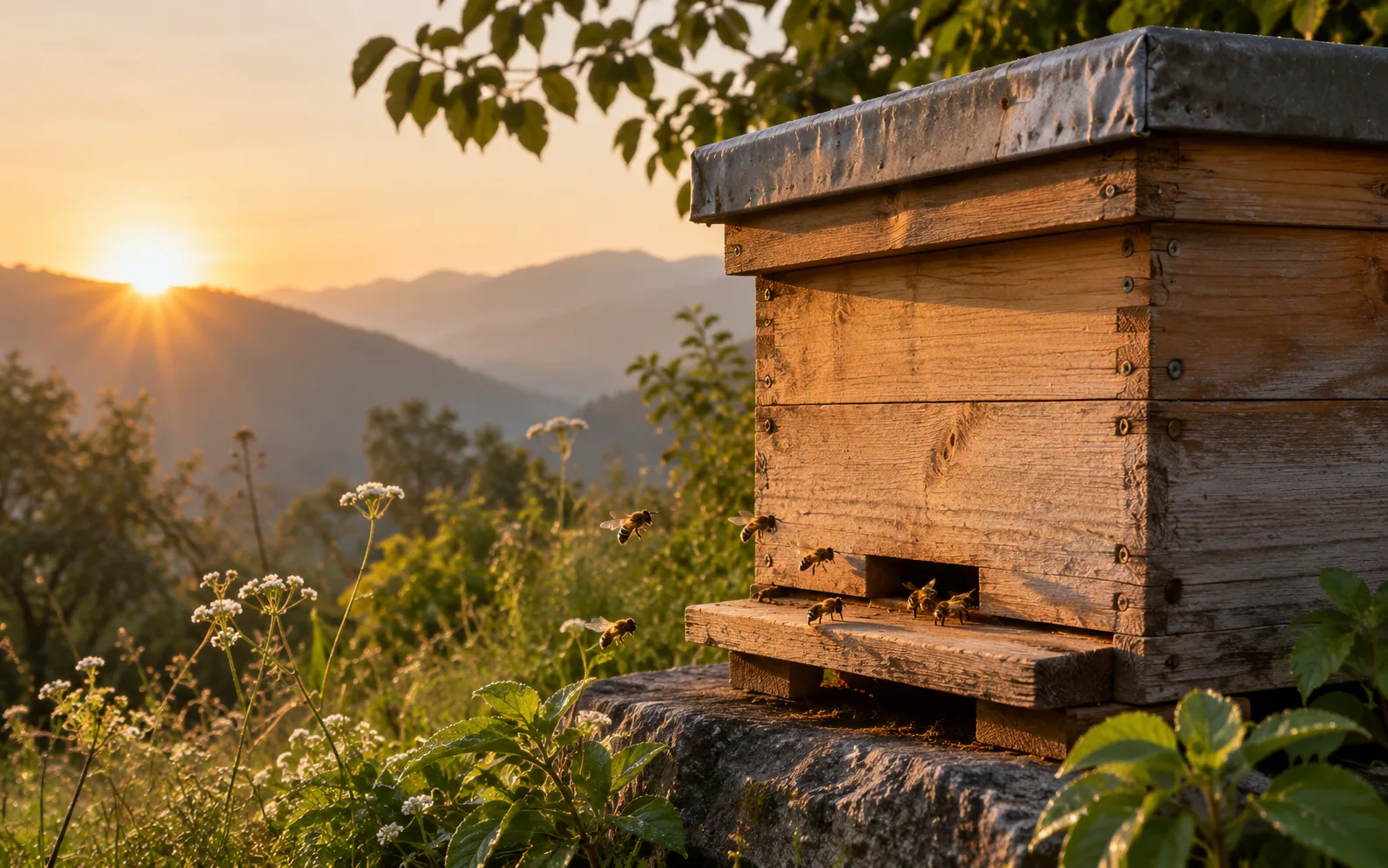
Kalka and Keylong get almost exactly the same amount of daylight every day of the year.
Quick answer: Day length in Kalka and Keylong differs by only about eight minutes, from roughly 10 hours in December to 14 in June. It nudges a colony's brood-rearing, but temperature and snow, not daylight, set the two valleys' seasons.
Both sit in the same band of latitude: Kalka at about 30.8°N, Keylong at about 32.6°N. That small gap makes a difference of only a few minutes of daylight. Yet the Kalka foothills flower from January, and Lahaul not until summer. So what's going on?
 Same sun, very different seasons.
The numbers
| Kalka | Keylong | |
|---|---|---|
| December solstice | about 10 h 9 min | about 10 h 1 min |
| March and September equinoxes | about 12 h 8 min | about 12 h 8 min |
| June solstice | about 14 h 9 min | about 14 h 17 min |
At the extremes, the two places differ by about eight minutes.
What daylight does for bees
- Bees forage by day. Longer days give more hours in which bees can fly, if it's warm enough and flowers are open. What decides how long bees can work.
- Day length nudges the colony's calendar. In flight-room experiments, colonies reared more brood as days lengthened and less as they shortened, but there was no single day length needed to start.
- Temperature matters more. Field and chamber studies find that the start of brood-rearing in late winter is driven mainly by temperature, with day length only modulating it. The first flight.
So what separates the two valleys?
Not light: temperature and snow. Keylong sits nearly 8,000 ft higher than Kalka, so its air is far colder and its ground is under snow for months. How altitude sets bloom timing.
What we can't claim
The topic we were given says "daylight hours dictate hive yields in both valleys". The evidence says otherwise: with near-identical daylight, it's warmth, water and flowers that decide.
A myth worth clearing up
"Mountain bees get more sun." Not more hours of it. The mountain sun is stronger, with more UV, but the day isn't longer. The high-altitude sun.
A solstice ritual
On 21 June, the longest day, note the sunrise and sunset times where you are. Then remember that, in Kalka and Keylong, the bees get that same long day, but only one valley is warm enough to use all of it.
Common questions about day length and bees
Do bees fly at night? Honeybees don't forage at night. They stay in the hive until it's light and warm enough.
Does day length change honey? No study shows that. Flowers and weather shape honey.
Keep reading
Part of our guide to how bees make honey.
Where this comes from
- Day lengths calculated with the standard NOAA sunrise-sunset formula, for Kalka (30.84°N) and Keylong (32.57°N), including atmospheric refraction: NOAA Solar Calculator
- More brood with longer days, no critical day length: Influence of photoperiod on brood rearing (1978)
- Brood onset mainly driven by temperature, modulated by photoperiod: Nürnberger et al., PeerJ, 2018; Photoperiod and temperature as seasonal cues (2025)
- Times are rounded to the minute and vary slightly year to year.
Raw, unfiltered honey, bottled as it is. From two valleys under the same sun.
Find your jar: Lahaul from ₹799 or Kalka from ₹499, for ½ kg · or see what is coming next.
Not Your Beesness, sold on āsthālaya. Delivered across India.


