
Know your honey · 4 min read
The altitude gradient: how height sets the honey calendar
Climb a mountain and you travel back in the season. A century-old rule of thumb puts it at about four days for every 400 feet. Here's how that plays out from Kalka to Lahaul.
By Akhil Verma, Co-founder, Not Your Beesness ·
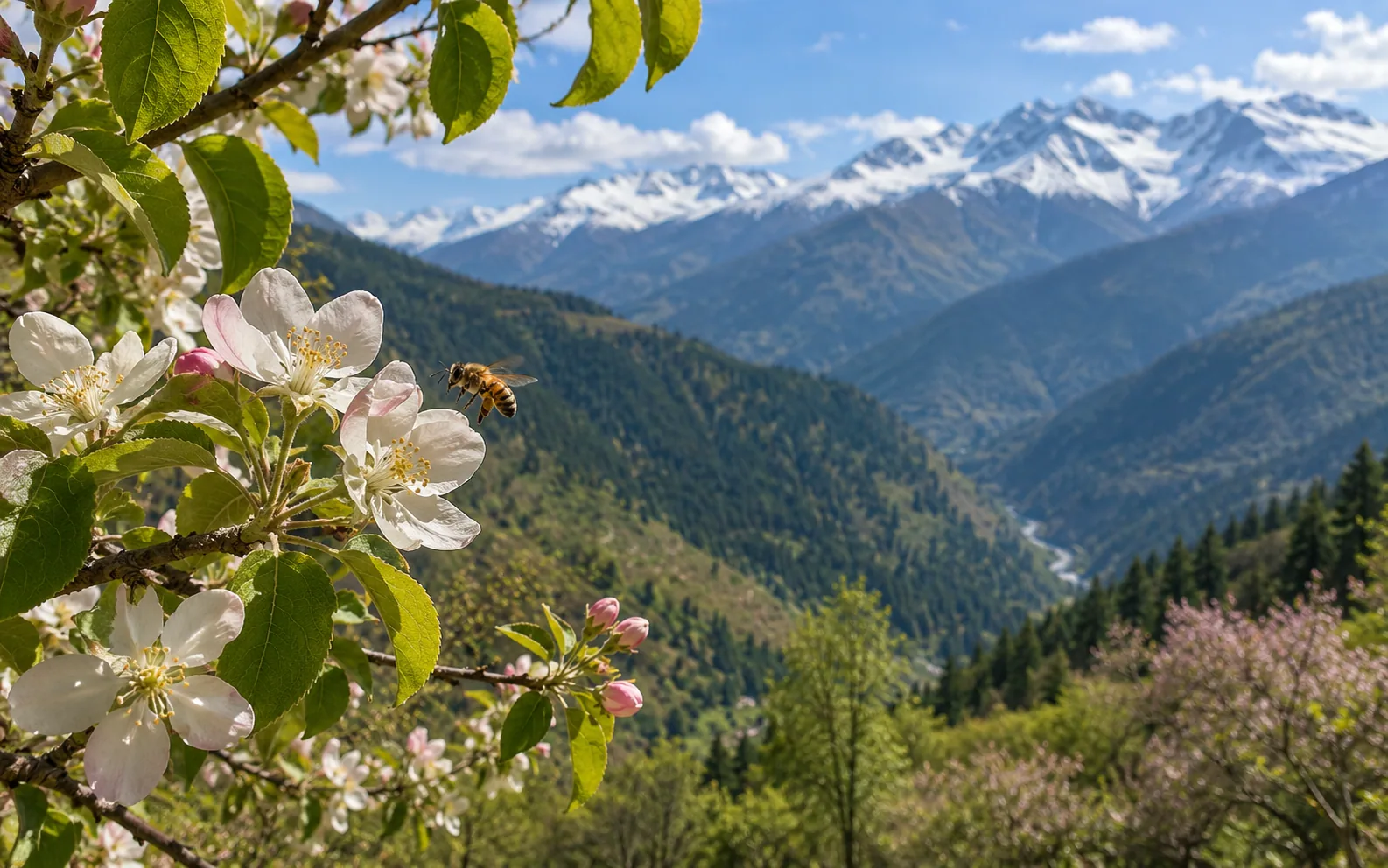
Drive from Kalka to Lahaul in April and you'll pass from late spring back into winter in a single day.
Quick answer: Altitude and flowering are linked: Hopkins' rule puts seasonal events about 4 days later per 400 ft of height. Around Kalka (2,150 ft) the bee season runs January–April; in Lahaul (10,000 ft) it peaks in July–August.
Flowering moves later the higher you go. Over a century ago, the American entomologist Andrew Hopkins put a number on it: seasonal events come about four days later for every 400 feet of height (and for every degree of latitude north).
 The higher you go, the later the spring.
From Kalka to Lahaul
| Where | Height | Main bee season |
|---|---|---|
| Kalka foothills | about 2,150 ft | January to April |
| Shimla hills | about 6,800 ft | summer honey in May–June, autumn honey in September–October |
| Lahaul valley floor | about 10,000 ft | peak flowering in July–August |
- Kalka starts the year: mustard, semal and kachnar from January. Springtime in Kalka.
- A study of honeys from Shimla district sampled summer honeys from May–June and autumn honeys from September–October.
- Lahaul waits for the snow to go, then crams its season into a few summer months. The Lahaul summer rush.
Why the rule is only a rule of thumb
- Hopkins' figure works out to about 33 days per 3,300 ft (1,000 m). A 2019 study that tracked spring leaf-out with cameras across North American forests found a smaller delay, about 21 days per 3,300 ft. The rule gives the direction, not the exact number.
- Slope, shade, snow and water matter too. A sunny south slope can flower weeks before a shaded one at the same height. What decides how long bees can work.
What it means for honey
Different heights, different seasons, different flowers. That's one reason our Lahaul and Kalka honeys are so different, even though both are Himalayan. Two places, two jars.
What we can't claim
The topic we were given asks for "harvest dates vs. valley height". Harvests follow ripe, capped honey, not set dates, so we chart seasons, not harvest days. Why no honey has a flavour fixed by its date.
A myth worth clearing up
"Mountain flowers bloom all summer." No. High up, the season is short and late, not long.
A travel ritual
On the Kalka–Shimla road in spring, notice which trees are in flower at the bottom, and look for them again at the top. Often they're still in bud. The toy train wildflower trail.
Common questions about altitude and flowering
Do mountain bees start later in the year? Yes, because their flowers do. The season follows warmth and snowmelt.
Is the 400-feet rule exact? No. It's an average; local conditions can shift it a lot.
Keep reading
Part of our guide to how bees make honey.
Where this comes from
- Hopkins' bioclimatic law, four days per degree of latitude and per 400 feet of altitude: Alabama Cooperative Extension
- Hopkins' 3.3 days per 100 m, and 2.1 days per 100 m measured with PhenoCam data (2000–2015): Richardson et al., Applications in Plant Sciences, 2019
- Shimla district summer (May–June) and autumn (September–October) honey samples: Melissopalynological study of Indian Himalayan honeys (FAO AGRIS)
- Kalka and Lahaul seasons: see sources in Springtime in Kalka and The Lahaul summer rush
- Shimla at 2,076 m. Heights converted and rounded. Seasons in the chart are indicative.
Raw, unfiltered honey, bottled as it is. From two heights, two seasons.
Find your jar: Lahaul from ₹799 or Kalka from ₹499, for ½ kg · or see what is coming next.
Not Your Beesness, sold on āsthālaya. Delivered across India.


