
Know your honey · 3 min read
The first flight: how bees come out of winter
After weeks in a winter cluster, a colony's first trip out isn't for nectar. It's a cleansing flight. Here's what wakes bees up in spring, and why there's no fixed date for it.
By Akhil Verma, Co-founder, Not Your Beesness ·
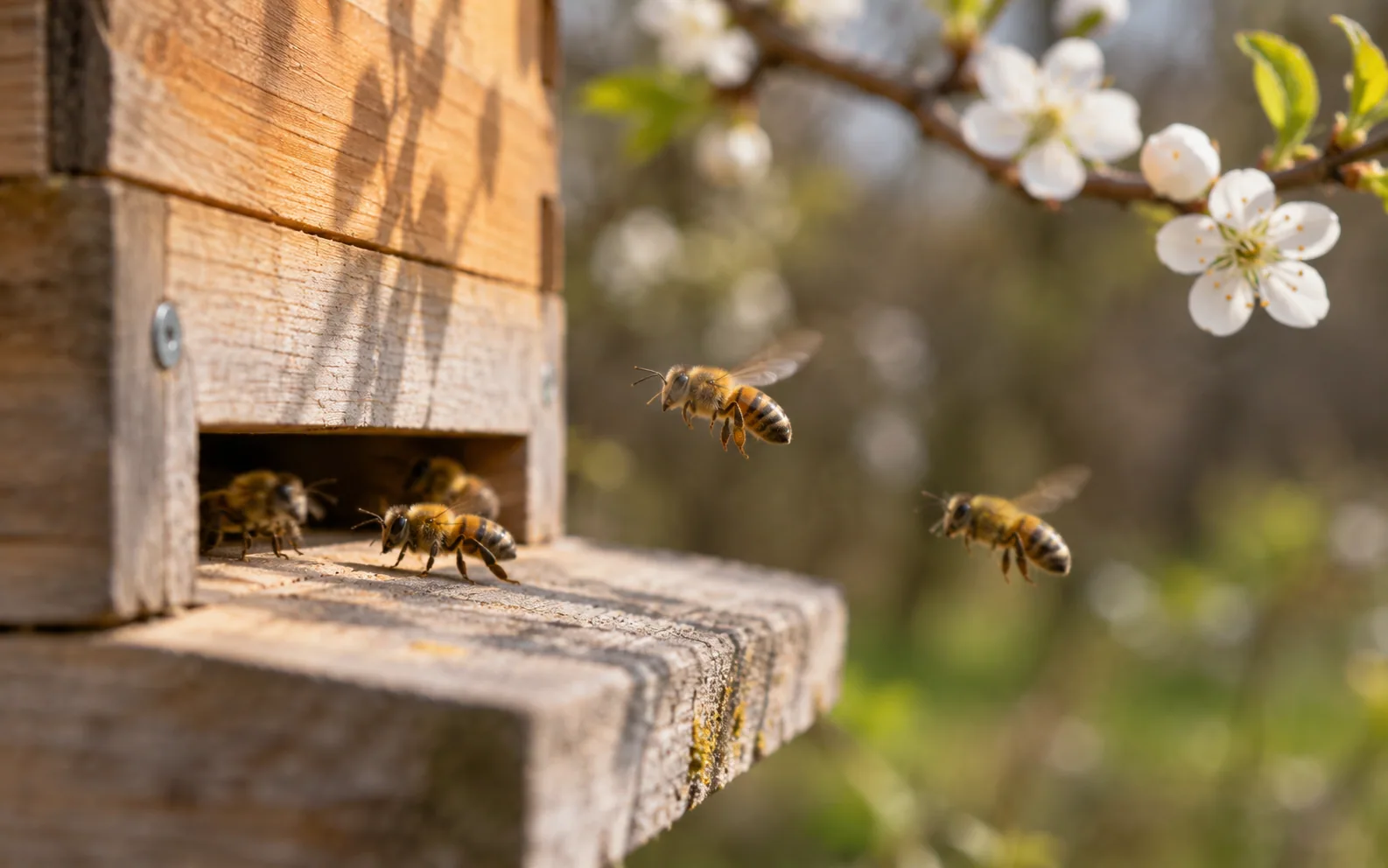
A colony's first trip out after winter isn't for nectar. It's to go to the toilet.
Quick answer: A cleansing flight is a colony's first short trip out after winter, to relieve themselves. It usually comes on a sunny day around 50°F (10°C); steady foraging follows from about 54°F (12°C). Warmth, not the calendar, sets the date.
Through the cold months, bees cluster tightly inside the hive and don't relieve themselves indoors. On the first warm, sunny day, they pour out for a short cleansing flight, and the snow or the car parked near the hive gets speckled yellow. The winter slowdown.
 Warmth, not the calendar, opens the door.
What wakes them: warmth
- Around 50°F (10°C), bees can make short cleansing flights on a sunny day. Some beekeepers see them at a little less.
- From about 54°F (12°C), and staying there, steady foraging begins.
- Bees that fly too far in the cold can chill and fail to return, so the first flights are short.
These are beekeepers' rules of thumb; sources differ by a few degrees.
What wakes the colony: warmth, and a little light
Research on overwintering colonies found that temperature mainly drives when the queen starts laying again in late winter. Day length plays a smaller part, shaping how strongly colonies respond to warmth. Does daylight decide a hive's year?
Two valleys, two springs
- In the Kalka foothills, winters are mild and bees can fly on many winter days; the spring flow starts as early as January. Springtime in Kalka.
- In Lahaul, the cold lasts far longer, and many Italian-bee colonies spend the winter in the plains and are brought back. Willows are among the first food. The high pass willow margins.
What we can't claim
The topic we were given says Lahaul's bees emerge "in May". There's no fixed month: it depends on the year's weather, and on whether the colony wintered in the valley at all.
A myth worth clearing up
"Bees hibernate." No. A honeybee colony stays awake all winter, shivering its flight muscles to keep the cluster warm.
A spring ritual
On the first warm day after a cold spell, watch a hive entrance from a safe distance. Short loops close to the hive mean cleansing flights; straight lines out mean foraging has begun.
Common questions about the cleansing flight
What temperature do bees fly at? Short flights from around 50°F (10°C); steady foraging from a few degrees warmer.
Why are there yellow spots near hives in spring? They're from the bees' cleansing flights after winter.
Keep reading
Part of our guide to how bees make honey.
Where this comes from
- Cleansing flights and foraging thresholds around 10°C, chilled bees failing to return: PerfectBee; Honey Bee Suite
- Brood onset in late winter driven mainly by temperature, modulated by photoperiod: Nürnberger et al., PeerJ, 2018
- Italian-bee colonies in Himachal moved to the plains for winter: see sources in The nomadic keepers
- Temperatures converted and rounded. Thresholds are rules of thumb and vary between sources.
Raw, unfiltered honey, bottled as it is. From the first warm days to the last.
Find your jar: Lahaul from ₹799 or Kalka from ₹499, for ½ kg · or see what is coming next.
Not Your Beesness, sold on āsthālaya. Delivered across India.


