
Know your honey · 3 min read
The high pass willow margins: Lahaul's first green, and the bees' first food
Willows flower on bare twigs before their leaves open, which makes them one of the first bee foods of spring anywhere they grow. In Lahaul, willows line the fields and water channels. Here's why they matter.
By Akhil Verma, Co-founder, Not Your Beesness ·
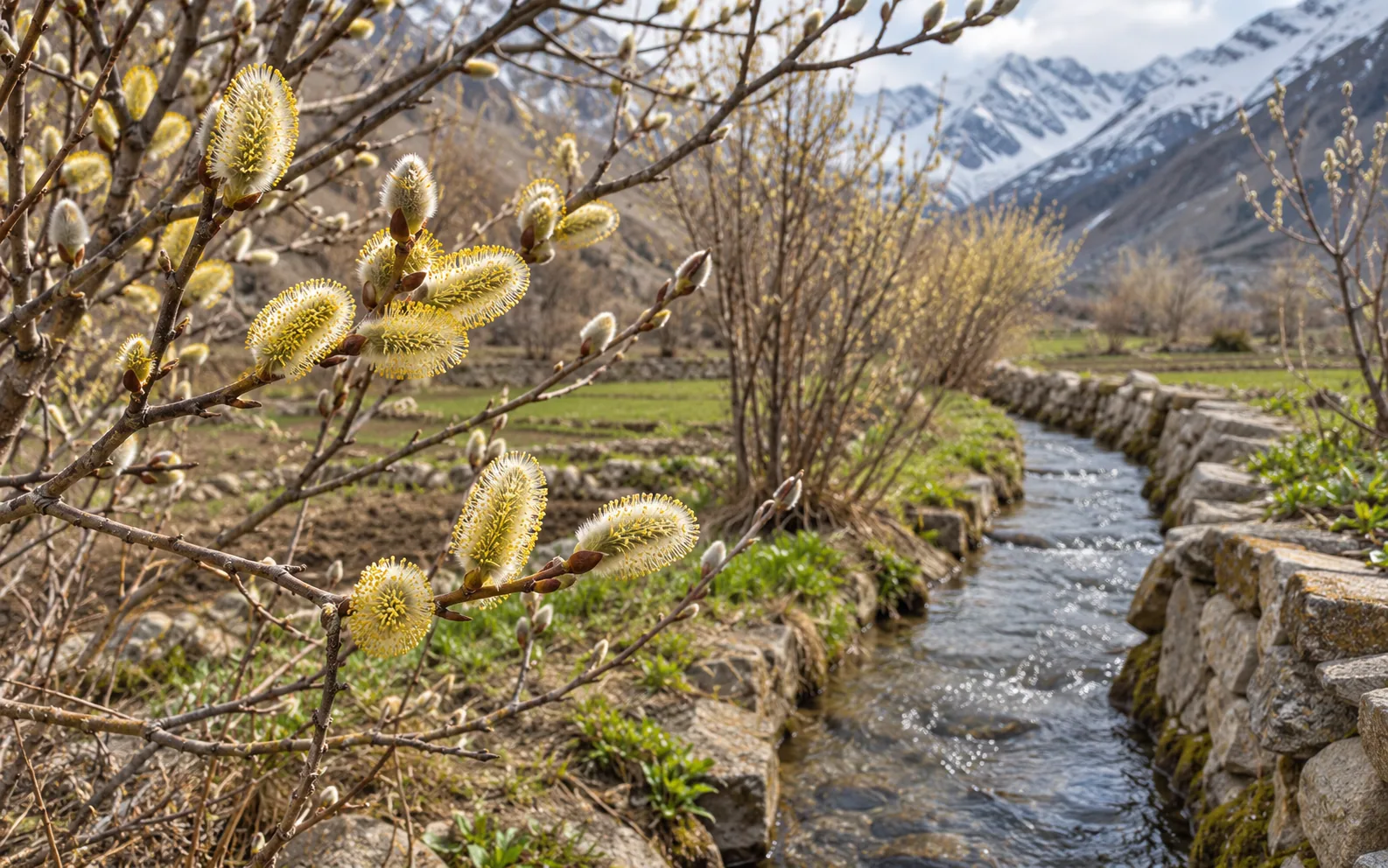
In early spring, when the hills are still brown, willow twigs suddenly fill with soft, silvery catkins. For bees, it's the first meal of the year.
Quick answer: Willow catkins open on bare twigs in early spring, before the leaves, so they're among the first bee foods of the year; male catkins carry the pollen bees prefer. In Lahaul, willows line the fields and water channels.
Willows are among the most important early-spring plants for bees almost everywhere they grow. In Lahaul, they're also the valley's working trees, planted along the fields and channels by the thousand.
 Catkins before leaves: spring's first bee food.
Flowers before leaves
Willows flower in catkins: soft spikes of tiny flowers that open on bare twigs, before the leaves. That timing is what makes them so valuable. They're in bloom when almost nothing else is.
Pollen and nectar
- Willows are male or female. Male catkins, dusted yellow with pollen, are the ones bees prefer for pollen.
- Willows give nectar too, so bees visit both kinds.
- For a colony coming out of winter, that early pollen helps it start raising young. The alpine dandelion rush explains why bees need more than one pollen.
Willows in Lahaul
Lahaul is mostly treeless, but willows are everywhere people farm:
- Planted along kuhls (hand-dug water channels), field edges and around villages.
- Used for fodder, fuel and timber.
- Shrubby willows also grow wild, up to about 12,600 feet.
The blue pine margins covers Lahaul's other trees.
What we can't claim
The topic we were given calls willows "the first green source for Lahaul's bees in spring". It's very likely true for any bees kept in the valley, but we found no record of when Lahaul's bees first use willow, or of willow's share in Lahaul honey. We won't claim either.
A myth worth clearing up
"Willow honey tastes of willow bark." No. Willow's bitter taste is in its bark, not its nectar. Honey tastes of nectar.
A spring ritual
In early spring, find a willow and look closely at its catkins. Some will be silvery and soft; others, the males, will be fuzzy with yellow pollen. On a warm day, watch for bees working the yellow ones.
Common questions about willow catkins
Are pussy willows the same thing? Yes. "Pussy willow" is the common name for willows with soft, silvery catkins.
Why do farmers in Lahaul plant so many willows? They grow fast with irrigation and give fodder for animals and fuel for the long winter.
Keep reading
- The Lahaul herb directory
- The wild rhubarb margin
- Beyond the Rohtang Pass
- The high-pass flora
- The rainwater barrier
Part of our Lahaul honey guide.
Where this comes from
- Willow catkins as early pollen for bees; male catkins preferred: University of Kentucky, Trees for bees; Rosybee, Willow catkins: early pollen for bees
- Bees visiting willows for pollen and nectar: IDEALS, University of Illinois
- Willows planted along kuhls and fields in Lahaul; wild up to 3,850 m: Rawat & Everson, 2013, Journal of Mountain Science
- No source records willow in Lahaul honey. Heights converted from metres and rounded.
Raw, unfiltered honey, bottled as it is. From a valley that wakes up with the willows.
Meet the Lahaul jar, from ₹799 for ½ kg · or see what is coming next.
Not Your Beesness, sold on āsthālaya. Delivered across India.


